
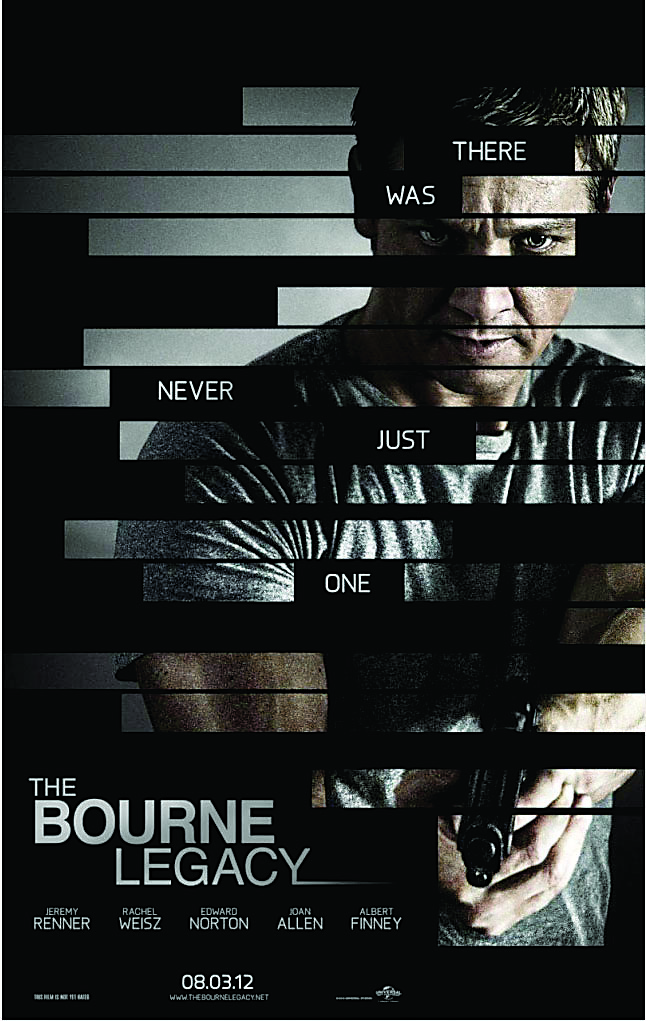
From the moment the Bourne Legacy began it was clearly evident where the budget for the film went: location, location, location. The film begins with a mysterious man surviving in the Alaskan wilderness, and we are treated to expansive helicopter shots of rugged mountains, lonely snow-laden forests, and stunning beauty. But that I can get from a National Geographic special. From the moment the main title flashes across the screen, I want something more than a pretty view. This is a Bourne movie. Bourne movies reinvented the spy genre. They gave us a spy with a conscience who could become an intense weapon in an instant. Bourne visited exotic locations, but the focus was always on him, his mission, his pain, his fight for survival. For most of the first half of Bourne Legacy, the focus is on an unnamed man and Alaska.
At the same time, somewhere else in America, Edward Norton is awoken. He is going to wish for the rest of the film that he stayed in bed because he is the most powerless and inept CIA coordinator in the history of the Bourne franchise. The story, what bare scant bones there be, is that while Jason Bourne is making his way from Russia (as seen in the end of the Bourne Supremacy) and makes his way through New York City on a vendetta against Treadstone/Blackbriar (as seen in the Bourne Ultimatum) Edward Norton’s character, who oversees the operation of several Treadstone splinter programs, is racing to erase all evidence that he ever did anything illegal.
While our unnamed hero fights off a few wolves and hikes through some snow, Norton has several other top level assassins elsewhere in the world assassinated by making them take a suicide pill (no, really). This works because in this version of the Bourne saga, all the agents are only special because they are highly drugged up, mentally and physically, which means as they are used to taking their blues and their greens (pills, that is) you can give them a yellow pill, tell them it is better, and wait for them to drop dead (no, really) and they won’t question you. Except for our ruggedly handsome hero, who is in Alaska (we learn) because he questioned something and as a result, the CIA punished him by making him hike through Alaska.
Because our hero is inconveniently in Alaska (an unavailable for suicide pill) the CIA attempts to kill him with a drone plane and a bomb. He survives the bombing and shoots down the plane with some trickery involving a tracking device and a wolf. However, once the CIA realizes that they missed, they try to kill him again. But, because for some reason Edward Norton’s CIA is underfunded and ignored, they can’t even get real time satellite imagery or advanced tracking data. He must rely on Canadian weather satellites and thousands of traffic cam pictures to try to locate the car they think our hero is driving. I’m not making this up, there is an entire five minute segment of all of Norton’s underlings shouting into phones about the make and model of the car and if anyone has seen it, could they please call back and let them know. At this point, I should mention that at no time during the film does our hero ever seem to be in danger.
The subplot revolves around a medical researcher who was involved in making the drugs that make this new batch of CIA operatives special. She survives a completely inexplicable and horrific massacre at her lab to survive an assassination attempt by a CIA psychiatrist only because our hero magically managed to show up to her remote house and save her. Because. The audience is never told that our hero is even trying to find this medical researcher, or what his goals are prior to this scene, but after he saves her, he interrogates her about drugs. Our hero is only actually concerned with one thing: his next fix. And for good reason, as we now learn that our hero, and Bourne replacement, was an idiot prior to recruitment. No, really. His IQ was below the ARMY recruitment minimum, and the flashbacks/video of his entrance interview into Treadstone show a man barely above the level of a third grader, mentally.
Our drugged up hero then forces the medical researcher to accompany him to the factory in the Philippines where his drugs are manufactured so that she can cook up a mega dose of meds and make him permanently strong and smart.
At the same time, Edward Norton, who has done nothing but be inept, finally discovers (almost by accident) that our drugged up hero is in Manila and he sends a newer and even more lethal drugged up assassin after him. Is there just a factory where all of these new assassins magically appear from? The tagline from this film is “There Never Was Just One” and by that they must mean “There is an endless supply whenever/wherever we need them”.
Anyway, we never actually get to see this newer and more lethal drugged up assassin fight our drugged up hero as all he can manage to do is chase our protagonists around Manila on a motorcycle before our very weak female researcher kicks his motorcycle and he crashes into a pole and dies like a wimp. No, really.
And that’s all they wrote, or could afford to, because the movie ends with a majestic helicopter shot of the South Pacific and a remix of Moby’s “Extreme Ways”.
The myriad weaknesses of the Bourne Legacy should be obvious by now, but to sum up: the audience follows a hero we don’t know and that we are never made to care about, who is chased by a threat that isn’t real or threatening, and there is something about drugs. There was no personal story, no character moments, no depth or emotion. There was no higher purpose, no commentary on the inherent evil and danger of blackops and unsanctioned operations. There was no human cost or soul searching. In short, there was nothing that made the Bourne Trilogy what is was, none of the things that made the Bourne films worth watching.
The whole time I was in the theater, I couldn’t figure out why I watching this movie. I felt like I was watching a movie about 003, Bart Bond, and that I should have been watching a movie about the real 007 instead.
Bottom line: Jason Bourne deserved a better legacy.

 a simple man