
First, a confession: the only cellular phone I have ever owned has been an Apple iPhone. My first iPhone was purchased in 2008 and was an iPhone 3G. After two years, I was eligible for an upgrade and purchased an iPhone 4. This year, I am once again eligible for an upgrade and will be ordering an iPhone 5 as soon as they are available for pre-order. Therefore, you would be perfectly justified in reading everything I say with an air of skepticism, in fact, this would be healthy. I have been accused of being an Apple fanboy, and while not every single piece of tech I own is made of Apple, it is only really because they don’t make printers or DSLRs. But, despite the overwhelming physical evidence to the contrary, I like to think that I go Apple because Apple designs and produces some of the best tech available for the price bracket. I haven’t always been a Mac zealot, but I’ve yet to see a computer or a phone that can rival an iPhone or a Macintosh. Ultimately, though, in this modern, technological world, devices are becoming much more personal than they ever used to be, and thus the user experience and preference is much more subjective that ever before. So if you like your Dell, or Android, or Kindle, far be it from me to try to change your mind. If you have found a piece of tech that suits your needs and pushes your hotkeys, by all means, plug and play.
That is not what this is about. Rather, I want to investigate what innovation means, in light of the iPhone 5 launch and two differing articles I read in my morning Zite digest. (see Zite) This will be neither exhaustive nor definitive, but I hope to at least jumpstart your thinking about the topic. Yesterday morning, Apple released the iPhone 5. You can find all the details you need about it at Apple.com.
This morning I read an excellent article by Mark Wilson over at Co.Design entitled “The 3 Worst Design Details from Apple’s iPhone 5 Event”. His main point is this: “Apple sold the masses on design, and then they gave us stretched iPhones, silly straps, and iPod Nanos worthy of parody.” Wilson maintains that Apple had “solved its critical usability issues and changed the way the world communicated” but that once they created their Sistine Chapel, Apple “refused to put the chisel down. They stretched iPhones, added more icons, and generally did things just for the sake of doing them” without actually doing anything innovative, in terms of design, with their new iPhone. Wilson thinks that Apple has designed themselves into a corner with the best mobile phones ever, and simply does not know where to go next, so they substitute shiny bezels for amazing new products. “Apple has built their iDevices too well to keep modifying without doing some damage to the original work. Michelangelo wasn’t expected to make a thinner, faster, and all around more handsome David 3. But Apple is” and therefore we get an iPhone 5 that is simply a taller iPhone 4s with a bit more power under the hood. David, but with even more chiseled abs and something stronger under the fig leaf. Ultimately, while dismayed at the iPhone 5, the new iPod Nano, and the latest iPod Touch, Wilson admits that all of Apple’s genius has not left the Infinite Loop with Steve Jobs, and points to the radically redesigned Apple earbud headphones, called the EarPods, as evidence that Apple still has the design edge, somewhere “still holding out from a foxhole deep within Apple” but he doesn’t think the possibility for a truly incredible next big thing is very high.
On the other side of things, MG Siegler, writing for Tech Crunch, in an article entitled “Apple’s Magic Is in the Turn, Not the Prestige” thinks that “Apple took something ordinary, a phone, did some extraordinary things to it, and then made it re-appear in grandiose fashion. It’s a great trick. It’s so good, in fact, that I think it’s fair to call it true magic” but that Apple’s failure is not in the trick, but in repeating that trick every time they re-introduce the iPhone. By this time, the world has seen that particular trick, and while still amazing, it has lost its luster, especially since Apple’s greatest magician, Steve Jobs, is no longer here to grace the stage. But that is what we see. While Siegler admits that “to some, this repetition is now boring” he thinks “Apple looks at it the opposite way: they’re perfecting their trick.” Apple has the lead when it comes to smart phones (among other things) and has no real incentive to radically re-design. Siegler reports that “there are two companies that are making any money in smartphones: Apple and Samsung. Or, put another way: Apple and the company” that is copying Apple’s formula. When Apple has no real competition, just copy-cats, all they have to do is improve the show, all they have to do is “photograph their assembly process with 29 megapixel cameras to ensure that a machine picks the exact inlet from 725 unique cuts” and the magic is complete.
Even if that were the whole story, I think that shows a surprising level of innovation. But, take that a step further. Siegler turns the complaint many have, that “when people say they’re disappointed about the new iPhone, what they’re really saying is that they’re disappointed it doesn’t look that much different from previous version(s). But again, not only is that true, Apple went out of their way to make sure that was the case” and he then quotes Jonathan Ive, Apple’s lead design engineer:
“When you think about your iPhone, it’s probably the object that you use most in your life. It’s the product that you have with you all the time. With this unique relationship that people have with their iPhone. We take changing it really seriously. We don’t just want to make a new phone. We want to make a much better phone.”
Siegler’s point is that true innovation is in taking something familiar, something iconic and magical and keeping it the same while making it so completely different. Think about it: when most tech companies make a new computer or gadget, with better battery life or something, the tendency is that it gets bigger, changes shape, or something to accommodate the new internal components. Isn’t real genius in incorporating better internals while making the exterior even more svelte that it was before? And, in fact, this is exactly what we want and don’t understand. “Apple” according to Siegler “is not and will not make changes just for the sake of change. And while some may now be clamoring for this change, the paradox is that if Apple did make some big changes, many of the same people would…moan about them. Apple is smart enough to know that in this case, most people don’t really want change, they just think that they do because that’s the easiest way to perceive value: visual newness.”
Ironically, the iPhone 5 delivers visual newness. Siegler invites people to walk into an Apple store and pick up a new iPhone and “within minutes or even seconds, you just know this is something different. Something far beyond what others are doing with their false magic. You want this. You need this” because all the innovation inside the phone, and yes, even the refining of the same old exterior, will make the same old iPhone a new and amazing iPhone.
A very good point.
But I prefer to look back to history, but I’ll keep it short. When I was a kid, the first phone I remember using was an old black rotary phone. Something like what you see on the right. 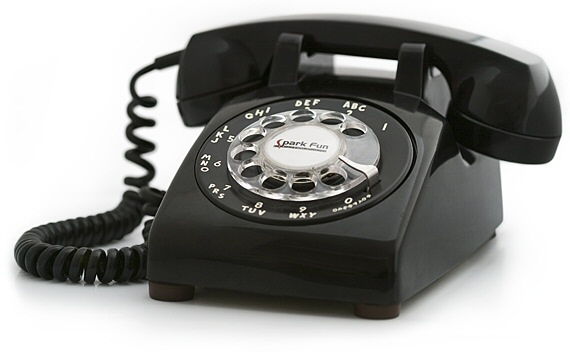

Somehow, now with the iPhone, we expect major innovations at every iteration and complain when they don’t show up, even while, as Siegler and others suggest, the real innovation is occurring under our very fingertips. Let’s examine an even shorter history of the phone, and one specific phone, the iPhone. Released in 2007, it has undergone six re-releases, but only three re-designs. 
No, the iPhone 5 is not a massive step forward in innovation. Yes, the iPhone 5 is a massive step forward in innovation. It depends on what you are expecting, and what you are looking for. Apple leads the world, of that there is no doubt. As the recent Samsung trial proved, before the iPhone phones looked and acted a certain way, after the iPhone, all of that changed, just like before the touch tone phone, most phones were rotary phones, but then those buttons changed the telecommunications world forever.
Innovation is a long, tedious progress, and in crafting the iPhone 5, Apple has moved the entire process forward another huge step, and make no mistake, they will again, but they have to earn the right, and they have to make the journey: there are no short cuts. And, when you think about it, five years is a damned short time to go from the original iPhone to the iPhone 5. Apple is moving at breakneck speed. Just give ’em a bit more time, and the wow will come.

 a simple man