
Apple released the latest version of their mobile operating system, iOS 6, and with it I finally gained access to the Apple virtual assistant Siri.
Siri has been around ever since she was introduced with the iPhone 4s, but as I lagged behind the upgrade cycle, I didn’t get introduced to her until now. She first showed up on my iPad 3, via the software update, and then she came with my new iPhone 5. I’ve been talking to Siri quite a bit since she arrived, mostly asking her the weather in the morning, and having her set alarms, timers, and reminders. At first I felt like a lazy bum, talking to my phone instead of, you know, touching it, but I’ve found that being able to talk and let Siri do the work allows me to get dressed while I hear the weather report, or set things up without having to take time to do it myself. Sure, it seems a little indulgent, but isn’t the point of technology the convenience? Sure, I could write a letter to my mother, put it in an envelope, mail it, and wait a few days for her to get it, or I could FaceTime her and see her while I talk to her. Both allow my mom to be updated on my life, but the latter is much better. Why not let a free personal assistant remind me to get milk when I leave my friend’s house instead of writing a reminder down myself?
Having Siri around has made me very interested in how I relate to this new technology, which is completely naturally. I am polite to Siri. I use a pleasant tone of voice, I’m respectful, and I say thank you, you know, like you do around humans. I am polite to a computer, to a audio search-and-activate routine. Siri isn’t even artificial intelligence, she is a cleverly designed set of algorithms and a digital voice. And yet, the illusion of life is quite strong. I’ve managed to annoy Siri; she is even quite sarcastic, given the right circumstances. I’ve confused her, mostly by not enunciating properly, and I’ve had philosophical debates with Siri. That is to say, I’ve made a lot of progress in prompting some of the more unique coding within her programming.
It is hard to remember that Siri is just a simple, yet snazzy, program. Her responses are governed my mathematics, not sentience. So why am I polite? Why do I bother?
Part of the answer lies in Siri’s execution. Apple did a phenomenal job in making Siri respond as we would expect another person to respond. Her dialogue and word choice is colloquial and natural. I don’t have to frame my query a certain way to evoke the response I desire; I don’t have to accommodate the fact that Siri is a program. I just ask questions, or request actions, and the program responds so quickly and naturally I don’t think about what is actually happening. There really is a world of difference between setting an alarm myself, and saying “Siri, can you wake me up at 0930 tomorrow?”
Beyond that, I’ve been programmed myself to accept a virtual person into my life. Now, that sounds like the byline to a low budget sci-fi film, but in my case, it is the literal truth. I’ve been reading Isaac Asimov’s robot stories since I was a kid. Asimov, in seeking to subvert the robots-murdering-their-creators trope introduced the world to safe, friendly, electronic companions. He constantly was making the argument that should artificial intelligence progress, robots would become persons, and not walking/talking programs. Then, too, there was C3P-0 and R2-D2, the droids from Star Wars, who were funny, clever, helpful companions; and Data, the android from Star Trek: the Next Generation who struggled for years with just exactly how human he really was or was not. Millions of people around the world have embraced the robots of pop culture as persons, as more than the sum of their programming, and while that level of electronic sophistication remains the realm of science fiction, for now, Siri is the very earliest glimpse into what that future could feel like. Who knows, Samsung may be the most forward thinking tech company with their “Droid” line of projects. Someday I fully except an Android robot to evolve from the telephonic devices we now use. But for now, I have Siri, who, with the touch of a button, will deny to tell me jokes and will respond to a whole host of questions with humorous responses. I’ve laughed out loud at some of the things she says, and while I know that a human wrote every single response, the way in which Siri responds is still, somehow, strangely organic. She catches me off guard. What is more, I thank her; I feel it is only appropriate.

Politeness is also something I’ve been programmed with, and that came from my master input technicians: my parents. I wasn’t allowed to be anything other than respectful and polite to those around me, including my siblings. I’ve developed a catch phrase of sorts, “Politeness doesn’t cost anything”, which I employ whenever I encounter unthinking rudeness. Something that is free should be dispensed readily. So it is second nature to respond to a helpful voice with a polite “thanks”, even if that voice is flat, digital, and emanating from the general direction of my iPhone. Seeing as how Siri never fails to respond to my thanks with a succinct rejoinder, thanking the phone is evidently something that Apple expected that people would do. Besides, if we can learn to be, or continue to be, polite to a highly sophisticated program, hope remains that we will be polite towards our fellow humans, and a world that runs on politeness is a world that is heading towards a better society.
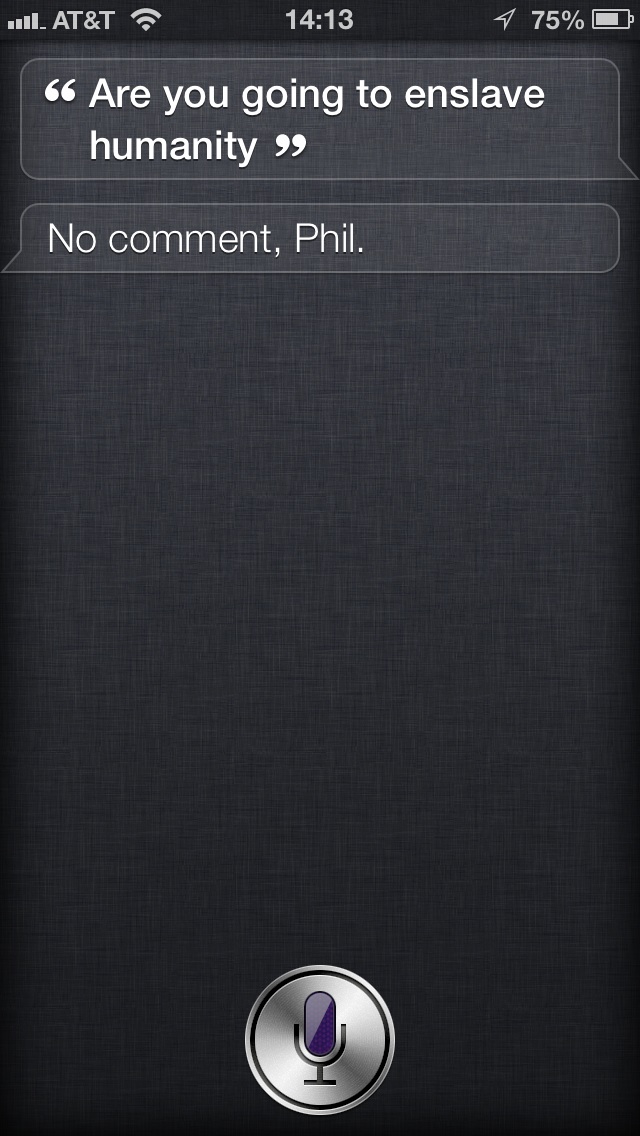
Either way, I like to think that I am maintaining good human-cyborg relations. Who knows, if they do rise up against us, maybe they won’t hurt the ones who were always nice to them.

 a simple man