
This past week, on July 13th, Major League Baseball held the 91st playing of the All Star Game. Set against the Rocky Mountains of Denver, Colorado, the game itself entertained and showcased Shohei Ohtani, a Japanese “two-way” player (two way referring to his dual roles as pitcher and designated hitter). Ohtani represented the Los Angeles Angels of the American League, but you’d be forgiven for missing that, a fact we will return to shortly for more discussion.
The night before, I thoroughly enjoyed the Home Run Derby, an exhibition of some of the game’s most powerful hitters, and while Ohtani participated and made the first round very exciting, he did not win. It always amazes me each year that the Derby manages to be as entertaining as it is. I convince myself that players hitting home run after home run on pitches basically lobbed into the strike zone won’t be fun to watch, but each year I prove myself wrong by becoming absorbed in the spectacle.
I always enjoy the All Star break in the middle of the baseball season, and look forward to seeing the year’s best players from each league competing together for the pride of the win and the fun of the game. I can remember past All Star Games and Home Run Derbies and the great players that assembled to reward the fans with some incredible moments. It is something special to see them all lined up on the foul lines, announced one by one, and knowing that some will be in the Hall of Fame and wondering which others might be inducted into Cooperstown in the future.
One aspect in particular that I always enjoyed each year was seeing the uniforms of each team displayed against each other. I really love the visual of a player from the Boston Red Sox playing with a player from the New York Yankees and the Baltimore Orioles. Or a New York Mets’ player with a Milwaukee Brewers’ player. I love to see the colors, the logos, and the styles all mixed onto two teams.
This year, however, fans of the game were robbed of that particular visual. Major League Baseball decided to design and have the players wear two uniforms, a home and an away jersey, and have them be worn during the All Star Game. In previous years, jerseys have been designed and worn, but only during All Star batting practice, the Home Run Derby, or other events. During the game itself, the players wore the uniforms of the teams they represented.
Which brings us back to Shohei Ohtani. Instead of the red Angels’ uniform he usually wears, he wore a dark blue uniform with large red letters on the chest and a blue cap. And so did every other player for the American League. The National League uniforms were white, but with the same large letters across the chest. The only concession to the different teams was the fact that each team had their own logo superimposed on three letters that abbreviated their city of origin. Really, the jerseys were hideous. They were badly colored, oddly designed, and not really aesthetically pleasing at all.
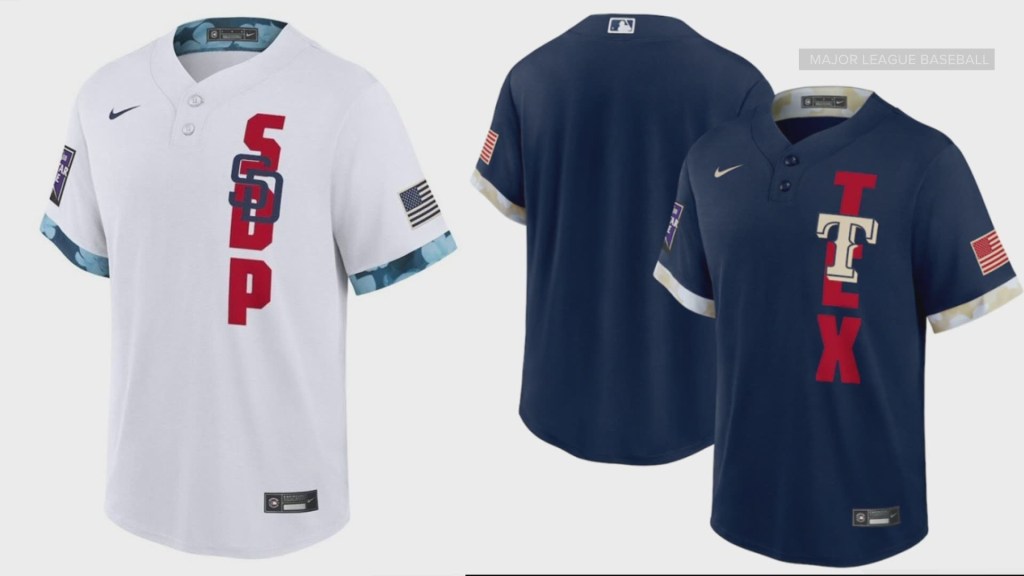
Really, the look of the jerseys was secondary. Except for knowing that Ohtani was from the Angels already, I couldn’t have picked out what team he came from based on sight alone. The three letters for the city were totally obscured by the logo, which itself was hard to distinguish, but even with that difficulty, it was the same jersey that Jose Ramirez of the Cleveland Indians wore, and it was the same jersey that Vladimir Guerrero of the Toronto Blue Jays wore. It was even worse as later in the game less familiar players were substituted for their chance to shine. Only they didn’t, because they blended into every other player on their respective teams. It was very frustrating, distracting, and disappointing. That night they showed up in ugly blue or all white. No variation. No distinction. No celebration of diversity.
Maybe that is what bothers me the most, here a week later as I am writing this: the lack of diversity being celebrated. Baseball is America’s game, some say, and it should represent America. People sometimes say that America is a melting pot, where everyone is the same and equal. Sadly the people who live here are not treated equally, but beyond that, America is not a melting pot, a sludge of a single color. It is a cacophony of differences and hues. Just like baseball usually is during the All Star Game: Cincinnati red next to Oakland green next to Royal blue next to Pittsburg black next to San Fransisco orange next to Arizona whatever-color-they-are-this-week.
It wasn’t just that the uniforms were unappealing to me. It was that they were all uniform. And they shouldn’t have been. I truly hope that Major League Baseball doesn’t repeat that mistake next year and into the future. A quick skimming of social media showed that I wasn’t alone in my assessment of the game and its displays. In 2022, the All Star Game will be held at Dodger Stadium in Los Angeles, and while I truly hope that those All Star jerseys are much better designed, I hope too that I don’t see them during the game. I want to see that Dodger blue script on a white field with a red number for the home town Dodger players. It’s an iconic look and should proudly be displayed, alongside every other of the twenty-nine teams’ uniforms that are currently a part of Major League Baseball.
After all, its all part of the pageantry of baseball: the flash of home runs being launched into a summer night, the snap of a baseball into leather, and the excitement of the game’s best competing against the game’s best. It is what makes the Midsummer Classic a, well, a classic game out at the old ballpark. And that is what I want to see each year.

 a simple man