
When the Leaves Fall

I like air conditioning in the summer mornings. When I wake, and pull myself out of bed, there is a chill in the air: it feels like autumn, if even for a second. Summer here in North Texas (where I’ve made my home for an alarming seven years now) is so brutal lately as to be overwhelming. I was reading another blog which talked about change being slow, inevitable, and arriving when it will. That is North Texas. Summer arrives sometime in May (usually) and won’t leave until well after solstice, until it is good and ready.

Leaves don’t fall from trees in North Texas because the days have finally turned chilly and the sunlight is fading above branches. No, leaves fall because the land turns parched in the scorching sun, and there is little to sustain them in the boughs of their tree. Even today, two days removed from October, leaves litter my lawn and driveway and the high will be near 100 on the Fahrenheit scale. This morning I awoke to the artificial chill, and longed for true autumn. It will arrive slowly, heralded by what summer should feel like in more temperate, reasonable climes. Sometime around November and into December will come a chill in the air, chased out by a warm, sunny afternoon.

By January and February, something like real cold will descend just to remind people what jackets and hoodies are for, before leaving for a brief spring. Summer roars back in a vengeance, withholding rain and drenching all the lands in harsh sunlight once more. Or so it has seemed and been for the years I have lived here. Certainly climate change is working its dark, evil magic on weather patterns, and maybe in the long ago before times Texas wasn’t so harsh, so much a crucible to test a person’s will to live in heat and misery. I know not, that was long before me.

I remind myself of autumn with decorations and false maple leaves strewn around my living room, and a picture of mountains topped with arboreal color on my computer’s desktop. It almost works. For a brief time, when the AC turns on again to blow cool air into the room, and I lose myself in the image, I can dream of autumn. It “…shakes me like a cry/ Of bugles going by” as a favorite poet, Bliss Carman, would say. A “touch of manner, hint of mood” he would say about the penultimate season. That is all I feel I grasp here in North Texas.

It may not always be so, and wasn’t. I grew up in Virginia where the four seasons lived when I was young. I also spent time in upper New York State and Penn’s Woods where four seasons yet reign (though New York was, like Wisconsin after, ironically flipped from Texas. There winter never wanted to leave, slumbering deep beneath heavy blankets of snow, if you’ll pardon the cliché). Maybe someday I’ll journey like a vagabond once more to a place where leaves change in the chill of real cold. Maybe someday.

For now, I’ll try to make my peace with the pieces of fall that I do get, artificial or not, and turn the calendar page from September to October, though the seeming eternal summer still reigns outside. Just now, I can hear through the (closed) window the muted roar of someone’s lawnmower. Grass grows again following recent, begrudging rain. We haven’t needed to mow for months of drought. Lawns leapt upwards in hope, only to be cruelly cut down. I wouldn’t really care to cut grass, except for the conformity of it all and the fact that suddenly, in the tall spikes, I can lose sight of my small dog and I’d rather she not have to struggle through thickets just to pee. No one should, really.

The morning train barrels by behind my house, and shakes me from my reverie. Time to be about the busyness of life. May autumn bring blessings to you, wherever you be and whenever she arrives. When the leaves fall, may it remind you, not of death, but of the new life that shedding old things brings.

Back to School

This morning I had my third official graduate level class. I am taking two this semester, and both have their challenges and joys, as one might expect. I’m also working at the same university, so that is at times convenient and busy making. But there is a nice intersection between my work and my studies that hopefully will be fun and productive.

I am working as the Writing Consultant. What does that mean? I assist students with papers and assignments. Punch up language, brainstorm, outline, higher-order thinking about logic and flow – everything is fair game. I haven’t met with any students yet (did I mention the semester just started?) so I have been filling my time by hanging flyers and speaking in various undergraduate classes about my services.

I am studying Oral Traditions and Literature alongside Abrahamic Shared Stories. Both are fascinating. In Oral Traditions I am examining four traditionally oral parts of literature that occur within a culture: proverbs (or idioms or sayings), riddles, poetry, and stories. It has been fun to think about proverbs, what proverbs are common in a language or cultural group, and what exactly makes a proverb (more on that later when I study it, I suppose!). Shared Stories will look at a few religious texts that are common between the Abrahamic faiths of the world, that is, Islam, Christianity, and Judaism. This class is way more technical and foreign to me.

I say foreign in that Shared Stories involves Ancient Near East, or even current Near East, thought patterns which to me (as a modern Westerner through-and-through) are not familiar. I know the Bible stories that we will be examining, but again, only through my fundamentalist Christian upbringing. I will look forward to examining these stories through different lenses to encounter their differences, similarities, peculiarities, and what it all means. My professor for Shared Stories is Jewish, so the class will come front loaded with his worldview. I must confess, his way of thinking was very off-putting during his first class, and I wasn’t even sure I wanted to continue in his class. However, I had a meeting with his co-teacher and she allayed many of my fears and encouraged me to step outside my comfort zone. Step I shall!

Oral Traditions will be more up my alley, though it, too, will look at many different cultures and locales around the world. That’s fine. Ever since I was a teenager, I’ve wanted to explore the world as best I can. Seeing as I haven’t budget to hop a plane and actually travel, I’ll take travel through literature. The university I am at, Dallas International University, began life as a linguistics-only school. It has since, and is still, growing beyond those beginnings. Getting back into education is something I have wanted to do for a long time, and I figured dipping my toes in where I live and work wouldn’t be a bad idea. Being that still most of the classes here are linguistic or anthropologic in nature, it was hard to find some that fit my literary bent. I think, in the end, I am taking the only two real literature courses that are offered.

Which brings me back to being the Writing Consultant. I will interact with my own classmates in Oral Traditions on at least one assignment, so I get to be paid for doing my own homework I guess. Ha! Works for me. At any rate, I am excited to be back in school. It is challenging, fun, has already been exasperating, and a little bit like riding the old metaphorical bicycle. I’m a little wobbly, but I think I’ll straighten out the wheels here in no time. I get to do reading, research, a little bit of creative writing, and help others at the same time. These are all things I love to do!

All that’s lacking to really feel scholastic again is leaves falling because it is cold (not hot as is the case here in Texas) and the changing of the season from summer to autumn (which, again, won’t happen here for some time in Texas, at least, not from a temperature standpoint). Still, being in school feels like the times-they-are-a-changing. Ahhh! But it’s good.

Finished

The last time I wrote on this blog, I started reading Stephen King’s On Writing. I don’t remember because my memory is unreliable these days. I know because I use an app to track my reading, and it says it took me thirteen days to read On Writing.

In the Before Times Long Ago, I would have read King’s book in an afternoon, or even quicker, but since graduating university, my ability to read books has lessened over time. I’d not be able to concentrate, and the will to read would not materialize for weeks (or even longer).

Then came the bout with Covid that nearly killed me. I think I read during that week, but in a haphazard way. I didn’t start or finish a book, but read selections from the Star Wars trilogy novelizations. That exercise was to stave off the boredom of potential death more than a real effort to read anything straight through.

Since Covid, all I have really read, aside from a few books here and there (I think Carrie Fisher’s and Anthony Daniels’s memoirs were among the longest), were picture books: The Art of Star Wars in several volumes. I am certain I’ve written about my frustration with being unable to read before on this blog.

Finishing On Writing feels like a breakthrough. King endorses reading as much as possible if one wishes to be a writer. That advice you will find in any treatise on writing. I also believe it. Something about the way King espouses that sentiment struck through my mental fog straight to my reader’s core. I want to read again, and frequently. I cannot say the desire existed much before.

I wanted to read in the way that people want to exercise or eat healthily: they know they should. But they don’t want to, really. Doing such things becomes a chore, a necessity, an aggravation, and usually, a non-starter. With me and reading it was similar: I just didn’t do it. Even reading King’s book took thirteen days because there were several in those almost two weeks that I just didn’t want to pick up the book. Persevere I did and finish I did.

Reading On Writing turned into a journey I needed to take. I had no idea what the book was going to say, nor did I expect the emotional impact it has had on my psyche. King talks about his life of writing, which includes his eventual sobriety and concludes with a life-threatening accident. I knew of neither. Look, the rest of King’s compendium really isn’t my thing and I knew almost nothing about him personally, but I picked up On Writing on a whim because I knew he was a good, established author. I figured something he had to say could be useful.

King’s advice was more than helpful: it was life-changing. Not least will be if I can read again because it was permissive. I know pretty much what King said already: eliminate adverbs, read plenty, write regularly, and so on, but the simple way in which he presented his advice, and life story, said to me that I can do those things, too. He doesn’t pretend to be some great writer, as opposed to a best-selling author, and he doesn’t stand on pretense. He is, and he invited me to be as well. Read what I like to read; write what I like to write (minus a few adverbs). And no worries about the rest.

Sometimes we all need the permission to do what we already know to do. Permission can take us from inaction to action. As kids we all wanted to do things, but it wasn’t until a parent or other authority gave us permission that we actually went out to do the thing (usually). I think Stephen King gave me permission to read, as weird as that sounds. I didn’t pick up his book asking for that, but late-90’s King communicated permission anyway.

I have a large backlog of books to read, including the Lord of the Rings. (Anyone reading right now knows that Lord of the Rings is among my favorite reads, which is to say, I’ve read it.) I set out to read Tolkien’s masterpiece once a year. That dream died when reading died. Now I just might try again. Autumn is the time of year I usually crack open Tolkien, in honor of Bilbo’s September birthday, and I think this year I will do the same. I have textbooks to read, and other reading on my horizon, but Lord of the Rings will be read!

I have a new purpose in reading. Enjoyment, of course, but to learn as well. Learn how other writers write. Learn how to craft wonder, intrigue, suspense, or put forth knowledge. I never read with that in mind before, but King told me to read with my eyes open, to note what other writers do and why and to emulate. I will do my best. After all, hand in hand with reading is writing. Ever since I first started reading thirty some years ago, I have wanted to recreate the experience I had in pages for someone else. If I am going to be a good writer, I must as well be a good reader.

I feel reborn, relieved, and reinvigorated. Light and full of light. Hyperbolic as well. I’ll take it all. I’ve not felt this way in a long time. A good book will do that for me, but I’ve forgotten the feeling. All that I had included dim memory and stale knowledge. Now I’ve got first hand experience once more! It feels good. Plus, life is short and if reading and writing get me through the pain of it all, so much the better. It did when I was a teenager, starting a mental health decline, but like so many things, I’d forgotten what billions know: reading is a pathway: to betterment, to amusement, to knowledge, and to joy. Yes, to escape as well. Who doesn’t need escape from time to time?

I’ve finished On Writing. But I’ve not finished writing, in fact where I’ve been precocious before, I plan to be prolific now. I’ve not finished reading, either. Where I may have been voracious before, I now plan to be insatiable. As author George McFly once said, “Like I’ve always told you, you put your mind to it, you can accomplish anything!” I still contend with mental illness, life, and a host of adversity, but anything can be accomplished, and I’ve put my mind to overcoming!

Grey Pilgrim

I am in the midst of a downturn in my mental health. I have been labeled as having a high likelihood of having a bipolar disorder, and this feels more true now than it has in a long time. For a while I was doing very well. I was creating, I felt good, and I spent time in the metaphorical sun. Today, and for a while now, I haven’t created, I’ve felt out of sorts, and I’ve been lurking in a metaphorical Mirkwood.

I often think of Gandalf, one of my favorite characters from JRR Tolkien’s imagination. He is called the Grey Pilgrim, because his wizard color is grey. Pilgrim is an interesting moniker. It means “a person who journeys to a sacred place” and the thesaurus adds the connotations of “traveler” or “wayfarer”. In Tolkien’s mythology there are a few sacred places in Middle-Earth, and out of it is the most sacred place of all: The Undying Lands, or Valinor, sort of a heaven realm.

Gandalf was certainly a wayfarer and traveler as he journeyed all over Middle-Earth during his long years, but he was also tasked with opposing the Dark Lord Sauron. Once that mission was complete, he was allowed to return to Valinor, and thus embarked on a final journey to the most sacred place of all.

I feel like a different kind of grey pilgrim. I am certainly no wizard, but since my early teenage years I’ve often felt a grey or murky blackness hang over me. Also, since even earlier than being a teen, I’ve been inculcated in religious things, and read John Bunyan’s famous story Pilgrim’s Progress. An allegory for spiritual things, the pilgrim Christian treks ever towards the Celestial City, certainly a “journey to a sacred place”. I was always taught to strive towards Heaven, an eventual home beyond earth and death. My depression, bipolar disorder, or whatever this is that I’ve had since 10 or 11, has made the doctrine of heaven problematic for me.

For one thing, I was suicidal for a long time, not that many knew or paid attention to the signs. As a young kid taught that a paradise awaited me on the other side, it was difficult to resist the temptation to shuffle off this depressing mortal coil and thus enter blissful realms. I know the Catholic Church used to preach that suicide victims couldn’t enter Heaven, probably for this macabre reason of keeping the downtrodden from seeking a better existence. But my fundamentalist church had no such teaching. Anyway, I obviously survived suicide and haven’t arrived on “God’s golden shores” but I often wished that I could have go through with various plans. The lure of a bright peaceful afterlife was a tantalizing vision.

For another thing, the idea that A Better Place (C) awaits would perhaps imply that suffering on Earth will yield rewards later on in that better place, either in the place itself, or through some sort of riches being doled out. In a city paved with supposed golden streets and boasting pearl gates, riches seemed sort of a cheap reward to me, but anyway I never liked the idea that I was being made to suffer so that I could reap later. That idea rings cruel, especially because there are many worse off than depressed, bipolar(?) me. That’s a lot of copping out on easing real, immediate pain in order to make belated reparations later. Why go through the charade if God could wave his spiritual hand and ease all suffering immediately?

What then is my pilgrimage about, if I am a different sort of grey pilgrim than a wandering, world-weary wizard or a 17th century wayfarer? When I discover that, I will let you know. For today, as Gandalf did for a time, I am stepping through the oppressive, murky, and dismal Mirkwood. I don’t have a hobbit, or thirteen surly dwarves, in tow, neither do I have a stronghold of darkness in Dol Guldor to exorcise, but wander I still. I often wish my purpose was as clear cut as kicking dragon-butt or tossing jewelry in a volcano. Incredibly difficult, dangerous, and downright depressing as those journeys turned out to be at times, there at least was a drive behind them, and a world or mountain to be gained in the here and now.

Eventually, as did Gandalf, Frodo and Bilbo were admitted into the Undying Lands as a respite for all the pain they endured in Middle-Earth, but they also had many years of rest in their homes as well (maybe not Gandalf, but Bilbo hung out in Rivendell for many years after defeating the dragon and that was pretty good by all accounts). Where is my Last Homely House? Where is my Bag End? Maybe I haven’t found it yet, but I wish I could.

Ultimately, I don’t know if heaven awaits me after death, or if it is a forever sleep I will definitely have earned whenever I do die, but I do know that I have life in me yet to live. It is sad and depressing right now, but I’ve also ridden these waves enough to know that as down as I am now, I will (should) surge upwards once more. It’s just the constant surfing is making me sick and tired. As I haven’t a choice but to be a pilgrim, I will keep moving. Maybe there is at least a cozy inn on the horizon that will serve a good meal and provide a bed better than a forest root.

I don’t know how to shake my depression. I don’t feel I’ve done a terribly good job of doing anything but enduring the troughs, and nothing really seems to work to bring me out except time. Gandalf himself had many long years of waiting before the Ring was found and he could formulate a plan to defeat Sauron, and in the end, such defeat (and Ring) was out of his hands anyway. So I guess I will wait for this greyness to lift. At least then I will feel more myself again, for a time. Damn, but this is frustrating.

But, to take a page from Tolkien’s book, Gandalf looked for and found happiness and pleasure where he could. Whether in lighting fireworks for young hobbits at Bilbo’s birthday, or in fighting for those less fortunate many a time, he always found a way to rise above his circumstances. That’s what I see I must do. Not necessarily go out and light off a firecracker, but enjoy what I can when I can. Gandalf, my old friend, I will do my best!

(A friend of mine would recommend pipe-weed to me, but as Old Toby doesn’t exist, I’ll have to do without smoke rings. And I’m not one for smoking anyway.)

Free Time

What is free time? Some people might say that it is time without anything assigned to it, that one is “free” to use it as they wish. I suppose that definition works well enough. In between work, chores, sleep, bodily care, and scheduled events lies this elusive “free time”. How do you use yours?

I don’t quite know what to do with my free time. I have many options, but I don’t always feel “free” to choose most of them. And I don’t quite know why this is. I have written before on this blog about being paralyzed by choice, a sort of executive dysfunction I endure from time to time, but I don’t always think that is to blame.

Take reading for example. I used to love to read, and would do so voraciously. Now it takes extraordinary effort for me to read. I have bookshelves full of books I would love to read, but any time that is free to me, I don’t find myself choosing to read. Instead, I end up playing Scrabble on my iPad or watching baseball, or, which is psychologically worse for me, just…sitting there. I rather hate the choosing to do nothing, actually. I feel terrible for having wasted the time, and not having accomplished anything, reading or otherwise.

I should mention that it isn’t always a conscious choice. I sit down in the evening, usually when my free time occurs, and think “I’ll just play one game of Scrabble, and then move on” but I also have this thing where I hate losing, so if I lose, I play until I win.

Wait…

Having just written that, and thought about it, that sounds like gambling. I don’t wager anything on these games and nothing is risked, but the high I get from winning may be no different. This just took a left turn. Hmm.

Still thinking here. Bear with me a moment…

If playing Scrabble is like gambling, where I am chasing a high, and it is interfering with what I may ordinarily do, then maybe I need to quit playing Scrabble altogether. Maybe you figured that out already and have been laughing at me, but I’ve just now worked this out.

I have been puzzling over how to chose to do other things, and now it is a little silly to me that the solution may have been that obvious all along, but let me continue with my original thought and see if that leads down the same path. Scrabble. Playing until I win sometimes takes the next game, sometimes ten (I am fairly evenly matched with the Advanced computer I play against, so winning isn’t ever guaranteed). By the time I finish with Scrabble, I am out of sorts, sometimes frustrated, and more mentally drained than I was when I began.

The negative momentum is strong at that point, and I don’t often get off my butt and start something else. That is where I end up sitting and doing nothing or turning on a baseball game. And then I feel I have wasted the evening. So yeah, maybe Scrabble does need to go. Look, I’ve been playing Scrabble because I am afraid of losing my mind. No, really, that has been my rationale! I read that doing crosswords could stave off dementia and other age-related mental decline, and I figured maybe Scrabble against a sufficiently advanced computer would do the same thing (don’t know about that, actually) so I played Scrabble. But it has become, apparently, a sort of addiction.

Back to free time, then. I have thought before about actually scheduling my free time so that I do what I want to do. I think I even wrote about that a while back on this blog: Tuesdays for podcasts and Wednesdays for reading, that sort of thing. I never actually did it, because doesn’t that defeat the purpose of free time? I also get weary thinking about being forced to do a thing, as if maybe that would rob the joy I receive from doing something.

I feel like I am rambling at this point, but also maybe getting somewhere. I read something the other day about being intentional and allotting time for things during free time, which kinda brought all this up in my mind. I think perhaps I do need to, perhaps loosely, schedule what I want to do. Or give myself permission to do whatever I want to do, whether reading or watching baseball or something else.

The other angle to this is the cult of achieving. I have been inculcated with the idea that a product must result from an activity, else it is wasted or frivolous. Sure, reading results in knowledge or pleasure, but I’ve felt it must be something more tangible. Example: I mess around with my action figures, but it only “counts” if I take a picture and post it to social media. Reading hasn’t felt like it counted because it was only for me. Which, again, now that I type that sounds like an absurd thing to say.

Absurd or not, the feeling is valid. I haven’t felt that I can do things just for me because the end achievement was rarely visible to others. And there we have it! I have been living life in the shadow of how it appeared to others. I know in my mind that a life spent listening to bird song and tending to flowers is not a life wasted. It is only this damnable capitalistic society that says only products are valuable, but that is bullshit. And I do know that. But it is so hard for me to resist that ingrained ideology.

I want to break free! I want to use my free time for me, after all, isn’t that why it exists? I will try this thought on for size: time for me isn’t wasted, in fact, it is the most valuable thing there is. Time for me rejuvenates me, enriches me, and adds immeasurable value to my life for me. And that powerful thought is hacking its way through my intellectual thicket.

Where have I come to, then?

1) no more Scrabble!

2) loosely scheduling free time is ok!

3) things done just for myself are valid!

I feel liberated! I have the ability to choose what to do in my free time! It amazes me how well writing works as a tool to work through a problem I have been having for a long time. I feel ashamed that it has taken this long to find my answer, but so glad that I may have one at last. We will see how well this works to break through the fog and indecision paralysis, but for now I am excited!

I began by asking what you do in your free time. I suppose I’ll end by asking: what will I do in my free time?

What Is Grief?

Trigger warning: divorce.

In the Marvel television show Wandavision, the facsimile of the android Vision confronts Wanda about her burgeoning rage, and the grief that underlies her rage. He asks: “what is grief, but love persevering?”. Wanda is facing the loss of her parents, as a child, the loss of her brother in the recent war against Ultron, and the loss of her imaginary children in the context of the show. With so much loss, it is no wonder she was turning to rage as a means to insulate herself from the pain of the losses. I know the feeling.

Four days ago I celebrated my fourth wedding anniversary for the second time. That is, a second fourth wedding anniversary. My first fourth anniversary was hardly a celebration as it was mere months away from seeing my divorce finalized. That was a hard blow to absorb. I was not divorced by my choice; I would have rather worked on the marriage and rebuilt it as necessary, but that didn’t happen. Ten years on from that marriage ending, I am still dealing with that loss.

I thought I was over it, past it, done with feeling the pain of that loss. But then I saw, quite by accident, a photo of my ex on a friend’s social media account. There she smiled, alive and well, and quite divorced from me and my life. And it hit me like a sucker punch to the back of the head. All the pain, the loss, and yes, the rage, of the divorce came racing back. It was physical, visceral, and quite overwhelming for a few minutes. Thankfully, I now have tools and equipment to deal with such emotionality where before I did not. I was able to center myself, breathe, and refocus. But it still hurt.

In my grief renewed, I remembered the love that perseveres. The love I once held for my former wife, the love we shared for all too brief a time, and the love of the togetherness. All of that is gone now, practically speaking, but some must persevere. For why else would I feel such grief ten years later? I realize as well that grief is never-ending. Sure, we can bury it, ignore it, compartmentalize it, and think we have moved past it, but when it charges back into our hearts? It is then we know the pain of loss never fully left.

I don’t think severe mental or emotional pain ever really leaves. And I think, too, that we as humans would lack something without it. Humans are social creatures, this we know, and part of that society is forming connections, relationships, and partnerships. Beyond marriages, we have families, friends, co-workers, and acquaintances. All of these liaisons inform and build who we are throughout our life, and when one of those connections ends, brief or long-lasting, significant or ethereal, there is a loss. And we grieve that loss. For something like an acquaintance, it may barely register. But for a life-partner or a family member, it usually lingers. That love perseveres the rest of our lives.

I have a life-partner once again, and it is with her I celebrated the second-fourth anniversary. I share love with her, and I am thankful for her presence. She enriches me so much in so many ways, and I trust I do the same for her. Her love cannot, and does not, diminish what I had for my ex, nor does the enduring love for my ex shade my current love. Love, quite simply, doesn’t work that way. It is not a zero-sum game. Love grows as we grow, and encompasses much. This is why a new wife’s love cannot replace what was before, and neither can an old flame extinguish a new. Love is to be shared and that never ends.

This is also why it hurts in perpetuity when a love is no longer shared, either through death or legal separation. Because one party holds an echo of that love but it can never again be reflected. Love stretches into what is now a void, unheard. Love perseveres, hence: grief. So what do I do? I practice my coping techniques, and I continue to move forward with my life. I don’t, and didn’t, wallow in my grief renewed, nor did I begrudge it its place. I felt it, observed it, and continued. I do the same whether it is a reminder of my ex, or of my beloved grandparents who are no longer with me, or even of friends who have passed beyond my daily reach.

Whoever wrote that line for Paul Bettany to voice as Vision evidences wisdom. I am not sure I would have expressed it that way, and that is the simple brilliance: it is a quiet phrase, but one that holds so much breadth. That’s why I love good storytelling, incidentally. A good story speaks so much truth into my existence, and guides me to reframe what I feel in new ways and gives novel paths to experience those feelings. Everything builds on what came before to construct what is and provide scaffolding for what will be.

Why enumerate all this? This, too, is a way I process grief: through words and sharing of experience. The Bible has a saying: “rejoice with those who rejoice; mourn with those who mourn” and I think that is true, valuable, and proper. As social creatures, our emotions are to be shared as much as our resources and company. By presenting my grief, and insights, I can build a community with you who reads, because we are both human, and therefore share a commonality of experience. I help you, and you help me: that is humanity. We mourn together, this love lost, and we also rejoice in my new found love of four years now. Where one withered and died, the other is growing and thriving. So thank you for sharing my cries and my smiles. We are in this together, and that is a wonderful thought.

Summer Haiku

A few haiku from memories of Virginia summers, perhaps from a growing up day, moving from morning to night:

Flapping gently by -
Push breezes soft as butter
Flies across the lawn.

Cicadas chirping
Loudly in trees’ leafy boughs -
Constant summer song.

Sweet pink lemonade
Sipped from beaded tall glasses -
Tinkling ice cold drink.

Grass freshly mowed short
Reflects the red’ning sunset
In long yellow swaths.

Bats chase tossed balls down
In the dark’ning dusky day
Darting to and fro. **

Fireflies wink and
Fade, blinking their amber butts
In hopes of a date.

Orion flashes
His star-jeweled belt and sun-shield -
Guarding the night sky.

** A note is needed for this one. An old tree in a neighbor’s yard held a colony of bats, and as night fell they would emerge to chase insects. My brother and I thought it great fun to toss baseballs up in the sky and watch the poor, no doubt confused, animals dive towards the balls perhaps thinking them a fat, slow, tasty morsel. Shrug. I suppose we were easily amused as we didn’t watch tv and tablet computers had yet to be invented.

Destined for Adventure

Indiana Jones. I grew up enthralled by the character of Dr. Jones and his erstwhile associates: Marion Ravenwood, Short Round, Sallah, Marcus Brody, Henry Jones, Sr., Mutt Williams, and the many colorful villains of his archeological (dare we say, grave robbing?) career. Raiders of the Lost Ark premiered in 1981 followed by Temple of Doom in 1984 and finally The Last Crusade in 1989. I came along in-between Doom and Crusade, so for me, Indiana Jones has always existed alongside Star Wars, Star Trek, and other franchises that my family loved.

With great joy in 2008, a mere 19 years after he rode off into the sunset, I went to the theater while in college to see the long-awaited next installment of Dr. Jones’ career: Kingdom of the Crystal Skull. I wondered if that would finally be all, but 15 years later in 2023, Indiana had one last adventure in him for Dial of Destiny.

Between Star Wars and Indiana Jones (and many other films!) I have watched actor Harrison Ford all my life. It will be a sad day indeed when he “goes first into the next great adventure” but his beloved characters from Han Solo to Indy will always be with us.

There is something evergreen about stories that span the world, led by a great action hero who never loses his hat. Steven Spielberg and George Lucas may not have been wholly original themselves when creating the character, mining as they did the 1930’s and 1940’s action serials that they themselves enjoyed once upon a time. Somewhere between robbing the past, and grabbing from their present with Harrison Ford, they created an icon. Something about the fedora, leather jacket, and bullwhip was an instant classic, all brought to life by Ford’s portrayal.

I got to see Dial of Destiny on Independence Day with my parents, and it really felt like a love letter to the character and the adventures he has gone on, while being an entirely new foray into the world that Lucas and Spielberg created so long ago on a Hawaiian beach as Star Wars was premiering back in Los Angeles. Dial does not shy away from the character’s age and fragility, matched by that of Harrison Ford who is now 80 years old. In itself, it is amazing that Ford has the energy and ability to portray such a physical character, helped no doubt by stunt doubles both digital and real, but all of Ford’s acting prowess is still on display as Indiana is world weary, regretful, and facing the end of his teaching career, archeology, and life.

Eventually I assume that even Indiana Jones will be rebooted for a future generation, as all old things become new again. Like Han Solo being re-portrayed in Solo: A Star Wars Story, you can’t keep the good archeologist down. Plus, Nazis always need their comeuppance, and who better to punch them repeatedly in the face than a good old American professor? “The pen is mightier than the sword” as Marcus Brody exclaims, and while Indy presumes that the real dangers to archeology might be folklore, he finds himself in plenty of scrapes along the way.

Dial of Destiny ends on a bittersweet note, both to the film and the franchise. I need to see it a few more times to see how I really feel about the story, but my initial feelings are that it is a solid entry to a grandly entertaining series. If you were to ask me which Indiana Jones film is my favorite, it would have to be Last Crusade. The interplay between Sean Connery and Harrison Ford is fantastic, and I’ve always loved the father/son story. Raiders of the Lost Ark and Kingdom of the Crystal Skull are two and three. I don’t find Temple of Doom enjoyable to watch, despite some really great sequences and some fine moments. As I’ve said, having only seen Dial of Destiny once, it is hard to rank it. But I’m glad for any Indiana Jones I’ve received, and those that put their hearts and souls into the films deserve all the praise. Films are meant to entertain, and Indiana Jones does that the best of any.

Indiana Jones and the Dial of Destiny Promo Poster

The Right Tool

I’ve been working on several projects lately. I recently wrote about the book I am writing in conjunction with my wife, but I have others in process. I love to make things in the physical world, not just the literary one, and my dad loves model trains. Together he and I are working to build a grand train display in his hobby room. My dad is coming up with the layout and some ideas, and I will be doing most of the building when it comes to scenery, greenery, and other such things.

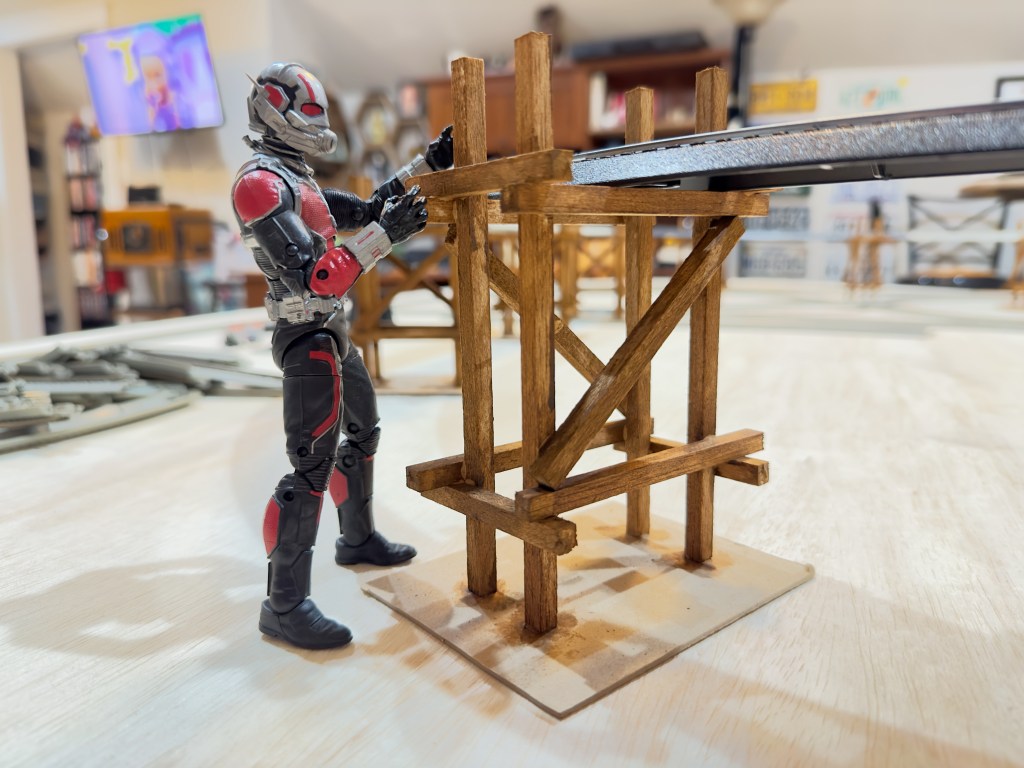
The first step is to build trestles. My dad has an HO (a larger scale, for the uninitiated) train that he wants to be on a square oval in the middle of his train table. In, around, and underneath that train track he wants to weave his N gauge (a smaller scale) train tracks. To do that, the HO needs to be elevated. Plastic risers such as they sell in the mass market for elevating train tracks are not tall enough, so it fell to me to build new ones.

I went to my local hobby store, and perused the shelves for what I could use to construct sturdy, yet lightweight, trestles. I found some balsa wood rods that were a quarter inch square and thirty-six inches long. Perfect! I found some reference pictures online that could be close to what I wanted to build, and then it was figure-it-out time! I played around with some sizing and how to build a lattice, but then came the cutting.

I don’t have many blades at my disposal other than a few pocket knives, but I do have an Exacto blade. I figured the balsa wood was soft enough that I could cut through it with that. So that’s what I did. Man, was that a bad idea! It took forever, didn’t always give me good cuts, and in the end, gave me sore fingers and a massive blister on my thumb where I pressed down on the Exacto handle. Not fun.

Eventually, I finished the trestles (with some Vallejo sepia wash they even looked like railroad ties and not balsa wood) and delivered them to my dad’s hobby room. Unfortunately, what we thought we needed was not enough. The track required a bit more support than we initially figured, meaning we had to move the trestles closer together than originally planned. That meant I was back in fabrication mode. My blister had finally healed, and I didn’t want a repeat performance from my thumb. Enter the Home Depot.

Home Depot sits across from the hobby store in the next town over, and after purchasing enough balsa wood rods to finish the project, I thought to myself that I would at least see if Home Depot had something I could use to cut them to make the job easier. I took a look at the hand saws, chisels, box cutters, and other blades and eventually found something I thought might serve my purpose: a small 8″ hacksaw with a small, many-toothed blade. So I bought it.

Coming home I tried it out on a scrap of balsa wood that I had left over from my first foray into trestle making, and it worked perfectly! The blade was small enough to cut the quarter inch rod, and sharp enough to give me almost the perfect cut! Wow, I wished I had thought to buy that at the beginning! The right tool for the job really does make the job that much easier. And now I have a small saw for other building projects I undertake in the future.

I quickly cut up the balsa wood I had purchased to make the rest of the trestles, and of course it took me an hour instead of half the day to chop it up into the lengths I needed. Now all that is left is assembly and paint, and then I should be done making trestles. After that comes securing them in place, placing the HO track on top, and, well, the project continues from there. N gauge track underneath, planning the scenery, and taking it further. This won’t be a quick project, but it has already been fun. I have had the opportunity to grow my fabrication skills and later I will be able to flex my creative muscles as well. I can’t wait!

And making things is a great diversion from writing, which I had been doing fairly non-stop until my dad and I embarked on the Great Train Project. Now I get to take a break from stringing words together and can cut, glue, and paint (usually in that order). And once I’ve come to a finishing point in the fabrication, I can get back to writing. It allows me the chance to work different processes, and not get burned out in doing only one thing all the time.

Other projects are also in the works for me, such as photography, organizing, action figure customization, and the list goes on. I might need to start scheduling my time to get to it all! We will see. For now, it’s “All aboard!” in finishing the train trestles, which I think I may do after lunch.

Ant Man helps to install a trestle.

A Book

“Hello” he typed, in what he hoped were friendly letters.

I am working on a writing project! A few years ago my wife started a book, and I agreed to help her punch up the language and refine the message. I started doing just that, and somewhere along the way put it aside for other things and never quite picked it up again. Now, in light of my recent lay-off from a job, I decided to revisit the manuscript and finally get it into good shape.

For the past couple of weeks, I have been doing just that. Starting from chapter zero, the introduction, I have been trying to work on a chapter a day. Life still intervenes and I cannot sit and write for an entire day, but today I finished up work on chapter four (of eight-ish)!

It feels really, really good to sit down, light a scented candle (a Middle-Earth inspired scent created by my friend Alisha), put on some music, and write. In this case, most of the words are there already, but they need shaping, like a child using the sand of the beach to form a castle. I add a little water, cast the damp sand in a shaped bucket, and overturn it upon the dry sand beneath. Or something.

Really I poke at it, delete a little here, add some there, rearrange this or that, and read read read. I read each chapter again and again so that I retain the flow and higher order ideas of the chapter, rather than get bogged down in a particular sentence or paragraph. It is ok to really hammer out the grammar of a particular phrase, but not at the expense of the whole. My tendency is to want to be elegant and precise and highfalutin’ but sometimes I just need the damn thing to say what it needs to say, beautiful phrasing be damned. (See, I just used “damn” twice in one sentence, a thing I usually avoid, but hell, it just needed to be like that. So, too, the book sometimes just needs to be what it is.)

I am cognizant as well that my wife wrote most of what I am editing and shaping. If I change too much of that text, it won’t be what she wrote any longer (insert Ship of Theseus metaphor here). I don’t want to lose her voice, or too many of her words in adding my own. She says things in different ways than I would, and as I am becoming co-author there will be plenty of me in there as well, but I don’t want her to disappear either. It becomes a balancing act.

I think that is what I am loving most about this work: the act of balance. It requires much of my extant skill to pull off this balance of retaining my wife’s phrasing, adding my own, while fixing errors, adding missing bits, and removing extraneous information. I truly hope the end result will be worth reading, and accomplish the goal we now share in writing. It has been exciting and invigorating to sit down each day and shape the castle one sandy block at a time.

I will announce more what the book is about when it is much closer to completion. For now, it is a project that is allowing me to stretch my muscles and really get into some word-smithing.

“Anyway” he wrote, changing topics slightly, “this book project is consuming a lot of my writing energy.” He paused. Continuing he typed: “that means that my blogging may not continue as frequently, however, I will try to maintain my ‘two blog posts a month’ schedule that I have for a long time now.” He typed a period and closed his quotation marks, and felt good about that particular sentence. He decided that he had said what he needed to, and that he could hit publish and be okay.