
They called the game
on account of rain
the children cried
with the skies
there will be no more balls
no fouls, swings and misses
strike the seventh stretch
the bottom of the ninth
and the top of the fifth
batten down the mound
await breaking clouds
rain, rain, go away
let our team win today
don’t let this delay
turn into a rain
out
Category: Baseball
Enter Sandman
The ear crunching chords of heavy metal music shattered the quiet, Kansas evening. The music crackled a bit, coming as it did from old, creaky speakers. When these speakers were designed, heavy metal hadn’t yet been invented. It was no wonder the rhythmic bass and electric guitars strained their mechanical limits.
Karin jerked awake and sat up straight in bed. From her bedroom on the second floor of the farm house, the music roared into the dark corners and echoed off the walls.
Say your prayers little one,
Don’t forget my son
To include everyone
Karin threw back her covers. A faint light was filtering in through her bedroom windows. The ballpark! Karin grabbed her bathrobe from the chair by her bed and shrugged it over her shoulders as she ran down the stairs.
I tuck you in
Warm within
Keep you free from sin
‘Til the sandman he comes
When she was a little girl, Karin’s father Ray plowed a corner of his cornfield and built a ballpark. At first it was a left field only, finely manicured Bermuda grass and a rickety old section of grandstand. Over the summer he labored and tilled and planted and painstakingly built a baseball diamond. Just across sagging chain link fences and creaking bleachers, tall ears of Iowa corn reached to the starry skies.
Sleep with one eye open
Gripping your pillow tight
The screen door banged against the door frame as Karin breezed out of the house. Her bare feet slapped against the brown dirt path that led from the front door to the left field seats. Though her father had long ago completed other sections of the grandstands for spectators, she always sat in left field. It was where the magic had first manifested, and though it had spread, it still always seemed strongest there.
Exit light
Enter night
Take my hand
We’re off to never never-land
Karen stomped up the bleacher stairs and sat down, out of breath and staring into the night. Her breasts were heaving as she gulped air. Her flaming red hair was unkept and tangled from sleep and the midnight wind. There, in the centre field wall where on enchanted nights the ghost men walked in to play baseball and out to rest until the next mystical “Play ball!”, a new shimmering baseball player was entering. His cleats shifted from translucent and grey to solid and black as they crunched the dirt of the warning track. Head down, he tucked his glove under his arm, and began to jog from centre field towards the pitcher’s mound.
At first, Karin didn’t know who he was. His pinstripe uniform wasn’t immediately distinct, but then she saw the bold big numbers on his back. 42. Karin gasped. Could it be?
Her gaze remained locked on the new pitcher emerging from the cornfield, but she acknowledged the arrival of her parents with a distracted wave of her hand. Annie, her mother, was an aged, mirror image of her daughter, though her red hair had faded and was streaked with the silver of age. Her father moved with the slow, creaking joints of a lifelong farmer. Though his face was deeply grooved from long days under the summer sun, his smile was still bright.
“Did I hear ‘Enter Sandman’?” he asked, a slight rasp in his voice.
“Yep. I wonder what Joe thinks of ‘modern music’?” Karin replied.
“Is it…?” Ray let the question tail off into a whisper.
Karin just pointed to the pitcher warming up on the mound. He was focused, quick, deliberate in his delivery to the catcher. His number was clearly visible, and though there was no name on the jersey, Ray immediately knew who was making warm-up tosses on his cornfield ballpark mound.
“Mariano Rivera.”
He didn’t so much say the name as breathe it with a holy reverence. From left field, Shoeless Joe lobbed a toss to the centre fielder, and turned to throw the Kinsella family a wink. He had heard Ray’s whisper. Joe enjoyed introducing new players to his magical baseball fans.
Rivera, the greatest closer to ever pitch in organized baseball, was warming up for the 1918 Chicago White Sox in a cornfield in Iowa.
“Watch this, Karin,” Ray said, leaning down from his seat to whisper in his daughter’s ear. “Mariano Rivera is the greatest pitcher to ever close a game. He throws a cutter, primarily. It comes in hard and straight like a fastball and at the last moment cuts hard. He discovered it by accident, they say. Chipper Jones, he played third base for the Atlanta Braves in Mariano’s time, called the pitch a buzz saw. They said Rivera broke more bats in a single season than any pitcher before him.”
Karin listened and watched with rapt attention as Mariano Rivera stood tall on the mound. He stared into the catcher for a brief moment before turning, and hurling a pitch towards home plate. Even from left field, above the crickets and the leathery flapping of corn husks, Karin heard the zip of a baseball, and the loud *snap* of the baseball smacking into the catcher’s mitt.
“Striiiiike one!” the umpire yelled. Mariano simply caught the ball from his catcher, kicked the dirt on the mound, and stood, foot pressed against the rubber, ready to go again.
“If you build it, he will come,” a ghostly announcer once said. Then “he” was Shoeless Joe Jackson. Tonight it was Mariano Rivera, the last ball player to ever wear number forty-two, and the greatest to ever pitch the ninth inning.
Karin smiled. The magic was still alive in the Iowa cornfield.
Underdogs
Baseball is the best sport in the United States.
Hands down, no debate, unquestioned: baseball reigns supreme. The game has been played for over 150 years, from coast to coast and it has incorporated players from around the world, and all strata of society. But longevity is only part of what has made baseball great. Baseball stands above because it is, at it’s heart, American. It is the American Dream, the American Way, and the American Spirit all wrapped into one and played out on a close cropped diamond of green, framed by deep, dark brown dirt, guided by sparkling white lines, and guarded by the citizens of this great country.
More than that, every single game on a baseball field is a microcosmic re-enactment of America’s history. A brave, few men stand against a determined foe, defending home territory, or valiantly striding between enemy foul lines. Nine strong soldiers bear arms, bats, and gloves with battle plan and knowledge of their opponent, and an intimate understanding of the coming battle and all its stratagems. They fight for their pride, their right to stand tall, their destiny to achieve the greatest victory available.
Anyone can join this struggle, this game. Farmboys, bean counters, lumberjacks, and geniuses: all have stood beneath the sun and stars to have their moment at the plate, their place upon the everlasting meadow of the ballpark. The poor, the rich, the educated, the street-smart, and the wiseass. Baseball is not a game of privilege, and it does not respect superstars. Anyone can rise above to be enshrined forever in the eternal halls of the famous. Anyone can turn the tide, stand in the gap, or do the impossible in so doing be made mighty.
The game has been played, largely unchanged, since its inception. Twenty-seven outs, eighteen players, three strikes, one blinding white ball wrapped in stitching colored with the blood of those who every day leave it all on the field. And it is all up for grabs, every single time. Every single time an umpire, beneath blue shirt and steel mask, shouts “Play ball!” every single player knows that today could be their day, this game could be their game, it is for them to win or lose.
In baseball: anything can happen. Fortunetellers lose fortunes trying to foretell outcomes. Players defy the oddsmakers like titans defying the gods.
How else do you explain an outfielder named Kirk Gibson, who stood impossibly tall one day in 1988, doubled over from the pain of a stomach virus, hobbling on a pulled left hamstring and a swollen right knee called into action to do what could not be done against one of the most dominate opponents of his era, pitcher Dennis Eckersley. It seemed Gibson’s manager had lost his mind. This was the first game of the World Series, baseball’s ultimate showcase, the stage most ready for the performance of the year from two teams who had proven time and again that they deserved to be there. Winning the first game is beyond big, beyond huge, with it comes momentum and energy. Baseball playoffs are a zero sum game. The postseason is played against time, against dwindling effort and opportunity. Each swing, each inning, each out is lost forever. There are no second chances, and surface mistakes can become fatal wounds. So why would Tommy Lasorda call upon ailing Kirk Gibson, of all people, to stand in the batter’s box and contend at his worst against the best?
Lasorda knew then what he knows now: baseball is a game of heart and soul. In pain, and growing weaker, Gibson took the toughest assignment ever given a ballplayer and quickly looked to be done. Two strikes down, and every movement a torture of battered and broken body Gibson’s heart was strong. He knocked aside two more pitches to stay alive, evading the strikeout with what he could muster. And then: with teammate streaking towards second with theft in his heart, Gibson bent his good knee, and with nothing more than blood and guts he piled upon the ball’s white hump the sum of all the passion of a country, and had his bat been alive, its wooden heart would have burst upon it. Never had leather been struck with more meaning. Though the home run was hit, the game would not be won unless Gibson could complete the play. Gibson had to endure the basepaths. Through burning pain, he grimaced, and limping on both feet, hobbled ’round the bases, pumping his arms and cheering his team’s victory with each pained breath.
One man who know one thought could make a difference changed everything.
Baseball wakes in spring with the resurrection of earth’s northern hemisphere. It grinds through the long, hot summer, but in the autumn, when the leaves explode with color and air crackles in its crispness: baseball comes alive. October baseball is electric. The season races towards the end, each team fighting, desperate to be last standing, desperate for their chance to show the nation that they deserve to be crowned king of their coliseum. It all comes down to division princes, and league champions, and finally, two teams who through determination and desire have dominated all others. In October, the world champions are revealed.
In April, no one can tell who those two last teams will be. In September, still, no one really knows. In November, it is undeniable. But October: that is when bats thunder, crowds roar, balls sizzle, and that is when the magic happens. That is when heroes fall, champions crumble, and the underdog breaks free.
In America, it quite simply does not get any better than the simple game of baseball.
Pop Culture ID
I am from a galaxy far, far away: wistful sunsets and lifeless ice cubes. I am from the Final Frontier: the SS Botany Bay and the HMS Bounty. I am from Tatooine, Vulcan, Cloud City, and the Alpha Quadrant. I’m a doctor, not a scruffy nerd-hearder.
I am from the great divide, Eureka Creek and the Five Mile: brumbies, stagecoaches, and bullwhips. I am from extended families, mountain men and their horses. The stew had turnips in it, and taters in it, and rabbits in it; well, I don’t always eat wallaby, son!
I am from the sewers of New York City: cowabunga, pizza, and turtle ninjas. I am Donatello and Michelangelo. I am from Xavier’s school for the gifted: playing cards, trench coats, and bo staff Cajun gambits. Sacre bleu!
I am from Cleveland, Jacob’s Field and the comeback kids. I am from elation, heartbreak, and all the old familiar losses. I am from the sandlot, Babe Ruth, and legends that never die. Bury my heart at Pro Player Stadium.
I am from Serenity Valley, the black and browncoats. This is a fertile land and we will call it “this land” and you cannot take the sky from me. I am from the signal that cannot be stopped, and a preacher called Book. I aim to misbehave.
I am from Sunnydale High: the life, love, and hell of high school. I am from the Powers That Be, Pylea, and the dimensions of hell. The world is doomed, but I want the dragon: I’ve never fought one before. All that matters is the fight and the soul within that yearns to be human again.
I am from the Internet, where One Must Fall and the earth is scorched. I am from the Bean-With-Bacon-Megarocket, WinAmp, Kazaa and shareware. I am from floppy disks, up-dialing, and AOL. I am from Steve Jobs, the iPod, iTunes, and iBook G4s back when tigers roared. And one more thing…
I am from Billund’s little yellow men: studs that construct worlds from the ether of imagination. I am from the baseplate, the brick, and the bi-plane. Build me up, tear me down, make me new again.
Why I Dislike Derek Jeter
It isn’t anything personal, mostly because I have never actually met the man, but I dislike Derek Jeter, (the professional baseball player).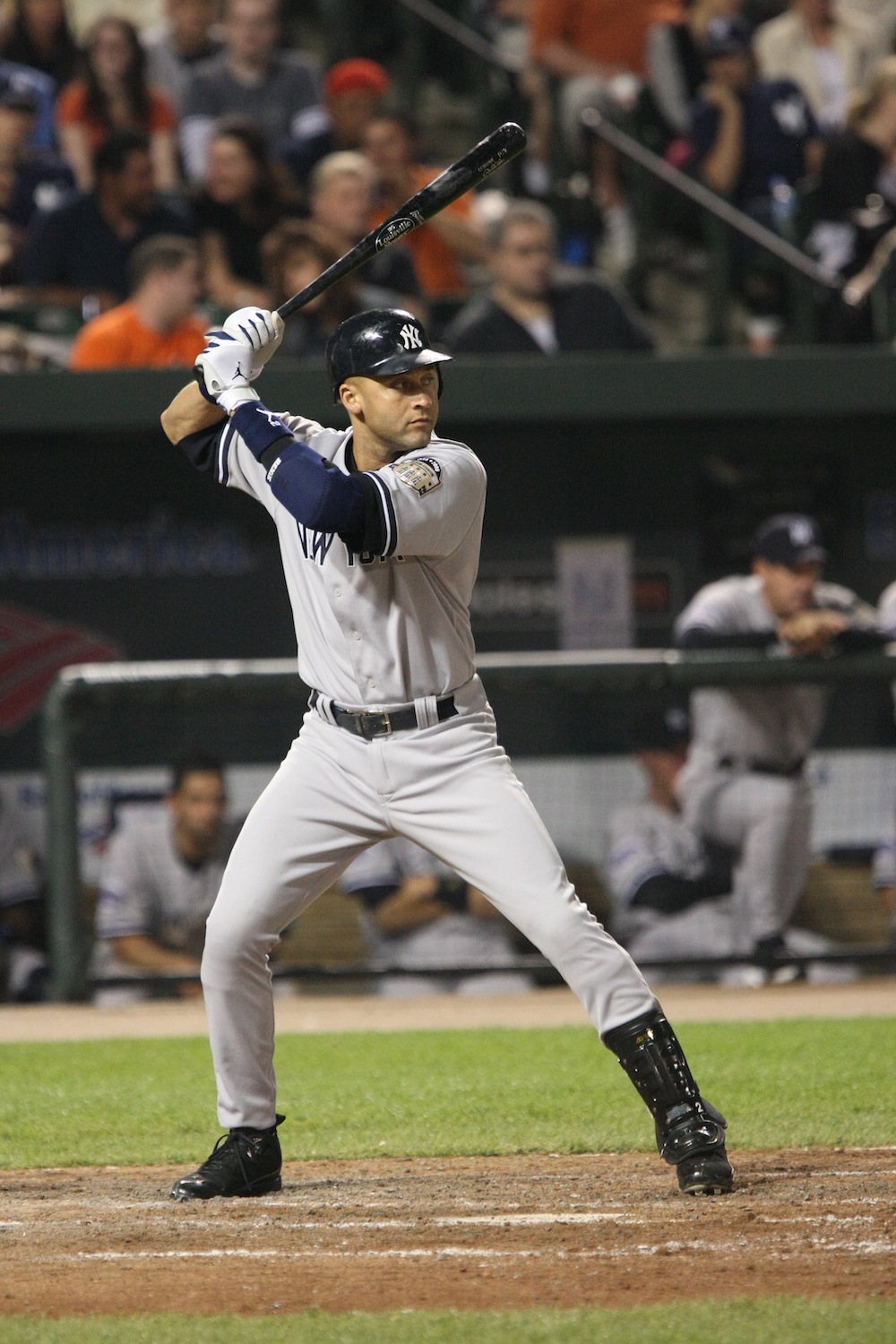
I actually have a very hard time articulating this fact because my personal belief is that it is a waste of time to like or dislike people I have never met. What is the point? I don’t know them. Obviously, I lack information, and any lack of information leads directly to a weak or false conclusion, especially about people. How then do I continue this post without hypocrisy? I am not really sure, but I have this theory: people are constantly and naturally making evaluative decisions every day, about things and people we encounter and so this is, if not completely rational, at least consistent with basic humanity.
Feel free to judge me similarly without knowing me; I assure you, I will be unperturbed for as long as I know nothing about your judgments, and if I do become aware of them I am certain my reaction will be to arch an eyebrow (or possibly run off to a corner in which I will huddle and weep annoyingly while rocking back and forth). Either way, you are free to your own opinions.
Anyway, back to Derek Jeter. Derek Jeter plays the shortstop position for the New York Yankees, and has for his entire professional baseball career which began in 1995. Coincidentally, I really started to be interested in baseball as a sentient being in 1994 (when I was seven) and have, consequently, been watching Derek Jeter play baseball my entire life, especially during the 90s when it seemed like almost every year Derek Jeter and the Yankees were in the world series (96, 98, 99, 00, 01, 03) and Jeter was in the All·Star Game (98-02, 04, 06-10). Furthermore, Derek Jeter is unquestionably one of the greatest shortstops to play the game, purely from an athletic and statistical point of view. Just recently he capped his career to this point by reaching a mark never before attained by a shortstop or a New York Yankee: Jeter hit his 3000th hit.
But my problem with Jeter lies not in his performance on the field, but rather his persona off the field, and his revealed personality in interviews and the public forum, the most recent example of which revolves around the 2011 All·Star Game. Jeter won the popular vote for starting shortstop for the American League All·Stars by a large margin. He then proceeded to decline to play, or even to appear during the opening ceremonies, citing fatigue and a recent injury. He then proceeded to play several games in which he hit several more hits, including a home run for number 3000.
I can fully understand a player declining to play in an exhibition game for reasons of injury or fatigue. But, the players who show up for, and who have the option of playing in, the All·Star Game are voted for by the fans, fellow players, and coaches. Being selected for the All·Star Game means that a great number of people want to see you there, in that context, and cheer your success as a baseball player. Declining to play is understandable (some are even forced to not play due to rules to protect player health) but declining to show is a snub.
Jeter absolutely was recently injured. I understand that. But, he returned from injury to play long enough to reach a personal and professional milestone (3000 hits), and become one of only 28 hitters to reach such a milestone in over 114 years of professional baseball in America. If he could return from injury to hit a few more hits, and in so doing endure the rigor of a few games in order to do so, why could he not merely be present for the opening ceremonies of an exhibition game?
Declining to even be present, stay in a nice hotel for a few days, enjoy some exclusive privileges, put on a uniform and tip your hat to millions of cheering fans when they call your name is just arrogant and an extreme lack of class. Baseball players would be nobodies without a job if it were not for the fans who pay them to play a boy’s game via ticket sales and other revenues. Derek Jeter’s name would not be a household name if it were not for his millions of fans. And he just told them he did not care about them at all.
Lastly, while Jeter may be a future candidate for the Baseball Hall of Fame (based on his stats and records), and he may, in the past, have been an All·Star calibre player, this year he is playing well below form and well below the level of many other shortstops in baseball. This year, despite his 3000th hit, his performance did not merit an All·Star invitation. And when he was invited anyway, Jeter then spurned the invitation.
Derek Jeter displayed his arrogance and his contempt for the very people that employ him and make it possible for him to have the money, prestige, and acclaim that he enjoys. His is the insult of the kid given a present that he did not deserve by a loving caregiver who then turns up his nose at the giver and says “no thank you, I don’t feel like opening it, give it to someone else, I can’t really be bothered” and then goes to play in a corner.
And that is why I don’t like Derek Jeter.
I sincerely hope that if I ever get a chance to meet Jeter, I may come away with a completely different perspective. Knowing someone has the potential to make all the difference in the world in the way that person is understood.
Arizona and the All·Stars of Baseball
Last week Major League Baseball opened voting for the Mid Season Classic of baseball, the All·Star game, hosted this year by the Arizona Diamondbacks. I’ve been thinking a lot about the All·Star game, and two recent articles on mlb.com incited me to actually write my feelings out.
MLB columnist Anthony Castrovince writes that fans should be allowed to cast votes for the pitching staff of each team, while columnist Alden Gonzalez makes a case for keeping balloting as it currently exists. Read both articles, they are good ballpark food for thought.
My first thoughts are about who actually plays in the All·Star game, and how they are chosen. There are 34 roster spots available on each All·Star team, filled with pitchers and position players, usually around 10 of the former and 24 of the latter. Currently, each fan can vote 25 times for a list of 10 players for each team, nine position players and one designated hitter. This reflects the most recent change in the All·Star game which allows for a DH regardless of the league affiliation of the hosting team. The second most recent change to the All·Star game is that the winner of the game secures home field advantage for the World Series, either the National or the American League.
After fan voting is complete, the players/managers/coaches themselves vote for the pitching staff and second string position players. Lastly, the manager of each All·Star team selects about six players or enough to reach a final tally of 33. The 34th member of the All·Star team is a final fan ballot which selects from 5 players from each league selected by the All·Star team manager. Last minute substitutions due to injury, or in the case of pitchers, recent starts, is decided by the Commissioner’s office and the All·Star managers. Obviously this is a lengthy and complicated process.
Personally, I think that each fan should have the ability to vote once for 17 players. This would include 3 starting pitchers, 3 relief pitchers, 1 closing pitcher, 3 outfielders, 4 infielders, 1 catcher, 1 designated hitter, and 1 other player from a position of their choice. The remaining 16 players could then be voted for by the players, coaches, and managers, and the 34th player could be a final fan vote. Allowing fans multiple votes only exacerbates the annual problem of ballot stuffing, in which large market teams such as New York and Philadelphia can overwhelm the balloting, creating an extreme margin of votes. In every voting political system (that I know of) that is comprised of general elections, each voter can only vote once. I don’t see why this isn’t applicable to baseball. Fan involvement in the All·Star selection process is important, but right now I think the fans have a little too much power, and not enough available selections.
Beyond player selection, I have other concerns with the current format of the All·Star game: I remain ambivalent about the outcome of the All·Star game deciding home field advantage for the World Series. While it is nice to actually have the All·Star game mean something, at the same time, I don’t think the All·Star game is supposed to mean anything. As far as I know, the Pro Bowl (football’s All·Star game) is widely ignored by the football fan community. I watched the game last year, and the stadium in Hawaii was only half full. This is partly because the game is the week before the Super Bowl, and so none of the players from the teams in the Super Bowl participate, and partly because the game means nothing. Also, football players are so afraid of getting hurt that many refuse to play, and while this is an understandable reason to decline, fans want to see their favorite players play. I can’t say much about other sports’ All·Star games, but my general impression is that the fan reception is not much better.
However, baseball usually enjoys a large and positive fan reception to their All·Star game, mostly because 90% of the voted upon players actually play (unless they are injured, or as a pitcher, have recently pitched). I have never seen an All·Star stadium not full to capacity (and sometimes beyond). Also, the All·Star game is played in the middle of the season and in the middle of the summer. It isn’t buried in the dead of winter, after all is said and done. This breeds fan interest. It is played in the heyday of winning streaks, hitting streaks, and when most of the players and teams have hit whatever groove they are going to hit. Conversely, if a team or certain players aren’t playing well, it is also a time to step back, breath deep, and put the past few months behind them and remember when baseball was fun.
Ultimately, the All·Star game is a showcase of all the great players, both favorite and deserving (based on performance). It is every player a baseball fan wants to see in one place at one time (with some exceptions due to unequal balloting and the like). The bottom line is that there are many built in reasons to see the All·Star game without the home field advantage for the World Series being decided by the outcome. Home field advantage should be decided purely by the win-loss records of the teams involved, exactly like it is for each round of the playoffs prior to the World Series.
Moving on to another aspect of the game, I think what makes a baseball game boring for most people is the endless dance of pitching and hitting in which the pitcher takes forever to select a pitch, and the batter does everything to work the count for the best pitch to hit. The pitcher steps off the rubber, stares in at the catcher, steps off again, and then finally is ready to pitch. The batter steps out of the batter’s box, adjusts his helmet, his gloves, steps in, wiggles his bat, steps out, ad nauseam. This is actually what pitchers and batters are supposed to do to win games.
But those that watch the All·Star game want to see action and movement. Making the game count means that the players will revert to their tactics for winning baseball games. Making the the game an exhibition frees the players up to play the game for fun: by throw flaming fastballs and sweeping curve balls, by swinging at the first pitch and swinging for the fences, by making outrageous leaps and dives in the field. It would make the game dynamic, quick, and full of towering fly balls, screaming liners, and all the things that make baseball enjoyable to the wider audience of folks who like a day at the ballpark, and not just to those who wallow in the minutiae of the game, laboring over a scorecard and each pitch.
Generally speaking, getting people to watch and enjoy any sport is wrapped up in getting people to enjoy the game and helping them feel like they are a part of the game. Football does this well by televising the game with all sorts of cameras that put the viewer into the action, by commentators that know the game well and can make each play selection understandable to the viewer, and by a game that is predicated on multiple instances of quick action in which something is accomplished on each play. Baseball does this better at the ballpark than on TV, but it can be helped by altering the way the game is played, and the All·Star game is the perfect opportunity to shift the focus from winning to playing, and thus upping the energy while making it less vital to go all out for the sake of a win, while at the same time letting fans have a say in who makes the team so that they are excited to see their ballot choices take the field.
I think that if the player selection process was streamlined and expanded for the fans, while at the same time making the All·Star game more of an exhibition than a must-win game, it will remain fair for the leagues, and exciting for the spectators.
Either way, my votes are in for 2011, and I can’t wait for the Midsummer Classic from Arizona!
the Comebacker
the batter snapped his bat
and up the middle cracked
a hit. the ball screamed
towards the pitcher,
who, still reeling from his writhing,
spun, and weaved, and ducked
and in the end, kissed the dust.
the second baseman stabbed
out with leathered glove
and snagged the wayward missile
and casually tossed the ball
to the first baseman for the final out.
the pitcher crawled up the mound
and stood still dazed.
on one half of his face his beard grew still
but the other gleamed, shaved clean,
clean save for a mark, angry and red,
red like the smacked back end
of a baseball’s stitching.
(inspired by a play during the Cleveland Indians at Anaheim Angels game on 11 April 2011, with Mitch Talbot pitching and Mark Trumbo at the bat in the bottom of the 4th inning. Trumbo was out 1-4-3 on the play.)
Roadtrip
I have come a long way to be in Cleveland for the game tonight: 488 miles from Verona, Wisconsin, through Chicago, Illinois, past South Bend, Indiana, and finally to Strongsville, Ohio, the suburb where my grandmother lives in her condo on a quiet street. In about half an hour I will drive to downtown Cleveland, and hopefully get to watch batting practice.
I left Verona around 8 am, and about two hours later I was driving in heavy traffic through Chicago. My brother has a route that will take him around Chicago, thereby saving time, but I didn’t follow those directions, and am glad I didn’t, because I got to see US Cellular Field, the home of the White Sox. It rose high above the highway, steel girders and concrete frame gleaming in the morning sun. I resisted the urge to take the exit and stop and marvel at the stadium’s wonder.
But the ballpark stood empty, as the White Sox were already in Cleveland, preparing for last night’s game, so I passed it by. I always feel there is something sad about an empty ballpark, a structure built for the sole purpose of housing its fans.
All in all, the trip was smooth and uneventful. I cruised into Strongsville around five o’clock.
During the trip, I thought about how much travel a baseball team endures during the course of the season. I hope they get frequent flyer miles, for when they retire, they could fly almost anywhere for free on what they must accumulate. In the old days, a team would drive by bus, back when there were few teams, and they were close, and I am sure they still do to play their geographic rivals, but now in 2010 with teams spread from Seattle to Oakland to Arlington to Tampa Bay to Kansas City to Boston teams fly to many of their destinations.
So as I traveled, I thought of the Life of a baseball player that centers around two things: the game, and the road. That long eternal road, and a new game each evening (or afternoon). There must be comfort in all the old familiar places on the road, and in the renewal that comes from a brand new start after each nine inning battle.
Or maybe I am just an old romantic in a new era of baseball.
The Pre-Game Show
I am about to embark on an historic journey….what am I thinking? I almost forgot to bring extra plutonium!
Actually, I won’t need plutonium where I am going, which isn’t Hill Valley, 1955, but rather Cleveland, Ohio. Earlier this year I applied on Indians.com to receive an invitation to the Tribe Social Deck of Progressive Field, the home of the Cleveland Indians baseball team. I never figured that I would actually be the recipient of such an invitation, and had actually mostly forgotten about it when, a few weeks ago, I received an email asking if I would like to attend the August 31st game and watch the Indians host division rivals the Chicago White Sox. With no hesitation, after asking my wife’s permission, I said yes.
As anyone who knows me can tell you, I am a die- hard Indians fan and a life-long lover of baseball. I watch every game that I can, and shout at the TV when the Indians play like Little Leaguers, and leap for joy when they manage to do the impossible. I watched 13 years ago when they almost won the World Series against the Florida Marlins, and I watched 15 years ago when they lost the World Series to the Atlanta Braves. My heart has been broken many times, but I cannot help but cheer for them.
Despite my love of the game, and my passion to watch the Indians, I have only attended one game at their ballpark, at the time, Jacob’s Field. It was the inaugural season for the new stadium, the 1994 season which will always be remembered as the year there was no World Series because of a player’s strike. I don’t remember much about the experience: I was only 7 at the time, but I do remember going with my mother, my uncle (who lives near Cleveland and who we were visiting at the time) and a brother of mine (though I am unsure which). I remember drinking a Coke out of a large cup, and knowing that below me in right field was the legend Kirby Puckett. Because of that detail I know the Indians were hosting the Minnesota Twins. It must have been early July, and it was a day game. I think.
Now I am 23, and can’t wait to hit the road to once again see the Indians play in their coliseum. Two of the players that were on that field 16 years ago, somewhat amazingly, will be again. Sandy Alomar, Jr was the Indians catcher that day, and Omar Vizquel was their shortstop. On Tuesday, the day I will be in the park, Alomar will be standing behind first base, coaching for the Indians, and Vizquel might be at third base for the White Sox (he only plays occasionally). This time I will be in left field, and have a much better grasp on what is happening. There is an electric feeling in my heart, an excitement that builds.
I know that right now the Indians hold the dubious honor of being the 3rd worst team in the American League, and that they will likely to lose, if they don’t win. I know that the stands around me will probably be mostly empty in a city that is weary of losing seasons and injuries to star players, but for me, I will be channeling the spirit of Ray Kinsella, who built a left field in a corn field, and watched Shoeless Joe when no one else cared, or thought him a fool. The breath of the game will catch me up, and I will be lost in baseball reverie. (It seems like fate, too, that Shoeless played for both the Indians and the White Sox, and was the ghost in the cornfield and that the White Sox will be in town.)
Or, somewhat less melodramatically, I will enjoy a night out at the ole ballpark, watching a team and a game that I love.
On the Field: Interleague Play
Tonight is the first night for interleague play in baseball in the 2010 season. The Cincinnati Reds have made the drive north to Cleveland to take on the Indians. As it stands tonight, the Reds lead the National League Central Division, and the Indians bring up the rear of the American League Central Division, but in their interleague matchup the Reds and Indians are almost dead even for wins and losses, so it should be an interesting game. At the time of writing, it is the top of the fourth, and the game is tied 1-1, so it remains either team’s game to win.
Ever since 1997, when Interleague play was adopted into Major League Baseball, the Reds and Indians have been meeting as state rivals, and similar matchups take place all across the nation. The New York Mets are playing the New York Yankees, and the Philadelphia Phillies are hosting the Boston Red Sox. Later in the year the Chicago Cubs will host their cross city rivals White Sox.
All in all, I like interleague play. Before 1997, anytime a team, or even a player, from either league saw one from the opposing league it was during Spring Training, the All·Star Game, or the World Series. The separation between the American and the National Leagues was a mile wide and a wall of iron. The only real difference between the leagues, as far as rules go, is in the American League with the implementation of the designated hitter, a player that bats in place of the pitcher, but who doesn’t play defensively. Despite this minor difference, the leagues seem to have an intangible difference: the National League is said to be more offensive, the American League is more of a pitcher’s league.
I like interleague play because I like seeing teams from opposing leagues play each other. Because the separation existed for over 100 years, the novelty is still fresh. Secondly, I have been an Indians fan my entire life, which means I have become a bit of an American League fan, but I have never really liked the designated hitter rule. My personal philosophy is that if you play defense you play offense. Pitchers should not be exempted because of their “special” status as a specialized position player. National League pitchers have been hitting since the dawn of baseball and still manage to pitch extremely well. Let’s not forget that Babe Ruth, the most legendary hitter in all of baseball, was a pitcher for the Boston Red Sox and the New York Yankees. Sure, pitchers today are way more targeted than in Ruth’s time, but I think the logic holds.
Lastly, I like the idea of interleague play because it brings teams to town that otherwise a fan would not often see. Cleveland and Cincinnati are close enough that one could make the occasional drive to the other city, or in Chicago or New York one can simply take a subway or cab to the other stadium, but I doubt many people make the 5 and 1/2 hour drive between Boston and Philadelphia to be a fan of both the Red Sox and the Phillies. Now, at least three times during the season, a fan can see opposing league teams ride right into town and play the home team. In the era of internet and TV televised games, going out to the ballpark is still time well spent, and if you can see a team you would never before see, that is a bonus for fans.
As of 2010, every team in each league has played every other team at least once, and I hope that Interleague play continues into the future. I for one look forward to seeing which National League teams will come into Cleveland, and which cities the Indians will visit that they normally don’t see. This year, I am eager to see the Philadelphia Phillies cruise into Cleveland, because having spent several years in central Pennsylvania I have become a Phillies fan. Because my teams sit in opposing leagues, the opportunity that I would have to pick one over the other to cheer for is a limited prospect. In a few weeks, I will be forced to make that decision, but it is easy: I cheer for the Indians. Always first, foremost, and forever. However, my rational assessment of each team leads me to believe that the Phillies will beat the living daylights out of the Tribe, as currently the Phillies are the best team in the National League, and the Indians are close to the worst team in the American League. But, there is still plenty of baseball to play, and anything can happen.
Speaking of which, while I was writing this post, the Reds jumped ahead of the Indians 4-1, but in the last Indians’ at bat, Shin-Soo Choo of the Tribe went deep, hitting a two run home run helping his team tie the game 4-4. The top of the sixth is under way, and still either team could wind up with the win.
This is why baseball is the best sport in the world.
 a simple man