
Reflections in Film: TRON: Legacy

A few weeks ago I posted about my desire to see and review films. I then saw and reviewed Chronicles of Narnia: Voyage of the Dawn Treader.

I then present the second review in the series.

TRON: Legacy
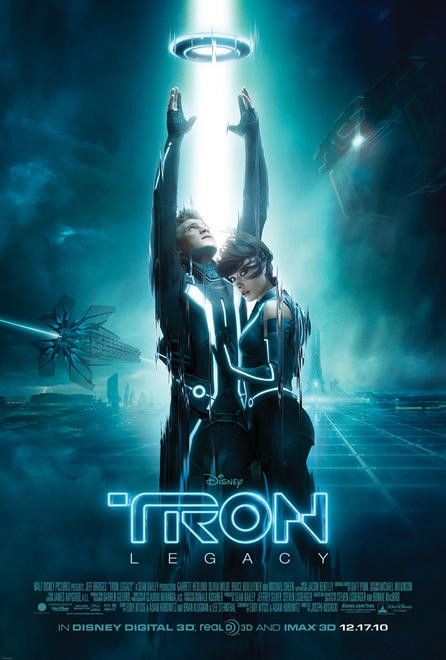
TRON: Legacy
TRON: Legacy

History: The original TRON came out in 1982, starring Jeff Bridges as Kevin Flynn, a hacker who used to work for a software company called ENCOM which had stolen Flynn’s designs for several computer games and marketed them as their own, making millions and making Flynn a flunky who depended on the profits from an arcade, in which teenagers played his stolen games, for income. In the effort to hack ENCOM’s computers and find proof that he in fact did create the games, Flynn was transported into the world of the computer and into a desperate fight for life against the Master Control Program which was seeking domination over both the world of the computer and the real world.

The story idea was compelling, the acting was pretty good, and the graphics were cutting edge (for their time). However, the world of computer graphics soon exploded and TRON was left looking painfully bad.

The film achieved geek cult status, and I first really heard of it, and became interested in it, after the title character of the television show Chuck had a TRON poster in his bedroom. I eventually rented the dvd from the library and loved the film after the first viewing. TRON had quite a bit of what I call the “2001: A Space Odyssey” effect (or, alternatively, the “Star Trek: The Motion Picture” effect): endless sequences of a ship flying through space accompanied by music, but the story is what captivated me. It was the Matrix without all the mysticism, enslaved humans, rock and roll kung-fu, (and Keanu Reeves) before the Matrix. It was a world of imagination and wonder; a world of beings who lived and died under the command of lines of code, beings who nourished themselves on luminescent electric energy, beings who died in gladiatorial combat on light cycles. It was nerdy, thoughtful, and very cool.

Hype: I was incredibly excited to see TRON: Legacy. In fact, I think the only movie in recent memory that I have been as excited to see was Star Wars: The Phantom Menace. I was keenly interested the story material, and I knew that computer graphics had finally come of age. All that the film’s writers, director, and producers could envision, they could finally create in full, vivid detail. The original TRON was all grey and light, and kind of incomplete, actually, but the new TRON could be black and light and cutting edge. The light cycles could really roar and the world of the computer could finally suck the audience in. I was expecting an immersive world and mind-blowing action sequences.

The Good: Everything that I wanted, TRON: Legacy delivered and so much more, which was actually less, ironically. The world of the Grid was beautiful, endless, and compelling. The graphics were top notch and stunning. The gladiatorial games (light cycles, disc wars) were violent, awesome, and soon over. There was less action than I anticipated, but that turned out, after contemplation, to be a very good thing. Legacy achieved true brilliance: it didn’t overdo anything that TRON had already done. It had exactly what it needed to tell the story, while advancing the world, the characters, and the philosophy. In was, in every meaning, TRON 2.0. It was TRON updated graphically and advanced in substance. It was satisfying, thought provoking, entertaining, and so very cool.

The Bad: History. TRON: Legacy advanced the story of TRON, but the history of what had happened in the intervening 28 years wasn’t really explained. There was some exposition, and some hints, but the backstory of what had really taken place wasn’t really fleshed out, either inside or outside of the computer. I was left wanting a bit more story, but not in the good way. None of this effected my understanding of the immediate plot, or my enjoyment of the film, but my curiosity wasn’t quite sated.

Along with history of the world of the computer, I would have liked to see a little more interplay between Kevin Flynn and the antagonist Clu 2.0, his digital creation. This was such a complex and multi-textured relationship that I would have loved to see it explored and teased out a bit. I would have liked to live in the mind of Kevin, and see a bit more of how he felt about Clu 2.0.

Also, what had Tron (Flynn’s digital sidekick from the first film) become? I want to know.

The Personal: I have never had a film so completely fulfill what I wanted to see. I connected to the emotional interplay between Sam Flynn and his estranged father Kevin Flynn; and I resonated with the dynamic of the relationship-gone-wrong between Kevin Flynn and his computerized creation Clu 2.0 which was part father/son, part lover, part brother, part God/creation. I saw reflections of my own relationships in each of these aspects, and was able to really emotionally invest in the characters, while exploring my own emotions through the characters. This could be part of a much longer exploration of my life in light of TRON, but sometimes I really feel like Sam who felt abandoned by his father, and sometimes like Clu 2.0, who felt less and less the need for his creator. I also felt like Kevin, who saw the magic of his wildest dreams come true, and then turn horribly wrong and spin out of control.

For me, this is the most important part of cinema: the ability to create a world in which the audience recognizes reality while being able to enjoy the alternative parts of it.

Final Score: 4.1 out of 5 End of Lines.

Bonus: Favorite line: “I am going to knock on the sky and listen to the sound.” – Kevin Flynn. (This is right up there with “Tastes like coconut!” – Tony Stark from Iron Man 2.)
Reflections in Film: Voyage of the Dawn Treader

I posted yesterday about my desire to see quite a few movies in theaters throughout 2011 and then to write a visceral, day-after review to compare hype to happiness. I am beginning this blog series, which I have decided to call Reflections in Film, with two movies here at the end of 2010 which I have been very excited to see. First, Chronicles of Narnia: Voyage of the Dawn Treader, and second, TRON: Legacy.

Reflections in Film will be part movie review and part self discovery. I will write about the film itself: what I think it did well, what I think it did badly, and perhaps comment on different portions as necessary. I will also write on why I liked it, and what I took away from the experience. I admit that I am unsure of how, or if, this will work, but I am eager to try.

I will endeavor, as I can, to write the post the day after the viewing, in order to give the film a chance to percolate in my mind, but still be fresh and rememberable. However, with Dawn Treader, I am a few days late, but I do not think it will matter too much.

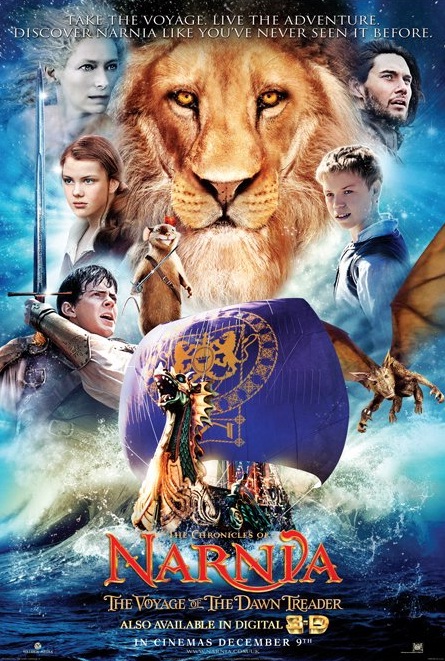
Voyage of the Dawn Treader

The Chronicles of Narnia: The Voyage of the Dawn Treader

History: I saw Dawn Treader on Saturday, December 11th. It is the third film in the Chronicles of Narnia saga, based on the books by CS Lewis. The first was the Lion, the Witch, and the Wardrobe in which four children from World War II era England discover a magical world called Narnia, accessed through a magical wardrobe. They discover that they are prophesied heroes, called from their world to defeat an evil White Witch and free Narnia from her spells of winter without end or Christmas. They are aided by the powerful lord of Narnia, a lion named Aslan. The second film was Prince Caspain, set a year after the first film. The four children are once again called to Narnia, this time via a subway station, and discover that several hundred years have passed in Narnia, and all whom they knew are dead. A race of humans from outlying islands have invaded Narnia and have pushed all the magical creatures and beings deep into hiding. An evil lord seeks to depose the rightful heir to the throne, Prince Caspian, and the children come to his aid in a battle to assure his kingdom while restoring freedom for all in Narnia. At the conclusion of the battle, the two eldest children are told by Aslan that they will never return to Narnia. The third film is the Voyage of the Dawn Treader, in which the two youngest children, some time after the second film, enter Narnia, along with their disbelieving cousin, through an enchanted painting. They arrive in the middle of the ocean and are rescued by King Caspian, who has launched an expedition to find seven lords who vanished some time ago. The children, the King, and the crew embark on a journey at sea through many perils and adventures, all the way to the end of the world where lies Aslan’s country. At the conclusion of this quest, the two original children are told they will never return to Narnia, but that their cousin may yet.

Hype: Having been a fan of the book series, and liking the first two films well enough, I was Moderately excited to see Dawn Treader. The first film followed the first book very faithfully and suffered a bit for it, being slightly stiff. The second film took a few more liberties with the intricacies of the book and became an living adaptation, holding true to the heart of the story while adjusting the story itself to become a decent movie. I prefer Prince Caspian to Lion, Witch, Wardrobe mostly because it was funnier, darker, and explored the characters in some depth.

I was hoping for more of the same from Dawn Treader, because several aspects of the story deal more heavily with internal conflict than with battles (though there are some); and the first two Narnia films delivered a magical, wonderful world, and I longed for a return to that world with all the texture therein.

The Good: I think that Voyage of the Dawn Treader stayed true to the book, in terms of story, plot, and characterization. I could feel the magic of being once again in Narnia. The character of the cousin, a boy named Eustace – who believes firmly in science, and logic, but who is also a simpering, preening brat – was perfectly cast. Will Poulter had only starred in one other feature film, but his performance as Eustace was spot on. He was every inch the character that one loves to hate. The other two main characters, Lucy and Edmund Pevensie, were again portrayed by Georgia Henley and Skandar Keynes as they had been in the first two Narnia movies. I love seeing the maturity that an actor brings to a role as the actor grows physically between films in a series, especially when the character is also supposed to age and mature, and the actors chosen for the first Narnia film are still the best choice for the third. They embody CS Lewis’s characters quite well.

Aside from the cast, the film was beautiful, full of vivid detail, and immersive. I didn’t think the digital effects were overdone at all (a flaw more and more common in this current golden age of computer driven cinematography) which I greatly appreciated.

The Bad: Time. I felt rushed through the story, and I didn’t like it. The journey takes the children and King Caspian to several different islands and locations and on each one new information is learned about the lost lords, or a new challenge is faced, and it just felt like the film rushed each of these destinations. I would have preferred a bit more exploration at each turn. Both the first and second Narnia films took time to set the scene and evoke the mood, and gave the audience place to observe the main characters’ emotions and struggles at each new situation. In my memory of Dawn Treader such observations were a blur they happened so quickly.

The character of Eustace, on one particular island, turns into a dragon, an all too real metaphor for the way he acts and treats people. Throughout the book he struggles with the fact that he may never return to human form, and the horror of his own being, and eventually is forced to go to a dark internal place in the struggle for humility and repentance. In the movie this happens, but like most things, it is too quick. There is a sense of Eustace’s emotional state, but goes from human to dragon to human much too rapidly, and the audience doesn’t have time to be acquainted with his situation. This would have been a conflict well worth the exploration.

To compare to an earlier film, in Prince Caspian, the character of the eldest Pevensie child, Peter, struggles with his own growth as a person. At the end of Lion, Witch, Wardrobe Peter was made High King of all of Narnia, and he and his siblings lived there many years as adult regents before returning to England, once again to be children. At the beginning of Prince Caspian, Peter is shown having a very hard time adjusting from King to nobody, from adult to child, and even throughout his return to Narnia, Peter’s pride and lust for power take him to dark places where his decisions impact the lives of many. He struggles with the new rightful King Caspian and eventually finds his place in both worlds. Prince Caspian gave Peter’s character time to evolve, whereas Dawn Treader rushed through the evolution of Eustace, both literal and metaphorical.

However, the rapid pace of the film wasn’t enough to ruin my enjoyment of the film, nor was it enough to obscure the characters’ growth. It merely hovered on the edges, perceptible but not necessarily distracting.

The Personal: As I mentioned earlier, I love the Chronicles of Narnia in book form, and have a fondness for their movie counterparts. I like a film that presents realistic characters, and shows those characters growing in some fashion throughout the film. Sure, I love a good fight sequence, explosion, or action piece, but what really makes a movie for me is the ability to connect with the characters. Theater, film, books, and campfire stories only work because the audience sees themselves in the people of the story. Maybe they recognize an exact reflection. Maybe they see the opposite, their perfect self, or maybe they recognize their own flaws, but they witness something of themselves in the characters. The ability to form solid connections, emotionally, intellectually, and spiritually depends upon the actor’s portrayal, the director’s influence, and the cinematography’s framing of the character. In Dawn Treader, the first and third were there in spades, while the second was weak. I knew what was coming for each character and wanted to feel that connection, but the timing issue disrupted that enough to through off my emotional bonding. I enjoyed the film, but didn’t get to project myself into Eustace, or Edmund, or Lucy and see my struggles, triumphs, or goals in their own, and for me something was lost.

Final Score: 3 out of 5 Dawn Treaders (barely matched hype level)

In the Year of Awesome

As 2010 winds down, I look across the horizon into the new year of 2011, and as I do so, my heart beats all to a flutter, and I will tell you why: I am ridiculously excited about more than one film that will be released next year.

This year had a few good movies, among them Iron Man 2, Inception, and Toy Story 3, but next year is set to be an astounding year. It is full of sequels, threequels (in one instance a 5th), a few new comic book movies, and at least one completely original story. I have a list of 10 films that I absolutely do not want to miss seeing in theaters, and quite a few alternates that I would love to go see, but cannot quite justify the expense to do so (please feel free to provide funding).

I am telling you this because I am quite well acquainted with the phenomenon of a film not living up to its hype, and leaving in its cinematic wake a trail of tears, disappointment, broken hearts, and emptier wallets. I am interested in documenting said phenomenon with a full review after each movie, a scoring of some sort, and a determination of the final experience of each film.

I can honestly say that I have not been as excited for an entire year of movies before in my life.

Behold: the Listing!

Fast 5 (April 29) the fifth in the Fast and Furious franchise, starring Vin Diesel and Paul Walker

Thor (May 6) the story of the Norse god Thor (Marvel comics version), starring Chris Hemsworth

Pirates of the Caribbean: On Stranger Tides (May 20) the fourth in the Pirates franchise, starring Johnny Depp

X-Men: First Class (June 3) a new prequel to the X-Men trilogy, starring James McAvoy and Kevin Bacon

Cars 2 (June 24) the only sequel Pixar has made outside of Toy Story, starring Owen Wilson and Michael Caine

Transformers: Dark of the Moon (July 1) the third Transformers film, starring Shia LeBouf

Captain America: The First Avenger (July 22) the story of Marvel’s biggest hero, starring Chris Evans and Hugo Weaving

Cowboys & Aliens (July 29) a new story about the old west and aliens, starring Daniel Craig and Harrison Ford

Mission Impossible: Ghost Protocol (December 16) the fourth M:I film, starring Tom Cruise and Ving Rhames

Sherlock Holmes 2 (December 16) the sequel to last year’s film about the legendary detective, starring Robert Downy Jr

Honorable mentions include Green Hornet, The Adjustment Bureau, Rango, Green Lantern, Rise of the Apes, Three Musketeers, The Adventures of TinTin: Secret of the Unicorn. I might actually go to one or some of these, but I am not sure yet.

I will begin this blog series with the final two films of 2010 that I highly anticipated: The Chronicles of Narnia: the Voyage of the Dawn Treader; and TRON: Legacy.

Yes, there is more to life than movies, but I have been an avid film fan all my life and I love writing. In recent years have become more intentional about why I like certain movies and why I dislike others, and therefore want to explore myself and my love of film more intentionally through this blog. Writing is my avenue towards self-discovery.