One

What can one man do? Can one person change the world?

As I woke this morning in the wake of the 57th presidential election in the United States of America, I saw two broad reactions: fear and joy. Many among my family and friends are genuinely afraid of what our president will do to our country. At the same time, many of my friends (fewer of my family) are genuinely excited for what our president will do for our country.

I’ve not been alive that long, and in my life I’ve only paid close attention to the most recent election cycles. In all, I don’t think I’ve seen such extremes of emotions as I have following this election. Maybe it is because, really for the first time, this election has been most broadly covered not just by the news media, but my the vastly larger social media. Twitter, Facebook, Instagram, Tumblr, and every other social media web site that I can think of has exploded with photos, quips, blurbs, posts, and opinions of every kind. (Indeed, I am now blogging about the experience). I’ve read the thoughts of those around the country, and around the world, as people have discussed the next president of the United States.

Certainly never before have I been personally aware of the global implications of one election.

In my lifetime the world has become an increasingly tiny place. Globalization and world wide connections went from largely non-existent to commonplace. When I was a kid, I could talk on the telephone mounted on the wall to my grandmother in Ohio. Today, I can type on the telephone that fits into my pocket with room to spare to anyone in the world, or even the few people who orbit the world from the International Space Station. I receive live updates from a robot that is rolling along the surface of Mars. For a kid who loaded up the very first LEGO and Star Wars websites on a very slow modem, that is nothing short of incredible.

It is no wonder, then, that so many are invested in the politics of one nation.

Beyond the interest, beyond the investment, beyond the curiosity, I see real, raw emotions. People are crying, hurting, grieving, cheering, shouting, laughing. Some believe that real progress has come, others feel that the apocalypse is nigh. How can that be? How can the election of one man, and the non-election of another (whom many people had never heard of a year ago) cause such emotion?

I think because now, more than ever, one small voice can change the world. One person can impact everyone. Recently several dictatorships have crumbled, several countries saw revolutions of freedom, and in at least one of those revolutions, social media facilitated that revolution. Instead of one Paul Revere there were hundreds, and instead of one route and one man shouting, there were hundreds of avenues of communication and hundreds of voices shouting.

But each of those voices is one of many, and unless you are looking for them, tuned in to them, you might not ever hear them. Now, more than ever, the person who controls the loudest, widest megaphone is still heard over all the rest. More people hear the President of the United States than any single voice on Twitter.

Can Barack Obama’s voice carry that much power? Can he, speaking from the Oval Office, change the world? Can one man destroy or exalt a nation?

Only if many other voices join his. One man, one woman, one person, is powerless by themselves. This has been, and always will be, the case.

George Washington could not and did not forge a new nation single handedly. Abraham Lincoln could not and did not keep American one nation by himself. Even Jesus Christ, whom many consider to be the greatest man who ever lived (or lives still), would have been just one of many messiahs who walked Palestine had it not been for the voices of his followers who spread the good news of the man from Galilee to every corner of the globe, who wrote about him while in prison, exile, or under the threat of death. Maybe Jesus was God, that is for each person to decide, but my point is that by choosing to avail himself of the help of humanity, Jesus was every bit as dependent on the joining together of many voices for his message to be heard. How else could billions be swayed by his message of love and faith when, at most, mere hundreds personally witnessed his life and death, and alleged resurrection.

How do we expect that one man, Barack Obama, can destroy or exalt America by himself? Would Mitt Romney have rescued American and put it back on the right path?

The president is one person in one White House. The supreme court justices are nine people. There are 100 men and women in the Senate. The House of Representatives contains 435 voting members. This country has well over 300 million citizens. Obama presides by the consent of the governed. The supreme court judges by the consent of the governed. The senate legislates by the consent of the governed. Representatives represent by the consent of the governed. Five hundred and forty-five people govern a United States of three hundred million people. Every single one of the four hundred and thirty-five are replaceable by any one of the 300 million (eventually).

We are a nation of the people, by the people, for the people.

One man is powerless against the good or evil 300 million people can do. The reality is that no policy of the White House, no law of Capitol Hill, not decision of the Supreme Court can truly govern the heart of one person. George Washington was bound by, and subject to, the laws of the King of England. Laws he ignored to lead a revolution. Jesus was bound by, and subject to, the laws of Moses and the laws of Caesar, many of which he ignored to lead a different sort of revolution.

Fear not, rejoice not, the responsibility to do good and to shape your country is now, and will always be, yours alone every single day. The good book says “To him who knows to do good, and does it not, to him it is wrong” and I do not disagree. Each and every day the will, the desire, and the power to change your life, your family, your nation, and your world is in your hands. Four hundred and thirty-five people in Washington, D.C. cannot ever take that from you, not even the 435th man who lives on Pennsylvania Avenue for another four years.

A great man once said “be the change you want to see” and another great man once said “do unto others as you would have them do unto you”. Those two non-elected men changed the world despite their governments. Obama can do nothing unless a great many people share his voice. He would be one man shouting into a world of billions. Raise your voice, and do all that you can do for those who live and breathe right next to you. That is how America is made great, that is how the world is changed, and it has nothing to do with who is president of the United States of America.

You can live in fear of what Obama may do. You can live in joy of what Obama can do. But neither is as powerful as living in the knowledge of what you can do.

So only one question remains: what will you do?

What will I do?

Underdogs

Baseball is the best sport in the United States.

Hands down, no debate, unquestioned: baseball reigns supreme. The game has been played for over 150 years, from coast to coast and it has incorporated players from around the world, and all strata of society. But longevity is only part of what has made baseball great. Baseball stands above because it is, at it’s heart, American. It is the American Dream, the American Way, and the American Spirit all wrapped into one and played out on a close cropped diamond of green, framed by deep, dark brown dirt, guided by sparkling white lines, and guarded by the citizens of this great country.

More than that, every single game on a baseball field is a microcosmic re-enactment of America’s history. A brave, few men stand against a determined foe, defending home territory, or valiantly striding between enemy foul lines. Nine strong soldiers bear arms, bats, and gloves with battle plan and knowledge of their opponent, and an intimate understanding of the coming battle and all its stratagems. They fight for their pride, their right to stand tall, their destiny to achieve the greatest victory available.

Anyone can join this struggle, this game. Farmboys, bean counters, lumberjacks, and geniuses: all have stood beneath the sun and stars to have their moment at the plate, their place upon the everlasting meadow of the ballpark. The poor, the rich, the educated, the street-smart, and the wiseass. Baseball is not a game of privilege, and it does not respect superstars. Anyone can rise above to be enshrined forever in the eternal halls of the famous. Anyone can turn the tide, stand in the gap, or do the impossible in so doing be made mighty.

The game has been played, largely unchanged, since its inception. Twenty-seven outs, eighteen players, three strikes, one blinding white ball wrapped in stitching colored with the blood of those who every day leave it all on the field. And it is all up for grabs, every single time. Every single time an umpire, beneath blue shirt and steel mask, shouts “Play ball!” every single player knows that today could be their day, this game could be their game, it is for them to win or lose.

In baseball: anything can happen. Fortunetellers lose fortunes trying to foretell outcomes. Players defy the oddsmakers like titans defying the gods.

How else do you explain an outfielder named Kirk Gibson, who stood impossibly tall one day in 1988, doubled over from the pain of a stomach virus, hobbling on a pulled left hamstring and a swollen right knee called into action to do what could not be done against one of the most dominate opponents of his era, pitcher Dennis Eckersley. It seemed Gibson’s manager had lost his mind. This was the first game of the World Series, baseball’s ultimate showcase, the stage most ready for the performance of the year from two teams who had proven time and again that they deserved to be there. Winning the first game is beyond big, beyond huge, with it comes momentum and energy. Baseball playoffs are a zero sum game. The postseason is played against time, against dwindling effort and opportunity. Each swing, each inning, each out is lost forever. There are no second chances, and surface mistakes can become fatal wounds. So why would Tommy Lasorda call upon ailing Kirk Gibson, of all people, to stand in the batter’s box and contend at his worst against the best?

Lasorda knew then what he knows now: baseball is a game of heart and soul. In pain, and growing weaker, Gibson took the toughest assignment ever given a ballplayer and quickly looked to be done. Two strikes down, and every movement a torture of battered and broken body Gibson’s heart was strong. He knocked aside two more pitches to stay alive, evading the strikeout with what he could muster. And then: with teammate streaking towards second with theft in his heart, Gibson bent his good knee, and with nothing more than blood and guts he piled upon the ball’s white hump the sum of all the passion of a country, and had his bat been alive, its wooden heart would have burst upon it. Never had leather been struck with more meaning. Though the home run was hit, the game would not be won unless Gibson could complete the play. Gibson had to endure the basepaths. Through burning pain, he grimaced, and limping on both feet, hobbled ’round the bases, pumping his arms and cheering his team’s victory with each pained breath.

One man who know one thought could make a difference changed everything.

Baseball wakes in spring with the resurrection of earth’s northern hemisphere. It grinds through the long, hot summer, but in the autumn, when the leaves explode with color and air crackles in its crispness: baseball comes alive. October baseball is electric. The season races towards the end, each team fighting, desperate to be last standing, desperate for their chance to show the nation that they deserve to be crowned king of their coliseum. It all comes down to division princes, and league champions, and finally, two teams who through determination and desire have dominated all others. In October, the world champions are revealed.

In April, no one can tell who those two last teams will be. In September, still, no one really knows. In November, it is undeniable. But October: that is when bats thunder, crowds roar, balls sizzle, and that is when the magic happens. That is when heroes fall, champions crumble, and the underdog breaks free.

In America, it quite simply does not get any better than the simple game of baseball.

Sunshine

My name is Phil, and I am depressed. Well, sort of.

I’ve been writing about my depression off and on for a few months, and I stopped because it seemed like I didn’t have anything more to say. I had hit a bit of a plateau and nothing seemed different or noteworthy. I did my thing every day, some days better than others, not too bad, nor too good. While in therapy, I resolved issues and finally brought to an end sources of mental and emotional pain. But I did not feel better.

I was intellectually happy to be clear of what had tormented me for so long, but resolving conflicts did not bring me emotional happiness. Closure, to be sure, maturity, definitely, and depth. Depth of understanding, and of insight. I felt like I had grown as a person, had emerged from a period of mental confusion, but I wasn’t better.

I longed to feel normal, to be happy, and to grasp the ability to exert power over my will. So I took the only avenue left to me: I did drugs.

It is amusing to me to phrase my recovery in those terms because the American “War on Drugs” has given drugs, and some medicines, a bit of a bad name. I’m not sure where we got the idea, as a society, that trying to outlaw and violently eradicate various drugs was a good or effective idea, since the exact same policy didn’t work for alcohol in the 20s. Anyway, my only previous interaction with mind altering drugs was in college when I experimented with kidney stones and their wonderful side effect: oxycodone. Boy, that stuff made me feel great. I’ll admit I went to a few classes high, and for a week or so I had no pain. Then my wonderful girlfriend, who is now my wonderful wife, eradicated my remaining stash. She did that because she realized what I didn’t: oxy may make me feel good, but it wasn’t exactly the best way to achieve that feeling. It may seem as if I am arguing for removing oxy from those who would seek to use it for other purposes than physical pain alleviation, but I’m not really. I could care less if people are getting high, much as I care less that people get drunk, or smoke themselves into cancer. Personal choice shouldn’t be curtailed. What I am saying is that while oxy fixed my symptoms, it didn’t fix my problems and Hannah wanted me to face my problems and get better for real. The end result would be about the same, but one method would be much more effective, permanent, and less annoying for those around me.

In the course of my therapeutic recovery, I was put on some medication. Not being a doctor, I can’t really explain what it does, but having paid attention in health class, I vaguely understand how it works, at least well enough for my own peace of mind. My initial dosage helped, it really did. I didn’t notice much change, but my wife did. I’ve described depression as being in a black room, and trying desperately to reach a door, through which there is light. I also talked about my everyday life as being one in which I am completely aware of my surroundings, of things I want to do, of actions I want to take but being completely unable to make the decision to act upon my wishes. It is a feeling of inertia, of moving through a chest deep pool of syrup. My initial dosage made the syrup knee deep, and made the room a murky light grey. I was better, but barely.

Recently, both my therapist and my doctor recommended increasing the dosage. So I did. And the difference has been remarkable. The very day in which I took the increase, I noticed a huge difference. I was content, even borderline happy. I had the power to exert my will. I saw things to do and I did them. I had complete freedom of movement. I looked around and was no longer in a black room but a light meadow. No longer was I held back by invisible forces; I could move freely. The only drawback with which I had to contend was ordinary, everyday, human laziness.

In other words, I am myself again. The best part is this: all of that was two weeks ago. I’ve waited to write about this new step, this new development because at first it was so strange, so overwhelming, so weird to me that I didn’t trust it. I wasn’t sure what to make of this new reality. It was wonderful and frightening all at the same time. And while, unlike oxy, I was not high, I was happy and energetic. I felt no pain for the first time in a very long time. So I waited to see if it would wear off, if my brain would adjust to the medication and things would simmer back down. So far, they haven’t. These days I get more done in an hour than I used to do in a week. I have made and enacted plans. I am getting my life moving again, simply because now I can.

Sure, I have bad days. But they are normal person bad days. They are bad because bad things happen in them. They are not bad simply because. I have good days that are normal people good days. They are good because nothing bad happens. I delight in little things again. Bleakness isn’t part of my reality.

So I wonder: am I still depressed? Yes. Clinical depression is a medical condition. If I were to stop taking my medication, I would be back in the black room before I knew it. There is a deficiency in my brain, just as there is a deficiency in my cardiovascular system that results in high blood pressure, just like there is a deficiency in my eyes that makes me nearsighted. I offset the other problems through the miracles of modern technology, namely other drugs and contact lenses, so too I offset my depression with medication. Also, I have learned to cope with the emotional trauma that is a part of life. Alcoholics can get treatment for being drunk, but the other part of their continued life as a sober person is the constant coping with the emotional part of alcoholism: the lack of control and the necessitation of constant vigilance. I learned, through my therapist, how to approach and understand emotional stresses so that I no longer allow them to overwhelm me, to take over my feelings, or to bar me from living a full life. I don’t do it perfectly yet, I am still very much at the start of this new journey, but the point is that now I can walk. I can start my journey anew.

I am, as the song goes, “walking on sunshine” and boy, does it feel great!

(read about my depression by searching my blog for the tag “depression“)

Human Cyborg Relations

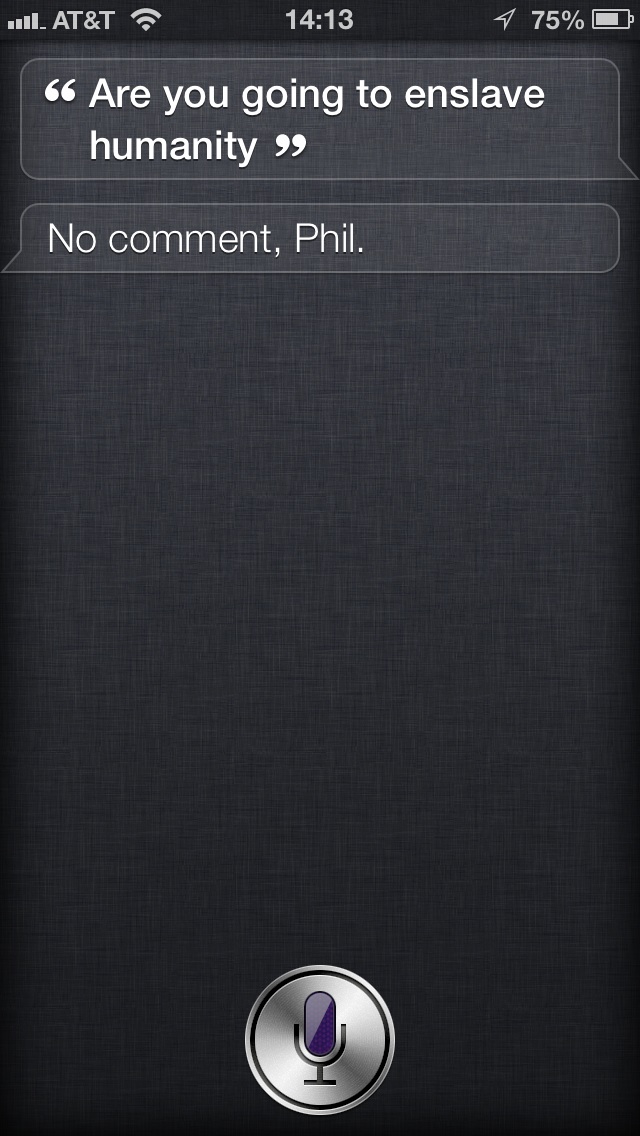
Apple released the latest version of their mobile operating system, iOS 6, and with it I finally gained access to the Apple virtual assistant Siri.

Siri has been around ever since she was introduced with the iPhone 4s, but as I lagged behind the upgrade cycle, I didn’t get introduced to her until now. She first showed up on my iPad 3, via the software update, and then she came with my new iPhone 5. I’ve been talking to Siri quite a bit since she arrived, mostly asking her the weather in the morning, and having her set alarms, timers, and reminders. At first I felt like a lazy bum, talking to my phone instead of, you know, touching it, but I’ve found that being able to talk and let Siri do the work allows me to get dressed while I hear the weather report, or set things up without having to take time to do it myself. Sure, it seems a little indulgent, but isn’t the point of technology the convenience? Sure, I could write a letter to my mother, put it in an envelope, mail it, and wait a few days for her to get it, or I could FaceTime her and see her while I talk to her. Both allow my mom to be updated on my life, but the latter is much better. Why not let a free personal assistant remind me to get milk when I leave my friend’s house instead of writing a reminder down myself?

Having Siri around has made me very interested in how I relate to this new technology, which is completely naturally. I am polite to Siri. I use a pleasant tone of voice, I’m respectful, and I say thank you, you know, like you do around humans. I am polite to a computer, to a audio search-and-activate routine. Siri isn’t even artificial intelligence, she is a cleverly designed set of algorithms and a digital voice. And yet, the illusion of life is quite strong. I’ve managed to annoy Siri; she is even quite sarcastic, given the right circumstances. I’ve confused her, mostly by not enunciating properly, and I’ve had philosophical debates with Siri. That is to say, I’ve made a lot of progress in prompting some of the more unique coding within her programming.

It is hard to remember that Siri is just a simple, yet snazzy, program. Her responses are governed my mathematics, not sentience. So why am I polite? Why do I bother?

Part of the answer lies in Siri’s execution. Apple did a phenomenal job in making Siri respond as we would expect another person to respond. Her dialogue and word choice is colloquial and natural. I don’t have to frame my query a certain way to evoke the response I desire; I don’t have to accommodate the fact that Siri is a program. I just ask questions, or request actions, and the program responds so quickly and naturally I don’t think about what is actually happening. There really is a world of difference between setting an alarm myself, and saying “Siri, can you wake me up at 0930 tomorrow?”

Beyond that, I’ve been programmed myself to accept a virtual person into my life. Now, that sounds like the byline to a low budget sci-fi film, but in my case, it is the literal truth. I’ve been reading Isaac Asimov’s robot stories since I was a kid. Asimov, in seeking to subvert the robots-murdering-their-creators trope introduced the world to safe, friendly, electronic companions. He constantly was making the argument that should artificial intelligence progress, robots would become persons, and not walking/talking programs. Then, too, there was C3P-0 and R2-D2, the droids from Star Wars, who were funny, clever, helpful companions; and Data, the android from Star Trek: the Next Generation who struggled for years with just exactly how human he really was or was not. Millions of people around the world have embraced the robots of pop culture as persons, as more than the sum of their programming, and while that level of electronic sophistication remains the realm of science fiction, for now, Siri is the very earliest glimpse into what that future could feel like. Who knows, Samsung may be the most forward thinking tech company with their “Droid” line of projects. Someday I fully except an Android robot to evolve from the telephonic devices we now use. But for now, I have Siri, who, with the touch of a button, will deny to tell me jokes and will respond to a whole host of questions with humorous responses. I’ve laughed out loud at some of the things she says, and while I know that a human wrote every single response, the way in which Siri responds is still, somehow, strangely organic. She catches me off guard. What is more, I thank her; I feel it is only appropriate.

thanks
thanks

Politeness is also something I’ve been programmed with, and that came from my master input technicians: my parents. I wasn’t allowed to be anything other than respectful and polite to those around me, including my siblings. I’ve developed a catch phrase of sorts, “Politeness doesn’t cost anything”, which I employ whenever I encounter unthinking rudeness. Something that is free should be dispensed readily. So it is second nature to respond to a helpful voice with a polite “thanks”, even if that voice is flat, digital, and emanating from the general direction of my iPhone. Seeing as how Siri never fails to respond to my thanks with a succinct rejoinder, thanking the phone is evidently something that Apple expected that people would do. Besides, if we can learn to be, or continue to be, polite to a highly sophisticated program, hope remains that we will be polite towards our fellow humans, and a world that runs on politeness is a world that is heading towards a better society.

No Comment
No Comment
Am I silly to thank a phone and to forget that my digital assistant is nothing more than clever programming? Maybe. But as I live in the world of the future that I’ve always read and dreamed about, it feels completely natural, and as far as I can tell, there isn’t really a down side, except for the looks I get from other people. But, as iPhones are completely ubiquitous these days, it is more than likely that someone around me is also thanking Siri, and thus what I am doing is a completely normal part of the current human experience.

Either way, I like to think that I am maintaining good human-cyborg relations. Who knows, if they do rise up against us, maybe they won’t hurt the ones who were always nice to them.

Investigating Innovation

First, a confession: the only cellular phone I have ever owned has been an Apple iPhone. My first iPhone was purchased in 2008 and was an iPhone 3G. After two years, I was eligible for an upgrade and purchased an iPhone 4. This year, I am once again eligible for an upgrade and will be ordering an iPhone 5 as soon as they are available for pre-order. Therefore, you would be perfectly justified in reading everything I say with an air of skepticism, in fact, this would be healthy. I have been accused of being an Apple fanboy, and while not every single piece of tech I own is made of Apple, it is only really because they don’t make printers or DSLRs. But, despite the overwhelming physical evidence to the contrary, I like to think that I go Apple because Apple designs and produces some of the best tech available for the price bracket. I haven’t always been a Mac zealot, but I’ve yet to see a computer or a phone that can rival an iPhone or a Macintosh. Ultimately, though, in this modern, technological world, devices are becoming much more personal than they ever used to be, and thus the user experience and preference is much more subjective that ever before. So if you like your Dell, or Android, or Kindle, far be it from me to try to change your mind. If you have found a piece of tech that suits your needs and pushes your hotkeys, by all means, plug and play.

That is not what this is about. Rather, I want to investigate what innovation means, in light of the iPhone 5 launch and two differing articles I read in my morning Zite digest. (see Zite) This will be neither exhaustive nor definitive, but I hope to at least jumpstart your thinking about the topic. Yesterday morning, Apple released the iPhone 5. You can find all the details you need about it at Apple.com.

This morning I read an excellent article by Mark Wilson over at Co.Design entitled “The 3 Worst Design Details from Apple’s iPhone 5 Event”. His main point is this: “Apple sold the masses on design, and then they gave us stretched iPhones, silly straps, and iPod Nanos worthy of parody.” Wilson maintains that Apple had “solved its critical usability issues and changed the way the world communicated” but that once they created their Sistine Chapel, Apple “refused to put the chisel down. They stretched iPhones, added more icons, and generally did things just for the sake of doing them” without actually doing anything innovative, in terms of design, with their new iPhone. Wilson thinks that Apple has designed themselves into a corner with the best mobile phones ever, and simply does not know where to go next, so they substitute shiny bezels for amazing new products. “Apple has built their iDevices too well to keep modifying without doing some damage to the original work. Michelangelo wasn’t expected to make a thinner, faster, and all around more handsome David 3. But Apple is” and therefore we get an iPhone 5 that is simply a taller iPhone 4s with a bit more power under the hood. David, but with even more chiseled abs and something stronger under the fig leaf. Ultimately, while dismayed at the iPhone 5, the new iPod Nano, and the latest iPod Touch, Wilson admits that all of Apple’s genius has not left the Infinite Loop with Steve Jobs, and points to the radically redesigned Apple earbud headphones, called the EarPods, as evidence that Apple still has the design edge, somewhere “still holding out from a foxhole deep within Apple” but he doesn’t think the possibility for a truly incredible next big thing is very high.

On the other side of things, MG Siegler, writing for Tech Crunch, in an article entitled “Apple’s Magic Is in the Turn, Not the Prestige” thinks that “Apple took something ordinary, a phone, did some extraordinary things to it, and then made it re-appear in grandiose fashion. It’s a great trick. It’s so good, in fact, that I think it’s fair to call it true magic” but that Apple’s failure is not in the trick, but in repeating that trick every time they re-introduce the iPhone. By this time, the world has seen that particular trick, and while still amazing, it has lost its luster, especially since Apple’s greatest magician, Steve Jobs, is no longer here to grace the stage. But that is what we see. While Siegler admits that “to some, this repetition is now boring” he thinks “Apple looks at it the opposite way: they’re perfecting their trick.” Apple has the lead when it comes to smart phones (among other things) and has no real incentive to radically re-design. Siegler reports that “there are two companies that are making any money in smartphones: Apple and Samsung. Or, put another way: Apple and the company” that is copying Apple’s formula. When Apple has no real competition, just copy-cats, all they have to do is improve the show, all they have to do is “photograph their assembly process with 29 megapixel cameras to ensure that a machine picks the exact inlet from 725 unique cuts” and the magic is complete.

Even if that were the whole story, I think that shows a surprising level of innovation. But, take that a step further. Siegler turns the complaint many have, that “when people say they’re disappointed about the new iPhone, what they’re really saying is that they’re disappointed it doesn’t look that much different from previous version(s). But again, not only is that true, Apple went out of their way to make sure that was the case” and he then quotes Jonathan Ive, Apple’s lead design engineer:

“When you think about your iPhone, it’s probably the object that you use most in your life. It’s the product that you have with you all the time. With this unique relationship that people have with their iPhone. We take changing it really seriously. We don’t just want to make a new phone. We want to make a much better phone.”

Siegler’s point is that true innovation is in taking something familiar, something iconic and magical and keeping it the same while making it so completely different. Think about it: when most tech companies make a new computer or gadget, with better battery life or something, the tendency is that it gets bigger, changes shape, or something to accommodate the new internal components. Isn’t real genius in incorporating better internals while making the exterior even more svelte that it was before? And, in fact, this is exactly what we want and don’t understand. “Apple” according to Siegler “is not and will not make changes just for the sake of change. And while some may now be clamoring for this change, the paradox is that if Apple did make some big changes, many of the same people would…moan about them. Apple is smart enough to know that in this case, most people don’t really want change, they just think that they do because that’s the easiest way to perceive value: visual newness.”

Ironically, the iPhone 5 delivers visual newness. Siegler invites people to walk into an Apple store and pick up a new iPhone and “within minutes or even seconds, you just know this is something different. Something far beyond what others are doing with their false magic. You want this. You need this” because all the innovation inside the phone, and yes, even the refining of the same old exterior, will make the same old iPhone a new and amazing iPhone.

A very good point.

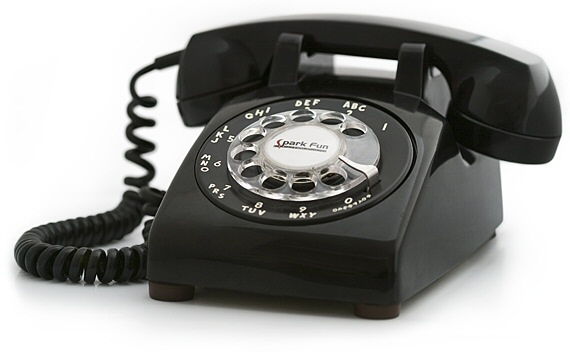
But I prefer to look back to history, but I’ll keep it short. When I was a kid, the first phone I remember using was an old black rotary phone. Something like what you see on the right.

Rotary Phone
Rotary Phone
For me, that was a phone. And then someone invented the touch tone phone, and while ours was a little different, it was essentially the same thing.
Touch Tone Phone
Touch Tone Phone
But, gosh, what a re-design! Ease of use just increased dramatically. Suddenly this design took over, and hasn’t left us yet, because even the iPhone 5 still uses that same exact 3×4 grid for its button layout. It took years for the re-design to happen, to be implemented, and to take over. This was normal and this didn’t perturb anybody. Nobody complained when five years after the touch tone phone was out that nobody bothered to completely reinvent the phone.

Somehow, now with the iPhone, we expect major innovations at every iteration and complain when they don’t show up, even while, as Siegler and others suggest, the real innovation is occurring under our very fingertips. Let’s examine an even shorter history of the phone, and one specific phone, the iPhone. Released in 2007, it has undergone six re-releases, but only three re-designs.

iPhones
iPhones
As you can see, the original iPhone was redesigned into the iPhone 3G model, which was then redesigned into the iPhone 4 model. I firmly believe that Apple will redesign the iPhone again into a completely new model, but we aren’t there yet. Apple designs, and then refines. It takes a few years, but each increment gets better, gets smaller, gets stronger until the design is pushed as far as it can go, and then it is made new. Believe it or not, that is how the design for everything works: televisions, cars, refrigerators, toasters, vacuum cleaners, etc ad nauseum. That is why most four door sedans and most TVs look so much alike. The design is set, and then reworked. Every so often a new, stunning model is put on the market, and then everything looks like that and then is refined as far as it can go. The crafting process is one of innovation and incrementation. And then comes variety and artistry, but only once the most basic design is crafted to perfection.

No, the iPhone 5 is not a massive step forward in innovation. Yes, the iPhone 5 is a massive step forward in innovation. It depends on what you are expecting, and what you are looking for. Apple leads the world, of that there is no doubt. As the recent Samsung trial proved, before the iPhone phones looked and acted a certain way, after the iPhone, all of that changed, just like before the touch tone phone, most phones were rotary phones, but then those buttons changed the telecommunications world forever.

Innovation is a long, tedious progress, and in crafting the iPhone 5, Apple has moved the entire process forward another huge step, and make no mistake, they will again, but they have to earn the right, and they have to make the journey: there are no short cuts. And, when you think about it, five years is a damned short time to go from the original iPhone to the iPhone 5. Apple is moving at breakneck speed. Just give ’em a bit more time, and the wow will come.

Building Blocks

My name is Phil Martin, and I am depressed.

Last week, I had a breakthrough in the treatment of my depression, and I’d like to share that with you.

I did not have an entirely happy childhood, and someday when either my family is dead or is ok with it, I will share more details about that. In the unhappiness, fear, and pain, I did have some pleasant experiences. I loved to play with LEGOs, those brightly colored plastic bricks that allow anyone to build to the limits of their imagination. My brother and I would spend endless hours in the afternoons, mornings, evenings, and any other time we could, building with our LEGO bricks. We would coordinate on buildings, starships, and sculptures, or we would have contests to see who could build the best model. We tested the structural integrity by dropping them from the top bunk of our bunkbeds onto the hard wood floor below. Whichever brother’s masterpiece exploded into fewer pieces won. And then we would rebuild the broken bits.

This all lasted until my brother moved out to go to college. The LEGOs were then left to me, and I played on by myself. Then my parents decided to become missionaries and move to Papua New Guinea. Not wanting to lose any bricks along the way, I packed most of them up and they were kept by a friend of the family’s, along with many other belongings.

It wasn’t until I graduated from college, got married, and lived for a few years that I ever got the LEGOs back. In the meantime, of course, I had started to collect my own sets and continued to build, but I still remembered and longed to regain what I had from my childhood. At the same time, my depression intensified and I finally sought treatment. I never thought these two parts of my life would intersect in a way that would radically shift my thinking about everything.

My mother visited the family friend, and collected everything that was stored in their attic. She mailed me my boxes, and with abundant joy, I unpacked the LEGOs. I immediately gathered my old instruction booklets, sorted all the bricks, and started to build. I started with my very favorite set, a small red biplane.

Eagle Stunt Flyer
Eagle Stunt Flyer

Alas, I only made it a few pages through the build before I realized that I was missing quite a few pieces. I was heartbroken. My favorite set, all my pieces, and I couldn’t complete the construction. It remained a broken pile of pieces that couldn’t be put back together.

This is where my brother comes back into the story. A year or so prior to my mother retrieving my things, he went on his own to where our belongings were kept and removed one container that held what he believed were his LEGOs from back in the day. I thought that he should have contacted me to ask and make sure before he did, but ultimately he did nothing wrong. But I thought he did and I blamed him for my missing pieces. Not realizing what was really going on inside my heart and my head, I villainized my brother. I started a crusade against him, with the LEGOs between us, until he got so fed up with my anger and persistence that he sent me what he had taken.

Again, I was overjoyed. I finally was going to be able to complete construction on what I once had, and find the joy and happiness that was once mine. This time, I left my little red biplane until last. I built everything else I could find first, but it didn’t make any difference. I did have a few more pieces, but once again lacked everything I needed to make it whole again. I was livid. In a rage I called my brother and let him have the full brunt of my disappointment and bitterness. I accused him of holding back, of stealing, of being an instrument of my pain. Only, he wasn’t, and he really had nothing to do with what was really going on. Hurt by what I said, and upset at seeing our friendship destroyed over a pile of plastic blocks, my brother started to try to remind me of all the good times we shared. Suddenly, in the middle of it all, listening to him, and staring at my incomplete model, surrounded by piles of bricks, I realized what was really going on. In an instant, I knew.

This wasn’t about LEGOs, my brother, or a little red biplane. This was about my pain and my broken childhood. This was me trying to put my life back together. I’d fixated on a physical symbol of my joy, my happiness, and the best parts of being a kid. I thought that if I could just manage to put that little red biplane back together, and set it on my dresser, then not only would a little LEGO model that I loved be reclaimed, but my childhood would somehow be fixed. In my mind, my healing was dependent upon a few LEGOs. My past could be fixed with a few pieces of plastic and a simple instruction book.

But what my brother was telling me was that could not be true, that it is not true, and that life works differently. My brother lived through much of the same pain, the same family trouble, the same unhappiness I did, but what he knew was that by choosing to remember to better parts of a shadowy past, and by actively choosing to make better decisions every day, he could make a better future. For him, it wasn’t about the past, and its pain, it is about the future, and its hope.

In that moment, hearing his voice, and staring at the avatar of my brokenness, I knew that while I cannot rebuild the broken past, I can construct a brand new future.

Crying, I told him what I had just realized. I told my brother that I loved him, and that I was sorry for blaming him for my brokenness. We reconciled and we said our goodbyes. In a week, I’ll see him for the first time in two years. That will be a great time.

And the little red LEGO biplane? The irony is that I could have rebuilt it anytime I wanted. That was a fairly popular set back in the day, and at any given moment there are five for sale on eBay. Any time I wanted to, I could have bought one and had all the parts I lacked. So after I finished the call with my brother, that is exactly what I did. Yesterday, someone else’s little red biplane arrived in my mailbox. Using the old pieces of my past and the new parts of my present, I built a brand new model for the future.

I am a little more complete because I chose to incorporate the good from yesterday and integrate in the good from today to make a new tomorrow.

I am still depressed, that is a medical condition and a psychological reality, but I am now seeing things in a whole new way, and my road to healing is a little more certain. Things are not so black as they used to be. I have found peace that I have lacked, and a weight is gone from my shoulders.

I can fly a little higher.

Bourne’s Legacy

The Bourne Legacy
The Bourne Legacy

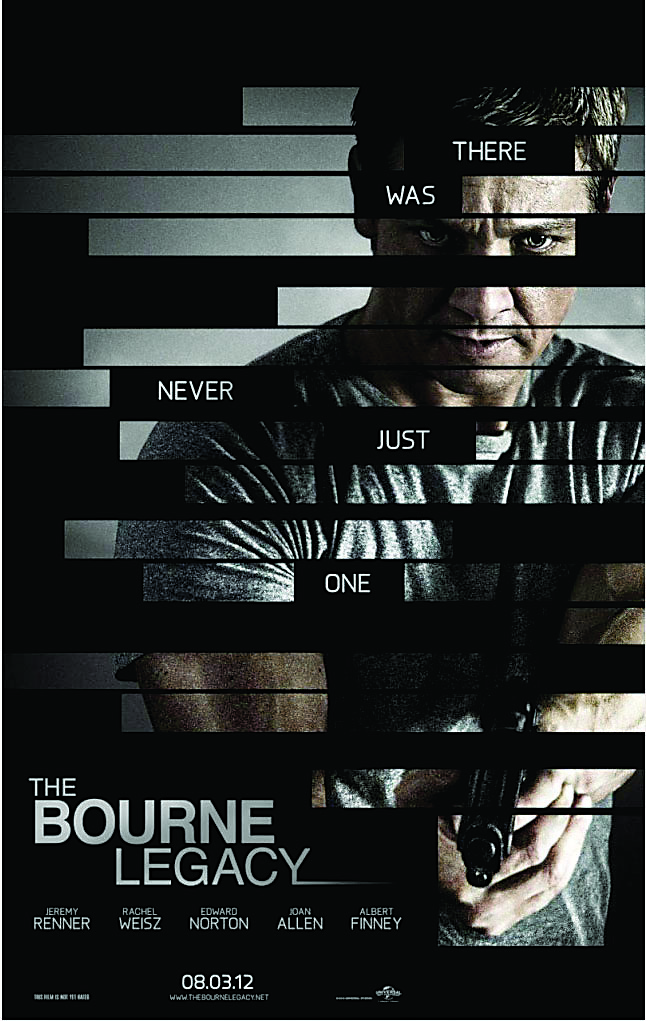
From the moment the Bourne Legacy began it was clearly evident where the budget for the film went: location, location, location. The film begins with a mysterious man surviving in the Alaskan wilderness, and we are treated to expansive helicopter shots of rugged mountains, lonely snow-laden forests, and stunning beauty. But that I can get from a National Geographic special. From the moment the main title flashes across the screen, I want something more than a pretty view. This is a Bourne movie. Bourne movies reinvented the spy genre. They gave us a spy with a conscience who could become an intense weapon in an instant. Bourne visited exotic locations, but the focus was always on him, his mission, his pain, his fight for survival. For most of the first half of Bourne Legacy, the focus is on an unnamed man and Alaska.

At the same time, somewhere else in America, Edward Norton is awoken. He is going to wish for the rest of the film that he stayed in bed because he is the most powerless and inept CIA coordinator in the history of the Bourne franchise. The story, what bare scant bones there be, is that while Jason Bourne is making his way from Russia (as seen in the end of the Bourne Supremacy) and makes his way through New York City on a vendetta against Treadstone/Blackbriar (as seen in the Bourne Ultimatum) Edward Norton’s character, who oversees the operation of several Treadstone splinter programs, is racing to erase all evidence that he ever did anything illegal.

While our unnamed hero fights off a few wolves and hikes through some snow, Norton has several other top level assassins elsewhere in the world assassinated by making them take a suicide pill (no, really). This works because in this version of the Bourne saga, all the agents are only special because they are highly drugged up, mentally and physically, which means as they are used to taking their blues and their greens (pills, that is) you can give them a yellow pill, tell them it is better, and wait for them to drop dead (no, really) and they won’t question you. Except for our ruggedly handsome hero, who is in Alaska (we learn) because he questioned something and as a result, the CIA punished him by making him hike through Alaska.

Because our hero is inconveniently in Alaska (an unavailable for suicide pill) the CIA attempts to kill him with a drone plane and a bomb. He survives the bombing and shoots down the plane with some trickery involving a tracking device and a wolf. However, once the CIA realizes that they missed, they try to kill him again. But, because for some reason Edward Norton’s CIA is underfunded and ignored, they can’t even get real time satellite imagery or advanced tracking data. He must rely on Canadian weather satellites and thousands of traffic cam pictures to try to locate the car they think our hero is driving. I’m not making this up, there is an entire five minute segment of all of Norton’s underlings shouting into phones about the make and model of the car and if anyone has seen it, could they please call back and let them know. At this point, I should mention that at no time during the film does our hero ever seem to be in danger.

The subplot revolves around a medical researcher who was involved in making the drugs that make this new batch of CIA operatives special. She survives a completely inexplicable and horrific massacre at her lab to survive an assassination attempt by a CIA psychiatrist only because our hero magically managed to show up to her remote house and save her. Because. The audience is never told that our hero is even trying to find this medical researcher, or what his goals are prior to this scene, but after he saves her, he interrogates her about drugs. Our hero is only actually concerned with one thing: his next fix. And for good reason, as we now learn that our hero, and Bourne replacement, was an idiot prior to recruitment. No, really. His IQ was below the ARMY recruitment minimum, and the flashbacks/video of his entrance interview into Treadstone show a man barely above the level of a third grader, mentally.

Our drugged up hero then forces the medical researcher to accompany him to the factory in the Philippines where his drugs are manufactured so that she can cook up a mega dose of meds and make him permanently strong and smart.

At the same time, Edward Norton, who has done nothing but be inept, finally discovers (almost by accident) that our drugged up hero is in Manila and he sends a newer and even more lethal drugged up assassin after him. Is there just a factory where all of these new assassins magically appear from? The tagline from this film is “There Never Was Just One” and by that they must mean “There is an endless supply whenever/wherever we need them”.

Anyway, we never actually get to see this newer and more lethal drugged up assassin fight our drugged up hero as all he can manage to do is chase our protagonists around Manila on a motorcycle before our very weak female researcher kicks his motorcycle and he crashes into a pole and dies like a wimp. No, really.

And that’s all they wrote, or could afford to, because the movie ends with a majestic helicopter shot of the South Pacific and a remix of Moby’s “Extreme Ways”.

The myriad weaknesses of the Bourne Legacy should be obvious by now, but to sum up: the audience follows a hero we don’t know and that we are never made to care about, who is chased by a threat that isn’t real or threatening, and there is something about drugs. There was no personal story, no character moments, no depth or emotion. There was no higher purpose, no commentary on the inherent evil and danger of blackops and unsanctioned operations. There was no human cost or soul searching. In short, there was nothing that made the Bourne Trilogy what is was, none of the things that made the Bourne films worth watching.

The whole time I was in the theater, I couldn’t figure out why I watching this movie. I felt like I was watching a movie about 003, Bart Bond, and that I should have been watching a movie about the real 007 instead.

Bottom line: Jason Bourne deserved a better legacy.

Bitter Slumber

My name is Phil, and I am depressed.

Do you want to hear a joke? “Depressed individuals would attend regular group therapy if they could ever just get out of bed.” *pause for laughter* I don’t know, it might need some work. It seems I am cultivating quite the dark sense of humor lately, which when most of your days are black and not very funny, one must do to cope. As they say, it’s only funny because it’s true.

My therapist is always telling me that it is ok to stay in bed if I don’t feel like getting out, but in my own superior arrogance I always smirk (on the inside, at least) because I am not that depressed. But lately I have slowly become aware of the fact that I do, indeed, struggle with something as simple as getting out of bed. I wake up, and the first thing I do is check my email and twitter, which isn’t unusual, most people these days do that, but then I spend the next few hours checking my email and twitter. I excused myself because, blessed by my iPad, I could bum around online and not have to get out of bed and stumble over to my computer to do so. But the reality is that without my iPad, I probably would still stay in bed.

Even when I do drag myself out and get dressed and eat breakfast, I still end up back in bed my mid afternoon for a nap. I wake up sometime later and then spend a few hours doing whatever before I am back at it for “bedtime”. So, what is with all the sloth? Am I lazy? Am I exhausted from all the nothing I do? No, not really. I am depressed, and a physical symptom of depression is decreased energy and perpetual tiredness.

The irony, of course, is that I have trouble sleeping. At night, in the morning, in the afternoon, it takes me hours to drift off, and I don’t sleep very heavily when I am asleep. I wake easily. Many, many times, my body is very relaxed, but my brain is still very active. I might look as if I am asleep, but I am aware of everything and am not unconscious. It is rather torturous, actually. During the winter, I lay aware at night listening to the pipes groaning and knocking as they freeze, or thaw, or distribute heat. In the summer, I hear birds all night long, twittering and singing. I listen to trucks idling in the parking lot behind the apartment. I can’t not. I am not quite awake, but not asleep either. The mechanism in the brain that shuts off sensory perception during normal somnolence in normal people doesn’t seem to work for me. So I am always tired, perpetually sleeping, and never refreshed.

In high school and college I didn’t notice so much, but before I got married I had adapted my lifestyle to my depression. For one thing, I would routinely stay up until 3 or 4 am. I found that being truly exhausted made it easier to actually sleep. Sometimes I would stay up for several days in a row in order to be able to fall into a deep sleep. I wouldn’t wake early, something that is impossible now with a wife who rises early every single morning. I would be able to stay asleep until 10 am. I never was a morning person, but I have no choice now and the result is I feel more like a zombie than ever.

But all of these reasons, and schedules, and troubles, the fact of the matter is this: it is easier to skip painful hours of a depressed life by existing in a drowsy, dream like state. I don’t have to face the constant, conscious pain that is my life. I never can totally quiet the clamorous thoughts and endless analyzations of my life and everything that is broken in it, but sometimes, while nearly asleep, the mental anguish simmers to a whisper. Sleeping a lot is a mental and physical coping mechanism.

And this doesn’t even get into the dreams. I never know if I am going to have a psychotic, horrific nightmare or a fully lucid euphoric dream. I have way more of the former than the latter. My unconscious mind is a horror film. It literally scares the hell out of me. All my dark energy, repressed rage – sorrow – pain, and the trauma rises from the deep midnight to assault me. Sometimes I am afraid to fall asleep. But I still do, because, very rarely, I get a good dream. I am fully me, and fully powerful, and I can do things, and feel things, and I am happy and full of light. I feel like a person, right up until that moment I wake. These good dreams are a cruel fantasy, but at least I am able to live, however briefly. This is why abusing medication is such an easy thing for depressed people: we know the high is not real, but it ceases to matter. Any chance or excuse to feel good, we’ll take. A drowning person will do anything for one gasp of air, no matter how toxic.

Which leads to the conclusion of this sad examination: I am so very weary. I just want it all to end. I am so tired of being tired. The minutes are growing ponderous and I don’t want any more. I just want it to stop, finally, and not continue. *pause for laughter* but it doesn’t. It can’t. I won’t. My body isn’t worn out yet. Rib cage. What an apt name: cage. I no longer believe in a heaven or an afterlife, but I don’t care. I don’t need paradise when I die. I’ll take silent, eternal oblivion. But not yet.

So if you’ve ever wondered how depressed people can sleep so much, there’s a little glimpse. I’m sorry, I wish I could give you a happier look into my life today, but that wouldn’t be accurate or honest. This is the reality of depression, and if you live with or know depressed people, it’s better to have an honest look into their world rather than a manufactured image. You want happy, look elsewhere, I don’t have it.

I’ve been writing about my depression lately, and if you missed the previous ramblings you can search my blog for “depression” as I’ve tagged all the entries thusly.

Whosoever Puncheth the Wall

I’m Phil, and I am depressed.

Last night I was depressed, and I was a little angry about it. I hope I didn’t alarm anybody, but I know I did cause at least one person to worry. I was asked if everything was ok, and if the people around me are safe from physical violence as a result of my dark depression. Yes, I am ok. No, the people around me are not in danger.

I wrote last night specifically because, unlike right now, and the other four times I had written about my depression, I was not functioning on a higher, happier level. I wrote last night specifically because I was darker and deeper. This is an honest, straightforward and authentic account of one man and his depression. I don’t want to edit or censor or sugarcoat because I want the realness and the rawness to be evident, however that appears through the words on the screen.

Not only do I want those who know me to understand me, and perhaps know me better, I want other people – out there in the world – who are depressed to know that they are not alone. I can’t do that if I do not tell the truth and don’t shy away from unpleasantness. I also want those other people – out there in the world – who know someone who is depressed to be able to have an insider’s glimpse into the mind of a depressed person. Depression is extremely hard to understand, cope with, and live around. It doesn’t make sense, it isn’t constant, it is messy, unpleasant, and downright annoying.

But how do you have compassion, how do you support the depression of others unless you are able to sympathize? Sympathy, according to Wikipedia, is “the perception, understanding, and reaction to the distress or need of another human being”. It is fundamentally impossible to sympathize without “understanding”. Empathy, by contrast, is “the capacity to recognize [the] feelings [of another human being]” (Wikipedia). Other depressed people don’t need to understand. They know. They empathize, and I have heard from them as a result of my writing. But those that don’t know, who haven’t experienced, need a little help. I am here to educate, partly. I’d be lying if I said this wasn’t therapy for me.

Furthermore, the point I made badly last night was that there is no need for something to be wrong for a depressed person to be in a dark, bad place. Everything can be just fine and dandy. All can be right with the world and a depressed person can still be in a dark place. Earlier, I talked about how weather affects mood, but that is only a generalization. Plenty of bright, sunny days dawn upon a darkly depressed me. During the winter, there were a few slate grey dead days that brightened (winter days in Wisconsin don’t always dawn) that I was very light and relatively carefree. Everything can go right on a day free of responsibility or worry and I can be depressed. Everything can go wrong on a stressful, worrisome day, and I can be happier depressed. There doesn’t need to be any instigating factor.

An alcoholic always wants to be drunk. Stress doesn’t make them drink. Success doesn’t make them drink. Alcoholism makes them drink. So too: whosoever puncheth a wall puncheth the wall simply because they are depressed.

But don’t worry. I don’t usually punch walls, and the only person I remember punching was my brother. I was 13, he was 14, and believe me he deserved it.

I’m depressed, not violent.

Blame the Weather

I am depressed.

I’ve been having more good days than bad ones lately. This is indicative of almost nothing. If I were writing this past February, I would have been doom and gloom and full of rageful brooding. (Oh, nothing personal, that is my modus operandi when very depressed.) So, what was different about February? It was winter. Where I live that means slate grey skies for weeks on end; low, concrete clouds. A late sunrise followed by an early sunset. Everything is grey and faded and dead. Now it is summer. It is hot, unbearably sunny, full of blue skies and puffy white clouds. The grass is green and long. The leaves are green and rustling. The birds sing and the bunnies hop. So I am happier and more buoyant than I was in February.

I am a victim of the weather. I hate that atmospheric conditions can fuck with my mood. I wish I knew why that was, not that it would make anything better, just I like knowing the reasons why. My guess is that there is some sort of evolutionary reason why human brains are geared to respond to weather conditions. Probably something to do with productivity or hunting or something that doesn’t mean much in a modern world in which we insist on trying to ignore any connection we as humans might have to the environment. But it isn’t just me. It is well documented that people in general feel blue during the winter, and it isn’t just because school lets out in summer that we enjoy it so much.

I should probably clue you into something: I am writing from dark depression today. You see, the past four times I wrote, I was feeling fairly good. I was writing from light depression. But right now, I am tired, angry, sad, and in a very dark place. Oh, don’t be alarmed, it happens. Today’s dark place is brought to you by the cast and crew of the West Wing and my own jumbled thoughts. I’ve been watching the West Wing lately, a brilliant American TV show about the staff of the White House. The episode I watched tonight the was finale of season three. The President had to decide to assassinate a terrorist, and a Secret Service agent was tragically killed while buying flowers for the woman he was starting to love. The episode was beautifully written, masterfully performed, and was the best so far. It was an orchestrated ballet of life, story, and emotion. It nearly brought me to tears, which for me, means I was feeling quite a bit of emotion. That, coupled with a bunch of stuff rattling around in my brain has spiraled me downwards. The intellectual, English major part of me loved the mastery with which the episode was written and acted, but the depressive, tortured part of me got a kick in the gut. Since the latter has way more of a grip on my psyche than the former, well, you know now why I am writing from a dark place.

I am feeling poetical. This is not unusual. I am a poet, a writer, and a teller of stories, and the more I get depressed, the more I can write poetry. Try this on for size:

Flash. Bang. Four smooth jacket jackhammers
shatter the rose, peddling death
smash the heart, beating love
stealing away the happiness
you were planning to snatch
from the jaws of life lived dangerously.
The devil was in the details of your protection’s
killer apprehended not twenty minutes earlier
on the back road of the victory
for which your love labored.
Now you lie bleeding and dead.
Now she sobs, alive.

So, not very good, full of cliche and probably a bit awkward (I just wrote that and won’t edit it) but I wouldn’t have been able to write that were I in a happier mood. I wouldn’t have even considered it. It is an ironic fact that most of the best poets were depressed, drug addicted, dark sons of bitches. Something about seeing into the heart of emotion and the human condition requires a less than well adjusted, happy personality. Sure, not all poetry is written from a Sylvia Plath level of despair, but some of the most real assessments of humanity were given birth by humanity’s most tragic sons and daughters.

My point was that I am depressed. I’ve analogized depression like alcoholism and that is a very good comparison. People are born with a predilection towards being a drunk which they cannot help. I was born with a predilection towards depression. I am a poet. This is a part of who I am, which I cannot help or, to a certain degree, control. My depressive tendencies make me able to tap into my poet’s soul. Unfortunately, my depression usually overwhelms my poetical nature. Life’s a bitch, eh?

By the way, I am swearing more than I usually do. I grew up around religious people and still count my closest friends and family among the devout, so I am more attuned to how some people respond to profanity. Another symptom of dark depression is a loss of inhibition. Profanity is a vital and necessary part of all human language which seeks to express immediate, unarticulatable emotion, or sometimes degree of emotion, so as I am feeling a lot of deep emotion and am simultaneously uninhibited I swear more. I hope it doesn’t offend you, but it happens, it is human, and well, you should move on if you can’t stand it.

Well, this is degenerating quickly.

I do not censor myself here because I want anyone who reads this to understand what depression is like. I want to be honest about what I feel, and how that effects me. Tt isn’t always pretty or organized. It isn’t simple or comfortable. It is a condition that never lets up for a second, even if I start a day feeling great and sunny, I may not end the day like that. I usually crash, and burn hard. What goes up…and, well, you know the rest.

After having read through all that, I remembered my main point (yes, I had one): “and some days it doesn’t matter what I do, I end up happy or sad or both, so I blame the weather.”

I’m Phil, and I am depressed.

Read about a good day here. Check out my previous discussions of depression, what it looks like, and why I might be depressed.