I wish

I saw the sun,
however brief;
it was fun.
I wish the day
‘d turn a new leaf,
burn th’ clouds away,
revealing blue, blue
sky, bid grey adieu.

I actually “tweeted” this poem on my twitter (@PhilRedbeard). I like that I am keeping to consistent rhyme schemes these days, as when I was a kid, or even in college, rhyming was inexplicably hard to do. (For those interested, but who can’t be bothered: ABACBCDD). The poem is also precisely 140 characters (including line breaks) exactly the twitter tweet limit. I feel very proud of myself right now.

Also, its true: I hate the grey days of Wisconsin winter and long for a bit of sun and blue skies.

Do Remember (Part I)

“How do you justify your existence? Nay, do not answer straight away. I will clarify for those lower beings in the room:…” This was said with just a hint of sniggardly derision. “How do you, an officer of the law in the High Order of the Most Righteous Sect of Her Lady On High, praised be Her Name, justify your disgusting existence?”

The defendant swallowed hard. The light was too harsh for his eyes, unused as they had become to such pure and undefiled photonic assault. The darkness was too dark; he could not penetrate it. In the cone of brilliant white light, faced with the mere silhouette of the judges’ panel and that loud, booming voice, he felt utterly alone and naked. This was, of course, the purpose of the overly dramatic and mostly theatrical lighting.

The defendant cleared his throat, an awkward and uncouth noise in the quiet of the patiently waiting court room.

“I forgot where I parked, Your Honors.”

There was silence. The assembled judges, twelve of them from around the Glorious Celestial Realm, were shocked that this simple statement could be the defendant’s sole defense. Most of them thought him definitely insane, both for not hiring an attorney, and second, for daring such an absurd defense.

“The court will indulge your obvious and momentary insanity. The defendant will be allowed a single re-statement of his defense, but I warn, do not tread lightly on the leniency or the patience of this court. Your charges are neither few nor inconsequential.”

“I understand, Your Honors. I will restate my defense.”

“Continue.”

The defendant stood up even straighter than before, and with a clear and ringing voice that filled the court room, stated,

“I, Second Lieutenant Silas Harrious of the High Order of the Most Righteous Sect of Her Lady On High, praised be Her Name, did, on the fourth of the Most Holy Month Belarious, utterly and completely forget where I parked my official vehicle: the planet upon which it was parked, and the population therewith being deemed hostile and unfamiliar, it was summarily rendered invisible in all known light spectrums and was, as a result, utterly devoid of the possibility of being thereafter located except through precise memory, upon which time said memory utterly failed me.”

The silence was even more shocked than before. In couching his defense in the language of the court, the defendant was stating as emphatically as possible his utter lack of insanity, despite his clearly absurd defense. The court was in no mood for games, but such a statement would not be enough to satisfy those that would inevitably review this court case. An explanation would be expected, indeed, by all the law and precedent of the land it was demanded, and that, the court supposed, was why the defendant decided to pursue such a maddening defense. The court endeavored to keep the rising anger and frustration out of his voice, and almost completely failed.

“The defendant will provide this court with a full explanation of your defense in as timely a manner as possible. Do not waste our time or good graces, else it will go even much more harshly in your sentencing. Does the court make itself clear?”

“Perfectly clear, Your Honors.”

“Then proceed.” And Silas Harrious did so.

“In the course of my duties, on this particular occasion I was pursuing the most nefarious heretic Paulus Klautus through the Outer Explored Territories, we both emerged from hyperspace in a backwater system, barely charted and explored, which possessed only one planet known to be inhabited. Our vessels had emerged on the outer edges of this system, yet my pursuit gradually wound through the outer planets, through an intermediary field of asteroids, and we closely approached the inhabited planet. It was at this time that an undetected solar flare caught us both unaware was we emerged from behind that planet’s sole moon. Klautus’ ship was completely destroyed -”

“Can you provide proof of that to this court?”

“In addition to my own personal testimony as an officer of the High Order, my ship’s log, which remains intact, includes a visual and sensory record of the event.”

“Very well. Proceed.”

“I, myself, had just enough time and wherewithal to raise my ship’s solar shields in the wake of Klautus’ destruction and avoided a similar fate. As it was, the turbulence from the flare served to knock me in to a deteriorating orbit around the inhabited world. I had only the barest control over my vessel and it seemed necessary to set down for repairs before attempting to break the gravity hold. My onboard diagnostic system, as well as my own intuition, told me that breaking orbit may have been possible, but there existed a significant chance of catastrophic failure should I attempt to do so.” Here the defendant was interrupted again.

“Most officers of the High Order would find death a more worthy fate than defilement. Your thinking represents an aberration. Do you wish to enter a plea of insanity? The court will be lenient.”

“Is it insanity, Your Honors, to cling to life and the hope of continued service to Our Lady On High, praised be Her Name?”

Caught in his own game, the court deigned not to reply directly, choosing instead to merely state,

“Please, continue.”

“I found a sparsely populated and small city in which to land, figuring that I might need to manufacture replacement parts from local material, and proceeded to do so under the cover of night. As I have stated, I forget exactly where that was, but as protocol and my own caution dictated, it was no doubt somewhere discreet.” Again, an interruption.

“But your presence in this courtroom, and your therefore obvious escape precludes your remembrance of your parking location. Will you not reveal it straightway?”

“I will not, Your Honors – ”

“I remind you that you are under oath, both as a defendant and witness in this court and as an officer of the High Order. You will tell this court the truth!” His righteous and personal outrage was evident.

“I am aware of my oath, Your Honors. I will most certainly tell the truth, the whole truth, and nothing but the truth so help me, Our Lady On High, praised be Her Name. It remains, however, my prerogative to tell the truth in such manner as I deem appropriate. My defense rests upon the fact of my forgetting and my subsequent remembrance, and should I reveal the latter before the former, it would color my defense in a manner which would erroneously indicate my guilt, and in so doing I would possibly incriminate myself further in the eyes of the court. I have rights, Your Honors.”

The court was about to answer, but the judge seated beside him covered their shared microphone and whispered briefly to him. Following the exchange, the court was not pleased, but was cowed.

“The point is conceded. The witness has rights. But the truth will be known.”

“Of course, Your Honors. In due time.”

“Proceed.”

“After completing a safe landing of my spacecraft, I secured the vehicle as per the flight code, and after reviewing the collected and available data on the planet on which I was now a refugee – ” The court, it seemed, could not help but interrupt whenever possible.

“Is the defendant wishing to claim Refugee Status and enter a plea of guilty under the Uniform Code of Refugees?”

“No, Your Honors. I used the word descriptively, not lawfully.”

“The court will remind you to exercise caution throughout your testimony to avoid further confusion.” The court cut off the defendant’s polite reply with a curt,

“Proceed.”

Part II

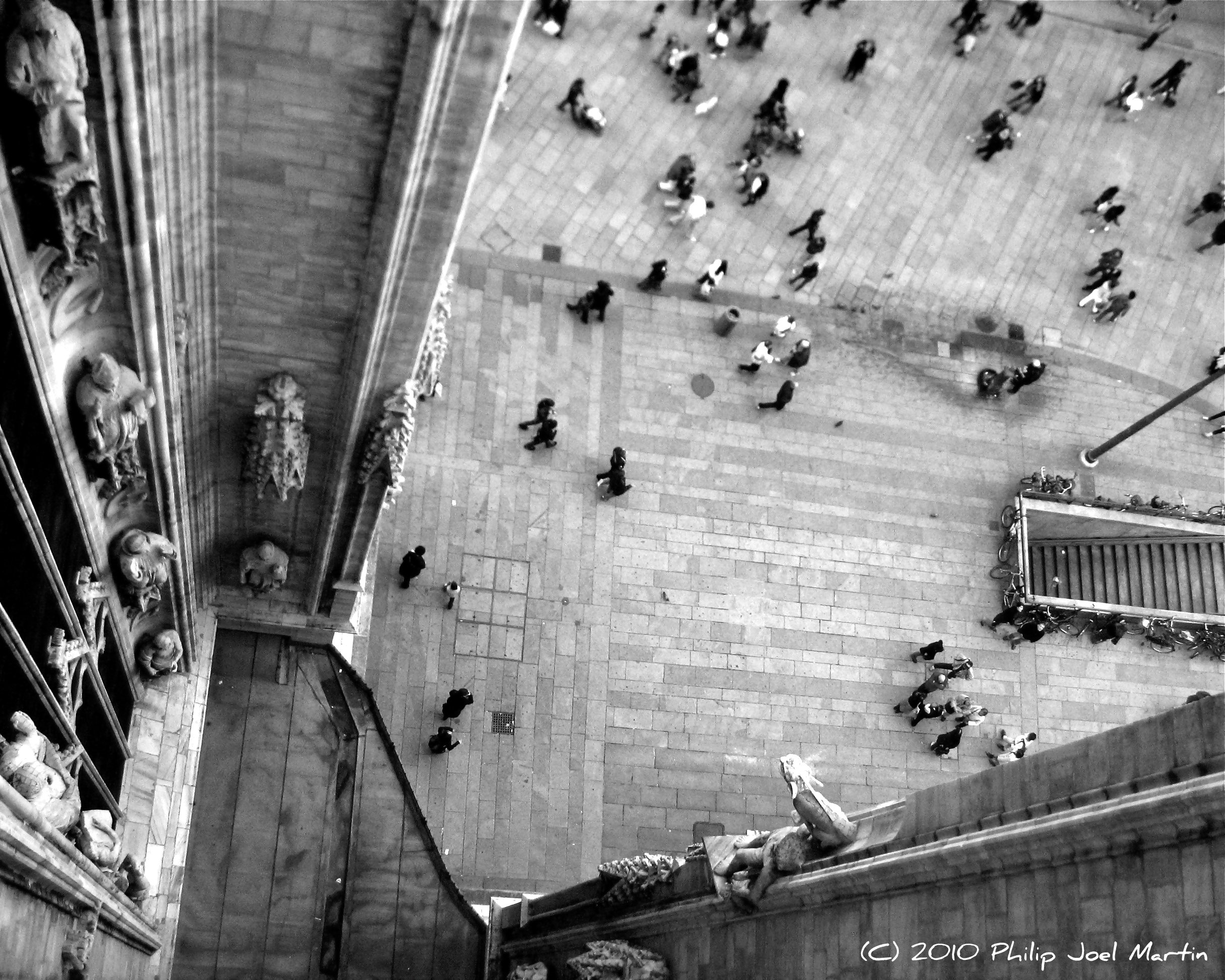
Milan

standing above the square
esconced shoulder to shoulder
statuesque saints and sinners
my marbled companions
weathered and stained
white against the ribald blue

we thousands gaze down
upon the passersby
tourists people posing
confessing with a smile
their joy at finding cathedrals
where the devout still pray

traffic never ends the press
never eases its gritty grip
sometimes in that small space
between the underground
while the bicycles wait one
stands and stares wonderously

sweeping up my eyes meet
those carved in stone ever
watchful of the millions
pigeons and people that fly
around the duomo walls
I find peace in Milan

View From Duomo Cathedral, Milan Italy

lightning

hot summer night
fireflies in the grass
flitting above the cornfields
lighting up the night
drifting on breezes that pass
glowing against the darkening star field
bioluminescent twinkling rivaling
Mintaka’s binary beaming
from Orion rising high
wheeling bats signal dusk’s arrival
shadows against the gleaming
I hug my lover, contentedly sighing

firefly
firefly

The Hundred and One (Sexist) Dalmatians?

The Hundred and One Dalmations by Dodie Smith is a delightful children’s book that I read as a kid (many times) and haven’t read since. I decided to read it again to see if it held up and was still fun. It definitely was an entertaining read.

101 Dalmatians
101 Dalmatians

When I was looking it up on my favorite social networking site for books, Goodreads.com, I was surprised to see so many reviews complaining of sexism or anti-feminine views being presented in the book. This was certainly never anything I noticed as a kid, but then, how many kids are clued in to that sort of thing? I found myself reading to enjoy, and also to examine, and my findings are that this book is hardly demeaning of women.

To be clear, I mostly focused on gender roles and the differences portrayed between the sexes, and judged the book thereby.

What first caught my attention was the fact that Mr. Dearly was the primary caregiver to the newborn dalmatian puppies (beyond their mother, Missis). He crawls into the cupboard for two days feeding the puppies constantly while working long distance over the phone. If traditional gender roles are in play, shouldn’t this be Mrs. Dearly’s job? This is clearly an inversion of the binary. Secondarily, of the two female nannies, Nanny Butler insists on wearing pants after the Dearlys are married, and back when this written, this was hardly the social norm. Again, a seeming inversion of the stereotype.

What I looked at next was the differences between Pongo and Missis. Pongo can understand human speech, can read, and thinks faster and clearer than Missis. On a cursory reading, it does appear that Pongo is presented as superior, and Missis as inferior, but that isn’t the case. It is a clearly established conceit throughout the book that dogs differ in intelligence, and in human understanding. It is also quite clearly stated that Pongo played with alphabet blocks and volumes of Shakespeare (thus accounting for his English comprehension) and is even referred to as the “keenest mind in all of dogdom” which establishes his peculiarity in both intelligence and human understanding. If one considers that a dog learns English much as any other non-native English speaker, this lines up exactly with human experience and is not sexist at all. After all, how much English would you learn if the most common word you heard was your name, and the rest was in condescending baby talk? Probably not even as much as Missis. Also, she clearly seems to be personally disinterested: she simply does not bother or care to learn more, which seems to be a personal choice.

Now, one could make a case for sexism based on the fact that it is Pongo to whom these advantages are given and not to Missis, and if all the dominant traits were Pongo’s, I would agree, but in almost all other cases, the two dogs are equal. They share equal affection and concern for one another. They equally adopt and feel ownership for all of the other dalmatian puppies, they are equal in their strength and determination throughout their desperate journey. In fact, Missis even rescues Pongo when he is injured by the little boy who throws things. She restrains him from acting against the child in anger; she finds the haystack and forces him to rest; she finds the Spaniel and secures food and lodging for them both. Again, if this were clearly sexist, he would be rescuing her instead of the other way around. In this episode, she is the hero, not the male dog.

There is one instance with the Spaniel in which Missis tries to learn her right from her left and ends up horribly confused and unable to get the two straight, and that could be seen as an indication that the female possesses less intelligence, but abstract concepts are hard to grasp for someone that isn’t introduced to them from a young age. I am a male, and I am an adult, and I frequently have trouble telling my right from my left. This is humiliating to admit, but it is true. I never bothered to learn them when I was a child, and as an adult, the concept is more difficult to grasp. There is clear research showing that much learning is cemented in the early ages, and the brain becomes more rigid after that. I have managed to decrease my ambiguity about right and left, but it has taken practice and focus. In the story, Missis has much more on her mind, is emotionally stressed about both her husband and her puppies, and is short on time. It is no wonder, then, that during the heat of the moment she simply became frustrated and couldn’t grasp the concept. Again, why her and not Pongo? I think this is part of staying consistent to character rather than making a sexist statement about the inferiority of women. If anything, Missis’ lack of education is more Mrs. Dearly’s fault that her own for not providing her with Shakespeare to chew on, but then while Mr. Dearly is given barely a few sentences to round out his job and life, we are given almost nothing about Mrs. Dearly. This is, after all, a story about the dogs and not their pets, and so there is precious little from which to draw conclusions. In order to remain un-sexist, one does not have to always choose the female over the male, but must show equality and fair treatment. In all, Missis is Pongo’s equal in practically every way that matters. I get the feeling that if Pongo chose to teach her, Missis would learn quite aptly.

Lastly, some reviewers got upset about the fact that the one puppy who was obsessed with television was the youngest female puppy, Cadpig, who was also the weakest, and they called this sexist. I disagree. In fact, this lone, apparently weak female made for the narrator the most important observation of all. The narrator of the story appears to be religious. The last building in which the puppies take refuge is a church. Cadpig becomes more obsessed with the nativity on display than she ever was with the television. In the end, she concludes that whoever “owned [the church] – someone very kind she was sure” had set out that refuge for them, complete with puppy sized beds. Clearly she is misinterpreting the reality of a church, as only a young, uneducated puppy can (female or male) but the narrator is using her to make a statement about God: the kindest person who looks out for even the most lost and destitute soul, according to most Christian theologies anyway. It is not insignificant, then, that the smallest and weakest character, through her obsession to the television, is the only one to realize the ultimate reality of good triumphing over the “de Vil”. To the woman is given the realization of the theme, plot, and message of the entire story. Sexist? hardly. If it were, it would be Pongo making that realization. There is every indication that he missed the implication entirely.

Actually, for my own part, I thought that having the villain of the story be a woman, the colorful and deliciously evil Cruella de Vil, could possibly be the strongest argument made for sexism. After all, the woman is the evil one! However, as Cruella’s cat explains, her husband was no less evil, just weaker and less demonstrative, and in that is the deconstruction of the argument: Cruella is the villain because she is much stronger than her husband, who is made out to be a mostly sympathetic character until his true nature is revealed. The only reason he is not the villain is he is too weak to be flamboyant about it. Furthermore, the devil is usually portrayed as male, so this is really a reversal of the norm.

Therefore, between Mr. Dearly inverting the nurturing paradigm, Missis heroically saving her husband, Cadpig realizing the moral of the story, and Cruella trumping her husband’s weakness, this book is not sexist in the least. (At least, in my humble opinion). Read it with an open mind, divorcing yourself of pre-conceived ideas and agendas and decide for yourself.

Over all the book was entertaining, amusing, fun, and quite well written for what is essentially a children’s novel. As much as I enjoyed it as a kid, I enjoyed it probably just as much as an adult.

Monster

There is a monster in our closet. He is big, and blue, and has scales and two fiery eyes. He has sharp teeth and likes to eat kids. And then he likes to eat babies for dessert.

My dad don’t believe me, but it’s true. I swear.

Even Billy believes me, and my brother Billy is dumber than a post. But Billy saw it. Dad didn’t. I think that is why Dad doesn’t believe me.

There is a monster in our closet. He is big, and blue, and has scales and two fiery eyes. He has sharp teeth and likes to eat kids. And then he likes to eat babies for dessert.

Fortunately for the monster, there is me, and my brother Billy, and our baby brother Bobby in his crib, all in my room, waiting to be eaten.

But that old monster don’t know what’s waiting for him. See, I don’t intend to be eaten tonight, despite what dad says about there being no monster and me not being eaten because it is just shadows and my imagination. I’ve put together a plan, and I’ve even got Billy to help. Bobby won’t help much as he will probably just be sleeping, but at least he will thank me one day when I tell him that his big brother saved him from being monster dessert.

Bucky, the monster slayer. That’s me!

Anyway, the monster. Tonight, when the lights go out and mom and dad go down the hall to their room, the monster will wait. He will wait long hours for me and Billy (on the top bunk) and Bobby (in the crib) to go to sleep. Then, he will quietly ease the closet door open. He will rustle our good Sunday clothes, and he might shuffle my old sneakers out of the way (so he don’t trip) and he will gingerly sneak past my LEGO tower and my G.I. Joe base. He will try not to knock over my erector sets and my house of cards, cause that might make noise and wake us up. I know that this is what he will try to do because last night he knocked over my Lincoln log house. (Dad swears that there is no monster, and that he knocked over my Lincoln log house last night when he came in the room to check on Bobby, but I know better. I know it was the monster.)

Once the monster passes the Lincoln log house, he then has to walk across the open part of the room, all the way to our bunk bed, on the far wall. He will pass right by Bobby’s crib, ’cause he won’t eat him till dessert. He will want to eat dinner first, and get the big boys out of the way. Me and Billy discussed it this afternoon, and we still aren’t sure if the monster will go for Billy on the top bunk first, and work his way down to me, or if he will go for me on the bottom bunk first, and then work his way up to Billy, but either way, I think we’ve got him!

That old monster won’t know what hit him, because we will only be pretending to sleep. We will stay tucked under our covers like Mom tucks us in, all neat and tidy after our prayers, and we will pretend to snore, and maybe mumble a little bit, just to fool that monster into thinking that we really are asleep. Because, see, monsters are a little wary, sometimes, and they won’t attack if they think us kids are awake, because they have to attack while we are asleep. Monsters are funny that way. Anyway, we will pretend to be asleep, because otherwise the monster won’t come, and then we won’t be able to kill him so he won’t eat Billy, Bobby, and me.

So, anyway, I hear that monsters like to eat kids for dinner, and babies for dessert, so I hope he brings his appetite tonight, because I want to see how well he likes the taste of my baseball bat.

Billy has his tennis racket, but what good a tennis racket is going to be against a monster, I don’t know.

Billy is kinda stupid that way.

From a Distance

Steve Jobs
Steve Jobs
Steve Jobs is dead. Apparently he passed away sometime this morning, and it seems obvious that his death is a result of his recent and prolonged battle against pancreatic cancer.

I first learned of his passing on my iPhone, and confirmed that the report was more than rumor on my iMac. I suppose this is as fitting a legacy as any for the man who changed the modern world. If I say that my life has been irrevocably changed because of Steve Jobs, I am not exaggerating or being sensationalist. The first computer I ever bought was an iBook (the laptop) back when I was 16. The first digital media player I ever bought was an iPod, classic Jobsian hardware. My first purchased desktop was an iMac, the great grand computer of Jobs’ Apple Computer saving computer. The first, and only, cell phone I have ever owned was an iPhone. I watch TV via my TV.

All my life I have been immersed in new technology, hardly surprising for a kid who grew up in the 90s. Most of my life has been shaped directly by Apple products. It should come as no surprise, then, that Steve Jobs’ death is hitting me harder than even I realized that it would.

I have been sitting here tonight, reading tributes to Steve on Twitter and FaceBook, and trying to figure out why I am on the verge of tears. Steve Jobs was a business man. He made products and sold them and made billions of dollars doing it. If the founder of Nike or McDonalds died tomorrow, I doubt I would give it much thought. It would be a footnote to my day. So why is Jobs’ death affecting me so much? Probably because Jobs did so much more than just make and sell a product. He has changed life itself.

I watched the keynote address from yesterday’s iPhone 4S product launch, and something Phil Schiller said is replaying itself in my brain: “we created the iPod because we love music”. Steve Jobs helped to create the digital music player because he liked music. Sure, the money he could make selling it must have been in the mix somewhere, but I really don’t have a problem believing that Steve’s primary motivation wasn’t the money, but the music. In all the keynotes I have ever heard Jobs give, one thing always seemed to be at the forefront of his presentation: enjoying life. Sure, he talked about how Apple was doing, and how many products they had sold, but always the emphasis seemed to be on the lives of the people using the products, and not on Apple’s bottom line. Jobs’ eyes sparkled when he talked about living at the intersection of technology and the liberal arts. He got choked up after demonstrating how his innovative FaceTime allowed people to talk face to face. He was like a giddy kid when he announced that he had brought the entire Beetles catalogue to iTunes, and not from the greed of pennies filling his bank account, but from finally being able to bring some of his favorite music to millions of people in a format that would allow some of the most popular music of all time to be preserved for hundreds of years to come.

I don’t know if this is true, but I’ve heard that Jobs’ annual salary from Apple is only $1. Not that he didn’t benefit from his company’s success, he surely did, but what was important to him was designing the world of tomorrow, and in creating new ways to enjoy the things that make life worth living: family, creation, and innovation.

I think because I was 16, in the prime of designing my life, when I first started to adopt Apple products, that I also started to design my life around Apple’s, and Jobs’, philosophy: think different. Create. Stand out from the crowd. Live life. My life has become a life in which I immerse myself in my creative endeavors because I find them stimulating. I think that is all Steve Jobs ever really did.

This man I never knew changed the world I live in. Steve Jobs changed my life.

I will miss him.

Twitter has been full of some awesome quotes from Steve Jobs. These resonate most with me:

“Your time is limited, so don’t waste it living someone else’s life.”

“We don’t get a chance to do that many things, and every one should be really excellent. Because this is our life.”

“Remembering that you are going to die is the best way I know to avoid the trap of thinking you have something to lose. You are already naked. There is no reason not to follow your heart.”

Against Censorship in Schools with an Eye Towards Education

Against Censorship in Schools with an Eye Towards Education

My son brought home a book
It sat all innocent in its aged leather binding
the paper pages cracked slightly with age
but the gilded print on the cover damned it
Huck Finn by Mark Twain
oh! the horror – for therein
is a black man called nigger
a slave to the white man
hideous and repulsive to modern sensibility
after all, we’ve lived through the 1960s
we marched with Dr. King, or at least learned
to share a water fountain, or a bus seat
we’ve grown beyond our racist past
surely now we can teach our kids
that niggers is no longer slaves
and that certain words debase and vilify
surely now we can teach our children
tolerance and love and acceptance
and that hatred is even more disgusting
than slave owning ever was
surely through Huck Finn
a fictional boy from our past
we can educate our children –
surely

My daughter brought home a book
It sat neglected in her tattered backpack
the pages were crisp and unbent
but the dust jacket’s lettering damned it
A Study in Scarlet by Sir Arthur Conan Doyle
oh! the horror! for therein
are Mormons treated with suspicion
rank intolerance and ignorance
an old man refuses to allow his girl to marry
a member of his own adopted congregation
as if who we marry is matter of another’s opinion
but the Virginia school board banned it
the book teaches hatred of Mormons
we can’t have that in our schools
we can’t have children reading that – though
surely now we can teach our children
tolerance and love and acceptance
and that fictional characters with heinous opinions
need not be our own
surely through a STUDY in Scarlet
a fictional book from our past
we can educate our children –
surely

Why I Dislike Derek Jeter

It isn’t anything personal, mostly because I have never actually met the man, but I dislike Derek Jeter, (the professional baseball player).

Derek Jeter
Derek Jeter

I actually have a very hard time articulating this fact because my personal belief is that it is a waste of time to like or dislike people I have never met. What is the point? I don’t know them. Obviously, I lack information, and any lack of information leads directly to a weak or false conclusion, especially about people. How then do I continue this post without hypocrisy? I am not really sure, but I have this theory: people are constantly and naturally making evaluative decisions every day, about things and people we encounter and so this is, if not completely rational, at least consistent with basic humanity.

Feel free to judge me similarly without knowing me; I assure you, I will be unperturbed for as long as I know nothing about your judgments, and if I do become aware of them I am certain my reaction will be to arch an eyebrow (or possibly run off to a corner in which I will huddle and weep annoyingly while rocking back and forth). Either way, you are free to your own opinions.

Anyway, back to Derek Jeter. Derek Jeter plays the shortstop position for the New York Yankees, and has for his entire professional baseball career which began in 1995. Coincidentally, I really started to be interested in baseball as a sentient being in 1994 (when I was seven) and have, consequently, been watching Derek Jeter play baseball my entire life, especially during the 90s when it seemed like almost every year Derek Jeter and the Yankees were in the world series (96, 98, 99, 00, 01, 03) and Jeter was in the All·Star Game (98-02, 04, 06-10). Furthermore, Derek Jeter is unquestionably one of the greatest shortstops to play the game, purely from an athletic and statistical point of view. Just recently he capped his career to this point by reaching a mark never before attained by a shortstop or a New York Yankee: Jeter hit his 3000th hit.

But my problem with Jeter lies not in his performance on the field, but rather his persona off the field, and his revealed personality in interviews and the public forum, the most recent example of which revolves around the 2011 All·Star Game. Jeter won the popular vote for starting shortstop for the American League All·Stars by a large margin. He then proceeded to decline to play, or even to appear during the opening ceremonies, citing fatigue and a recent injury. He then proceeded to play several games in which he hit several more hits, including a home run for number 3000.

I can fully understand a player declining to play in an exhibition game for reasons of injury or fatigue. But, the players who show up for, and who have the option of playing in, the All·Star Game are voted for by the fans, fellow players, and coaches. Being selected for the All·Star Game means that a great number of people want to see you there, in that context, and cheer your success as a baseball player. Declining to play is understandable (some are even forced to not play due to rules to protect player health) but declining to show is a snub.

Jeter absolutely was recently injured. I understand that. But, he returned from injury to play long enough to reach a personal and professional milestone (3000 hits), and become one of only 28 hitters to reach such a milestone in over 114 years of professional baseball in America. If he could return from injury to hit a few more hits, and in so doing endure the rigor of a few games in order to do so, why could he not merely be present for the opening ceremonies of an exhibition game?

Declining to even be present, stay in a nice hotel for a few days, enjoy some exclusive privileges, put on a uniform and tip your hat to millions of cheering fans when they call your name is just arrogant and an extreme lack of class. Baseball players would be nobodies without a job if it were not for the fans who pay them to play a boy’s game via ticket sales and other revenues. Derek Jeter’s name would not be a household name if it were not for his millions of fans. And he just told them he did not care about them at all.

Lastly, while Jeter may be a future candidate for the Baseball Hall of Fame (based on his stats and records), and he may, in the past, have been an All·Star calibre player, this year he is playing well below form and well below the level of many other shortstops in baseball. This year, despite his 3000th hit, his performance did not merit an All·Star invitation. And when he was invited anyway, Jeter then spurned the invitation.

Derek Jeter displayed his arrogance and his contempt for the very people that employ him and make it possible for him to have the money, prestige, and acclaim that he enjoys. His is the insult of the kid given a present that he did not deserve by a loving caregiver who then turns up his nose at the giver and says “no thank you, I don’t feel like opening it, give it to someone else, I can’t really be bothered” and then goes to play in a corner.

And that is why I don’t like Derek Jeter.

I sincerely hope that if I ever get a chance to meet Jeter, I may come away with a completely different perspective. Knowing someone has the potential to make all the difference in the world in the way that person is understood.