Earth’s Mightiest Poems

I made it to Barnes & Noble this week earlier than ever before in the morning, just after the store opened. On a Friday, that meant the store was mostly empty and quiet, just perfect for a bit of poetry play and rhyming.

This time I worked along two avenues, one with two forms that mix and match a poet’s own words to form new poems, and the other in exotic forms in the vein of the haiku.

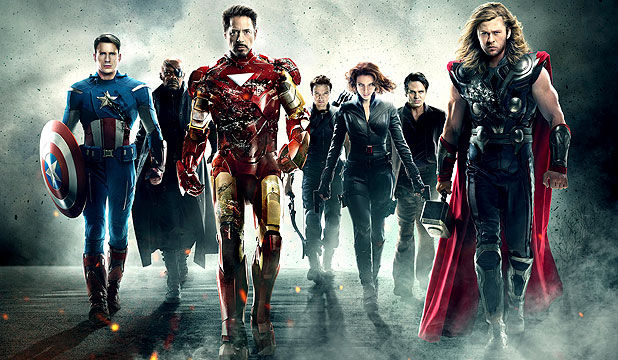
My theme today was the Avengers.
the Avengers
the Avengers

The first two forms I worked with were the Cento and the Clerihew. Both ostensibly re-work an existing poet’s lines of poetry to form new poems. Instead of taking an existing poet and his words, I instead worked from another medium that I enjoy: film. For my centos I remixed lines from the three Iron Man films to form poems. A cento also uses the name of the purloined poet as the first line of the poem, and in this case, the name of the movie. There is no meter or rhyme scheme.

Cento 1

Iron Man
Yeah, well, vacation’s over,
there’s the next mission, and nothing else.
(Sometimes you gotta run before you can walk.)
What you’re asking about: it’s me.

It’s not technically accurate,
I’m just not the hero type.
(Yeah, I can fly.)
The truth is: I am Iron Man.

Cento 2

Iron Man 2
It’s subtle, all the bells and whistles,
It’s a high tech prosthesis,
The suit and I are one:
It tastes like coconut. And metal.

The point is: you’re welcome,
I am your nuclear deterrent,
I’ve successfully privatized world peace:
it’s about legacy.

Cento 3

Iron Man Three
Let’s track this from the beginning:
we create our own demons,
the prodigal son returns.
Technically, I am Iron Man.

(I broke the crayon)
Everybody needs a hobby,
my armor was a cocoon:
I am Iron Man.

For these centos I tried to encapsulate what each film was about, speaking to both the plot and theme. And, as I said, all are composed entirely of lines spoken by Tony Stark/Iron Man.

Next was the Clerihew which is again formed by lines from an existing poetical work, for which I again used lines from a film, in this case, the first Avengers film. The clerihew uses the name of the poet for the first line of two couplets. There is no set length, and again, it is non-metrical and non-rhyming.

The Avengers

Thor
Who controls the would-be king?
Do I look to be in a gaming mood?
This is beyond you, metal man!

Tony Stark
Doth mother know you weareth her drapes?
Have you ever tried shawarma?
We have a Hulk.

Bruce Banner
So this all seems horrible.
I’m always angry.
Puny God!

Steve Rogers
There’s only one god, ma’am.
Put the hammer down.
We have orders, we should follow them.

Natasha Romanoff
These guys come from legend.
I’ve got red in my ledger.
This is just like Budapest all over again.

Clint Barton
You and I remember Budapest very differently.
Ever had someone take your brain and play?
I see better from a distance.

For better or worse: a clerihew. I tried to capture the core of each character, and also do a sort of call and response from one stanza to the next. In actual fact, each stanza is its own clerihew, as a proper clerihew is only four lines long. This is, truth be told, a super clerihew, just as the Avengers are a super team. Neat, huh? My cleverness knows no bounds, apparently.

Next up I tackled some more exotic forms. First, a Japanese form called the tanka, which is a five line poem consisting of lines of 5,7,5,7,7 syllables. Again, the Avengers gave me inspiration.

Hulk

Banner is a man
who got hit with gamma rays.
The man’s a monster
who turns tall and strong and green.
The Hulk is always angry.

Cap

Steven Rogers fights
for the small and helpless man.
The military
experiment made him strong,
time made him legendary.

Thor

He’s a demi-god
Thor from the realm of Asgard
He wields a hammer
a weapon to pound, a tool
to build a much better world.

After that I wrote a tanaga, a Filipino form consisting of four seven syllable lines, all rhyming.

Romanoff

Natasha’s a widow black,
a spy with assassin’s knack.
Fear and cowardice she lacks,
she shuts down the tesseract.

Finally, after all that, I wrote a Persian form called a Ghazal, which is written in couplets that rhyme the final word before an ending refrain. The ghazal is typically signed by the author in the last line.

The Avengers

There are six who fight: the Avengers.
In Loki they inspire fright, the Avengers.

Romanoff, a woman with widow’s bite,
Hawkeye, possessed of keen sight, the Avengers.

Thor, whose hammer throws light-ning
Captain America stands for the right, the Avengers.

Hulk, he smashes with green might,
Iron Man, a modern metal knight, the Avengers.

Though the world’s in a plight,
I, Redbeard, love to write the Avengers.

Do remember that all my poems are basically explorations of a form or style of poetry and are not claiming to be exemplars of said forms. They merely adhere to (most) of the rules of the form, no more, no less. Thus they are not great poems, or even good poems, but they are poems. I enjoy writing them, and as always, I hope you enjoy reading them.


Warrior Poet’s Way

It was cold this morning as I headed to Barnes and Noble, but it was a pleasant, autumn cold. I found a table and began writing. Halfway through my phone’s battery died, so I surreptitiously pulled a rhyming dictionary off the shelf and continued working. I managed to write three poems before the rozzers wanted their book back, but by then I was creatively spent anyway.

Today we have a ballade, not to be confused with a ballad, a rondeau and a rondel. The last two are French in origin. The ballade has a long a complicated rhyme scheme of ABABABBABA, and the final line of the stanza repeats as the final line of every stanza, followed by an envoi of four lines (again with that repeated line at the end). Usually they are written as to a prince, or patron, of the arts. Given my recent poetical adoration of pop culture, I have gone with a steady diet of Star Trek related themes in today’s poems. This first one hails from Kronos, the capital of the Klingon Empire.

Klingon War Ballade

Klingon Empire
Klingon Empire

My son, lift your bat’leth to the sky
the un-fought enemy is worst, I deem.
From cowardice and fear, fly!
Your Klingon brothers are your best team,
May you over the battlefield teem.
So let loose with battle cry!
To my advice there is but one theme:
Today is a good day to die!!

My son, raise your mek’leth high
and listen to this battle scheme:
A running man’s blade is never dry,
four thousand throats he may un-seam
in one night. He bathes in blood’s stream,
to his enemies he bids good-bye,
destroyed by disruptor beam.
Today is a good day to die!!

My son, strap a d’k tahg to your thigh,
and remember Sto-Vo-Kor‘s steam
awaits the warrior bold, so do not sigh.
Make your weapons shine and gleam,
build your battle regime:
Sharp knives are nothing without sharp eyes,
serve revenge cold for a taste supreme.
Today is a good day to die!!

Envoi

Prince, Tonight may your blood scream.
Tonight, eat deep of the bloodwine pie.
Tonight of victories may you dream,
Tomorrow is a good day to die!!

I’ve added links into my poem to the unfamiliar words, so you dear reader can know what I am talking about. Mostly they are Klingon weapons, Sto-Vo-Kor is the Klingon heaven, and bloodwine is a traditional Klingon beverage. I’ve also adapted several Klingon adages into the poem such as “A running man can slit four thousand throats on one night” and “Revenge is a dish best served cold” and of course the refrain is perhaps the most popular Klingon battle cry of all time “Today is a good day to die!”. I’ve written the poem as from a Klingon father to his young son, perhaps just before bedtime.

Next up is a Rondeau which has a complicated rhyme scheme of RABBA AABR AABBAR. The last line of the last two stanzas comes from the first half of the first line. The most famous example of this form is “In Flander’s Fields”. In my attempt I have again mined Klingon culture.

A Klingon Warrior’s Song to his Foe

Share in death, my warrior bold
Revenge is a dish best served cold
Fight to the end, do not a coward be
My mek’leth you’ll never see
You will not age, never grow old

Your life is forfeit, your fortune sold
You’ve nothing left, no sword to hold
Do not hide, stand straight and free,
Share in death.

When this battle, the end is told,
I’ll be heaped, be buried in gold
No, I will not, cannot hear your plea
Mercy will not come, I’ll not save thee
No grave you’ll have, only this wold
Share in death.

This poem turns on the old Klingon proverb that “Death is an experience best shared”. Next up is a rondel, which repeats the first two lines of the poem in the middle and again at the end while alternating rhymes throughout. For this one, I changed paces and traveled to Ferenginar, home of the Ferengi, a race completely obsessed with amassing wealth. This poem extols the virtues of Ferengi culture.

The Ferengi Heart

Ferengi Alliance
Ferengi Alliance

Nothing is sweeter than profit,
Latinum is the best of all.
I’ve heeded the greedy call
Of business and acquisition, her prophet.
I’ve made gold my precious cossette,
Wealth keeps me in thrall.
Nothing is sweeter than profit,
Latinum is the best of all.
I’ll steal as much as I can haul,
All I fear is the FCA audit,
All I need is Ferengi plaudit,
Charity is the only thing I appall.
Nothing is sweeter than profit,
Latinum is the best of all.

Highly amusing to me, and if you know anything about Ferengi culture, a highly accurate poem. Again I have hyperlinked some of the more obscure references.

I hope you have enjoyed my foray into the Star Trek galaxy, I know I have. Until next time, live long and prosper!

An Ode to Odes

It was cold and rainy as I made my weekly trek to Barnes and Noble, a perfect fall day. On the trees the leaves were changing and in the air there was a crispness. I felt juvenated and alive. I sat down at a large table in the back of B&N and took out my copy of the Ode Less Traveled and began to read and write.

Today’s forms included the many types of odes. These days an ode can refer to any kind of poetry, but there are specific forms that are “proper” odes. Among those I attempted the sapphic ode, the pindaric ode, and the horation ode. A sapphic ode is usually written with three stanzas, and each stanza is composed of four lines, three of iambic tetrameter and one of iambic dimeter. I say usually because there are many variations possible within the form, but as described is the classic form.

An Ode to Stormtrooper Armor

All gleaming white, the armor stands,
the black insidious eyes do stare.
It clothes the Empire’s ruthless bands;
should just be bare.

It takes a hit, a hole appears;
the soldier dies, a flash of light
upon the chest: what poor career
the choice, a blight.

Why wear the armor bright? It yields
no benefit. The man beneath
just groans and dies. Bury him in fields
of green, the heath.

A pindaric ode is written in three stanzas. Each has a function, and while overall the meter is variable, each stanza must be composed identically in form. I chose to write each stanza with four lines of iambic dimiter, trimeter, tetrameter, and pentameter in ascending order. This ode need not rhyme. Actually, no odes need to rhyme as odes are originally a Roman thing, and there isn’t much rhyme outside of English.

An Ode to Stormtroopers

Strophe (Turn)

All hail!
the brave, the few, the true,
an Empire’s legion: stormtroopers.
They fight and die to win the Empire’s day.

Antistrophe (Counter Turn)

But they
cannot take aim or shoot
a straight and forward beam of light
at their targets, through “crack” and “best” they be.

Epode (the Stand)

Perhaps:
secret rebel dreams hold
behind their masks of white and black
to let the heroes live to fight back.

Then there is the Horation ode, which is much like the pindaric ode where the prevailing method of the form is that it remain consistent to each stanza. I chose three lines of iambic trimeter and one line of iambic pentameter. Just because.

An Ode to Barnes & Noble

I love thy smell of books
and coffee commingled in’th’ air
I love thy stacks and rows
of history, humor

of toys and games and Nook
the digital book for all
and desks at which to sit
to read and write a poem

There are a few other odes, some proper, some not, but due to the variability and required subject matter, I skipped them.

Lastly I moved to other forms and attempted a villanelle, which is a fun, favorite form that I love to try. A villanelle has no set meter, but does have a set rhyme scheme in which certain lines repeat. Usually it is A1BA2, ABA1, ABA2, ABA1, ABA2, ABA1A2.

An Villanelle Ode to Baseball

Baseball is a many pleasured thing:
the ball that buzzes, the bat that cracks;
it starts after the anthem rings.

Pitcher fires the ball, batter takes a swing,
he hits a double with a mighty thwack!
Baseball is a many pleasured thing.

The runner’s picked off, a sneaky sting.
He jogs to the dugout, bent back.
It starts after the anthem rings.

The submariner a curveball slings,
the batter whiffs, the ball glove smacks.
Baseball is a many pleasured thing.

The centre fielder to the wall springs,
he leaps and makes the catch at the track:
it starts after the anthem rings.

It all can change with just a swing,
a swift strike or a homer bat crack,
baseball is a many pleasured thing:
it starts after the anthem rings.

As usual, I claim no greatness or mastery, unless it be of fun and adherence to form. I do my best to enjoy the process of writing and sharing poetry, and leave greatness to the eventual tinkering and adjusting that is editing and the time that is the measure of all things. I only hope you enjoy reading my poems as much as I enjoy sharing them.


Poems for the Poetical

poetry
poetry

I spent my evening at Barnes and Noble, a surprisingly quiet place to hang out, and worked through more of Stephen Fry’s The Ode Less Traveled. Here follows a few moderately good poems borne of the exercises that he suggested. As you might be able to tell, the subject was television. Enjoy.

Star Trek: Enterprise

They trek through stars in ships and pods
They beam and fight and talk and look
At blue Andorians, it’s true!
And pointy-eared Vulcan soldiers.

They meet a Tellerite trader,
The Borg, though they should not yet be
And the father of the fathers
of Data and Lore: Doctor Soong.


Chuck

Bartowski, Sarah, and Morgan,
John Casey, Gen’ral Beckman.
It’s Chuck: the nerd, the spy, the man.
He fixes PC’s and

The world when its at risk by spies
And Fulcrum, Ring, and Volkov.
It’s Chuck: the man, the nerd, the spy
Who wins each day and night!


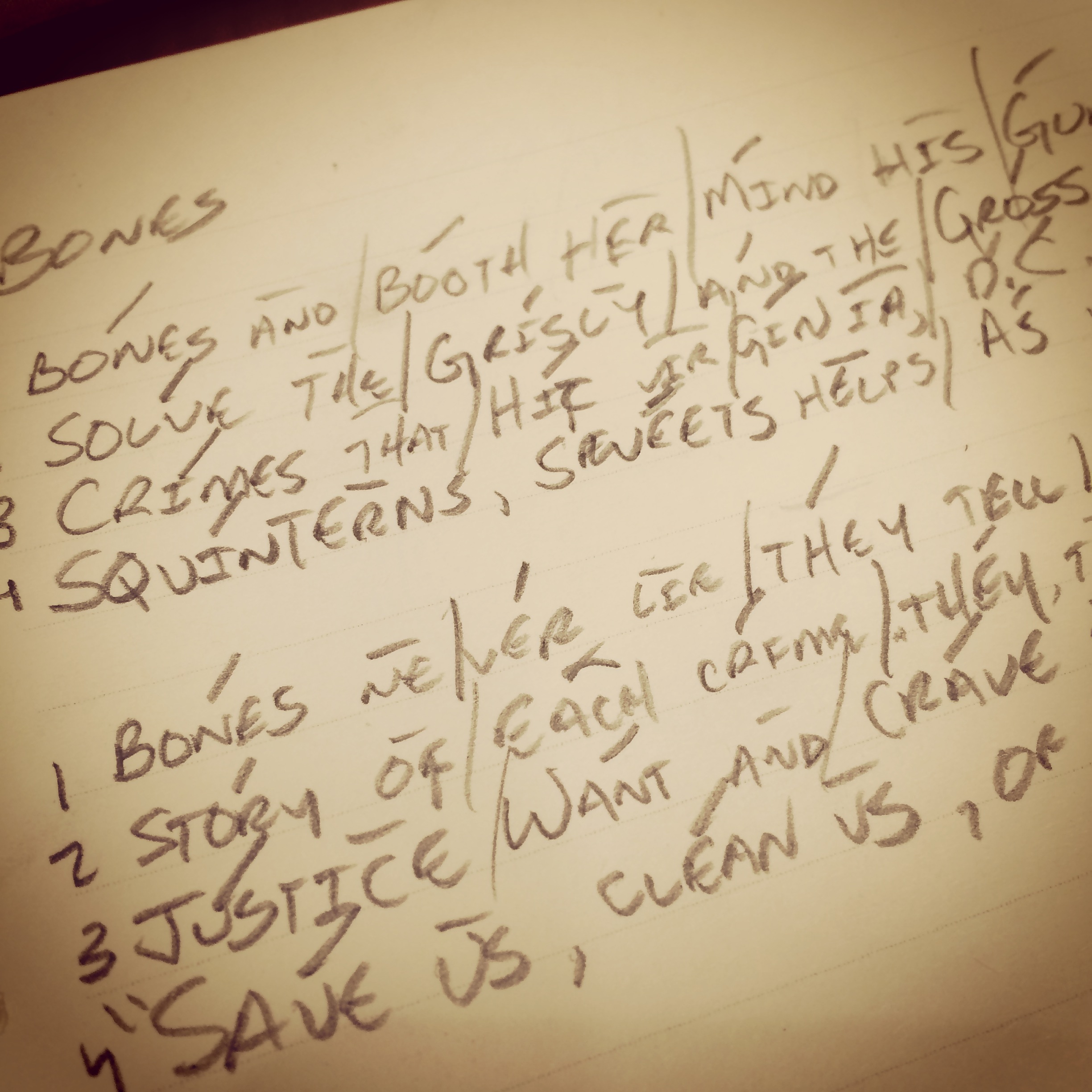
Bones

Bones and Booth, her mind his guns,
Solve the grisly and the grossest
Crimes that hit Virginia, D.C.
Squinterns/Sweets helps as well. Sometimes.

Bones never lie, they tell the truthly
Story of each crime. They, the bones,
Justice want and crave so mightily.
They cry: “Save us, clean us, of Sin!”


I was working with iambic tetrameter “Star Trek: Enterprise”, iambic tetrameter/trimeter “Chuck”, and trochaic tetrameter “Bones” if you were curious. Though, if you are good with scansion you might notice that none of these are consistent. Chalk it up to either bad form or creative license, depending on whether you mean me criticism or praise.