
Division of Labor

I am working on a compilation book of poetry. To date, I have written over 150 poems. Of those, I selected nearly 80 for inclusion in my book. After a few rounds of edits, I am at or around 73. I then divided those 73 into 4 sections of about 15 to 20.

My next steps are to make sure that each section is cohesive, that the poems in each section belong with each other, and that each individual poem is as strong as it can be.

To that end, I put a call out on Facebook, to my friends and friends of friends, to see if anyone would be willing to proofread a section of poems. I got five interested readers, so I gave one the entire book, and each of the rest a section. I have received feedback so far on two of the sections, and what I received has been overwhelmingly helpful. Once I receive all the notes from my readers, I will sit down and go back through each poem. Utilizing the notes, I will evaluate each poem in light of the section, the book, and its own efficacy.

It has been supremely helpful to solicit readers. I have already learned things that I didn’t know about how my poetry is received, what is confusing, what is great, and what really works. In my case, some of the poems I had written had never been read or disseminated so it was very helpful to get other eyeballs on my work.

Poetry, both the reading and writing, is a very subjective and personal experience. That is both what is fantastic, and dismal, about the art of wordcraft. Therefore, the final decisions on line edits, poem placement, and even inclusion in the overall book must be mine, but I can be guided by my readers to inform each decision.

Thus far, several things are clear. First, my poems are, generally, pretty good. There is a lot of hedging in that sentence, because I have a hard time accepting praise and recognizing my own merit. To a certain degree, most people have that problem. Second, I organized well on a first pass. I have not had many notes about switching poem order, so that means less work to do going forward. Third, while well written, not all poems are clear, or at least, how what I am doing in each poem serves the whole. I have debated for a while whether or not I should add annotations, and while not every poem needs it, I think a few certainly do. Some explanatory writing may be in order. Fourth, my biggest job will be standardization of the little things, like punctuation and capitalization, except where altered for effect or emphasis.

My end goal is to produce three versions of my book, one for the iBook store, one for Kindle, and one for on-demand in-real-life publication by the end of 2021. It will be tight getting there, but I think I can make it. The hardest job there will be getting the technical formatting and everything correct so that it reads like it is supposed to. Already I feel a little overwhelmed, but that is ok: one thing at a time, right?

A shoutout and huge “thank you!” to my five readers. Their work is a tremendous benefit to me, and my book will be better for it. I will give them all a a credit in the book, of course, but they have earned my eternal gratitude.
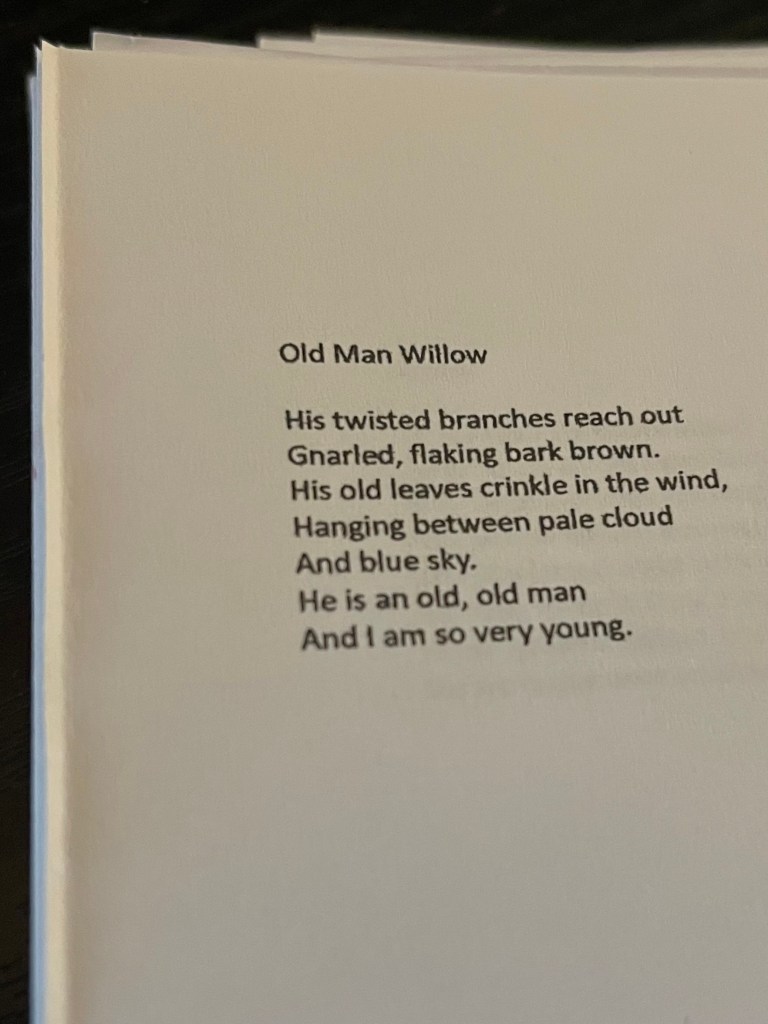
a poem

Shiver My Timbers

I shiver my timbers
In the sudden warmth of March
Lockstep
Towards the twelfth dread
Another spin around the drain
maelstrom’s fire scorching space

I fancy myself piratical
adrift, now making sail
Heaving to galactic destiny
Shanghaied
The siren sings of emancipation
Unlocking the depths

Yo oh heave ho
Haul anchors away
Into scarlet skies at night
Spinning yarns that couldn’t be told
Jones’ bones are allowed to speak
Dead man no more

Not all treasure
Is silvers of steel drenched
In blood
Pulled from beating hearts
Salty breezes sweep
Hearts high on sea swells

A Few Poems

In a bout of creativity, I wrote a few poems. I thought I would share them with the world.

First of all, a tribute poem, in free verse, about the death of AOL Instant Messenger, a program I used for many years at the beginning of the internet, in the long ago times, to chat with friends and family. Just today it was announced that AOL has shut down the service. Wow. Never thought I would see the day.

AIM

Little yellow person
Running ’round the world
Connecting…
Me to you to her to him
To talk
Life, and everything.
Until the twenty year rotation
Killed the connections
In favor of more tenuous tendrils:
Texts and time for faces
Time to run no more.
Rest in the graveyard
Of future things.
Did you leave an away
Message: R U there?

Next up is a little poem contemplating nuclear holocaust. It came to me in a moment at work the other day as I was watching a bubble of water skim across the dishwasher surface. After a brief moment, it suddenly popped, and there was a miniature shockwave that rippled across the water beneath. I live in fear that our stupid president might attack North Korea and start a nuclear war and no one will have the guts to stop him. A silly fear perhaps, but there it is. Here is my poem, also in free verse.

Push the Button

One should not
Push the button
Until one has under
Stood
The cataclysmic collapse
Of a water bubble

Finally there is a poem about the dignity of manual labor. Usually I don’t go in for that sort of thing, but as I was mopping the floor at work the other day it struck me that there is dignity in accepting what we have to do in the current moment and doing it to the best of our ability. As I said, I don’t think manual labor in and of itself imparts dignity or creates a work ethic that is worth anything, but I do think that doing one’s task well is worth, well, something. For better or worth, here is that free verse poem.


Quiet Dignity

Quiet dignity resides within
Back and forth
Back and forth
Simple mop and motion
Back and forth
Back and forth
Sweeping away yesterday’s
Crumbs and beet blood stains
Back and forth
Forth and back
For a change of rhythm
And pacing
Back and forth
Back and forth
Fan dries clean floors
The blades whir
Back and forth
Back and forth

A Haiku and Other Poems

Here follows a few poems I wrote over the summer, just for fun.

The first two poems I wrote while in traffic on my way to my summer job. I composed them in my head from a few images that came to me as I merged my way to my exit and wrote them down once I had safely parked. Of those two, the first is about a supercar in traffic, a concept I find endlessly amusing and a little bit sad, like a caged animal that deserves to be running free. I give you

Pent Up Rage

TwelV horses
Nowhere to race
Supercar in traffic

The second is a proper haiku about brake lights. For your consideration

Brakelite Haiku

Blinky red asses
Off and on the grey freeway
Little metal ‘flys

Next comes a poem that I wrote while in a local coffee shop called The White Rhino. I was struck by the seeming hipster-ness of it all, and was also contemplating the social justice warrior movement. Included herein are a play-on-lyrics, a reference to a video game, and well, here is

SJWs

The White Rhino watches
Over mocha choca lattes
And lonely hipsters who first
Saw the waves breaking over Dawn
Rifles clutched tightly
Ready to battle the better beasts
Of industry and backward progress
As if they themselves had come
From another era, man buns
Wound tight to ward off the right
A new wave
Of social justice warriors

And last, but not least, a baseball poem based on a William Carlos Williams poem about some rainwater, chickens, and a red wheelbarrow. There is, above the infield, a

Pop up

So much depends upon a white baseball
In the blue, blue sky
Plopping into
brown

leather

So there you have a few poems. I love them, like fragile little butterfly children that I release into the harsh winter air. Be kind to them.

Earth’s Mightiest Poems

I made it to Barnes & Noble this week earlier than ever before in the morning, just after the store opened. On a Friday, that meant the store was mostly empty and quiet, just perfect for a bit of poetry play and rhyming.

This time I worked along two avenues, one with two forms that mix and match a poet’s own words to form new poems, and the other in exotic forms in the vein of the haiku.

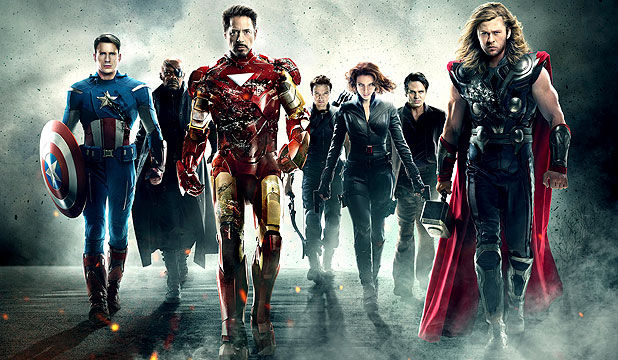
My theme today was the Avengers.

the Avengers
the Avengers

The first two forms I worked with were the Cento and the Clerihew. Both ostensibly re-work an existing poet’s lines of poetry to form new poems. Instead of taking an existing poet and his words, I instead worked from another medium that I enjoy: film. For my centos I remixed lines from the three Iron Man films to form poems. A cento also uses the name of the purloined poet as the first line of the poem, and in this case, the name of the movie. There is no meter or rhyme scheme.

Cento 1

Iron Man
Yeah, well, vacation’s over,
there’s the next mission, and nothing else.
(Sometimes you gotta run before you can walk.)
What you’re asking about: it’s me.

It’s not technically accurate,
I’m just not the hero type.
(Yeah, I can fly.)
The truth is: I am Iron Man.

Cento 2

Iron Man 2
It’s subtle, all the bells and whistles,
It’s a high tech prosthesis,
The suit and I are one:
It tastes like coconut. And metal.

The point is: you’re welcome,
I am your nuclear deterrent,
I’ve successfully privatized world peace:
it’s about legacy.

Cento 3

Iron Man Three
Let’s track this from the beginning:
we create our own demons,
the prodigal son returns.
Technically, I am Iron Man.

(I broke the crayon)
Everybody needs a hobby,
my armor was a cocoon:
I am Iron Man.

For these centos I tried to encapsulate what each film was about, speaking to both the plot and theme. And, as I said, all are composed entirely of lines spoken by Tony Stark/Iron Man.

Next was the Clerihew which is again formed by lines from an existing poetical work, for which I again used lines from a film, in this case, the first Avengers film. The clerihew uses the name of the poet for the first line of two couplets. There is no set length, and again, it is non-metrical and non-rhyming.

The Avengers

Thor
Who controls the would-be king?
Do I look to be in a gaming mood?
This is beyond you, metal man!

Tony Stark
Doth mother know you weareth her drapes?
Have you ever tried shawarma?
We have a Hulk.

Bruce Banner
So this all seems horrible.
I’m always angry.
Puny God!

Steve Rogers
There’s only one god, ma’am.
Put the hammer down.
We have orders, we should follow them.

Natasha Romanoff
These guys come from legend.
I’ve got red in my ledger.
This is just like Budapest all over again.

Clint Barton
You and I remember Budapest very differently.
Ever had someone take your brain and play?
I see better from a distance.

For better or worse: a clerihew. I tried to capture the core of each character, and also do a sort of call and response from one stanza to the next. In actual fact, each stanza is its own clerihew, as a proper clerihew is only four lines long. This is, truth be told, a super clerihew, just as the Avengers are a super team. Neat, huh? My cleverness knows no bounds, apparently.

Next up I tackled some more exotic forms. First, a Japanese form called the tanka, which is a five line poem consisting of lines of 5,7,5,7,7 syllables. Again, the Avengers gave me inspiration.

Hulk

Banner is a man
who got hit with gamma rays.
The man’s a monster
who turns tall and strong and green.
The Hulk is always angry.

Cap

Steven Rogers fights
for the small and helpless man.
The military
experiment made him strong,
time made him legendary.

Thor

He’s a demi-god
Thor from the realm of Asgard
He wields a hammer
a weapon to pound, a tool
to build a much better world.

After that I wrote a tanaga, a Filipino form consisting of four seven syllable lines, all rhyming.

Romanoff

Natasha’s a widow black,
a spy with assassin’s knack.
Fear and cowardice she lacks,
she shuts down the tesseract.

Finally, after all that, I wrote a Persian form called a Ghazal, which is written in couplets that rhyme the final word before an ending refrain. The ghazal is typically signed by the author in the last line.

The Avengers

There are six who fight: the Avengers.
In Loki they inspire fright, the Avengers.

Romanoff, a woman with widow’s bite,
Hawkeye, possessed of keen sight, the Avengers.

Thor, whose hammer throws light-ning
Captain America stands for the right, the Avengers.

Hulk, he smashes with green might,
Iron Man, a modern metal knight, the Avengers.

Though the world’s in a plight,
I, Redbeard, love to write the Avengers.

Do remember that all my poems are basically explorations of a form or style of poetry and are not claiming to be exemplars of said forms. They merely adhere to (most) of the rules of the form, no more, no less. Thus they are not great poems, or even good poems, but they are poems. I enjoy writing them, and as always, I hope you enjoy reading them.

(Repetitive) Poetry

I sojourned down to Barnes & Noble for my weekly poetry meet up with Stephen Fry (oh how I wish I could actually meet up with Fry to write poetry!). It was a cool, crisp fall morning, just perfect in every way.

Today’s poetry is a continuance of the rigid forms I have been exploring, with repetitions and rhyme schemes and convoluted processes. It sounds burdensome, but when you get into writing within the form, it can be quite fun to see the poem unfold. Today I have two (one is quite long, which is why I only have two): the sestina and the pantoum which my spell check wants to correct into phantom. Anyway, the sestina repeats ending words in a specific pattern at length followed by a three line Envoi that includes all six ending words in a set pattern. There is no official metre, though I have chosen iambic trimeter for my sestina. There isn’t a rhyme scheme, other than the way repeating words might be said to rhyme. As given to me by my friend Bobby Callaway, the theme of my sestina was “double” whatever that may mean to me.

Double

I wash my face and stare
into the frosty mirror.
What I see there scares me,
or is it me I see?
It could be him that looks
at me from out that glass.

I wipe and clean the glass
and start to climb the stairs.
From each picture a look
at me as if a mirror.
Each one is tossed, a sea
of thoughts churning in me.

I want to know: who’s me?
My soul’s fragile, like glass.
The cracks that form, I see,
I lose my gaze, I stare:
each one a hundred mirrors.
I am compelled to look.

Within each crack, a look,
a gaze, another me.
Each one another mirror.
Am I hollow as glass?
Do they, at me, all stare?
All this I can’t un-see.

But now that this I’ve seen,
I’ll take another look.
With new purpose I stare
into the eyes of each me
and find, as clear as glass,
the clear answer in’th mirror.

I’m me and him, mirrored,
each self that I have seen
in every single glass
a different side, new looks
at the same old, same me
at whom each day I stare.

Envoi

Into the mirror I look
And now just see just me
into the glass I stare.

So there you have it: a sestina. By nature, a long poem as it takes time to work through all the ways the end words may be jumbled. It can continue indefinitely, but with each sixth paragraph it starts to repeat the way the lines end.

Onto the next, the pantoum. The pantoum has an endless number of four line stanzas, each line composed of 8 syllables, and ending with a rhyme scheme of ABAB BABA etc. At least, it should rhyme, but it doesn’t have to. Additionally, starting after the first stanza, the second and fourth lines of each stanza are repeated as the first and third lines of the next stanza until the poem ends, in which case the first and third lines of the first stanza become the second and fourth lines of the last stanza. The explanation will perhaps be clearer with my example. The repetition and rhyme often lends itself to solemn themes, so I have chose the Battle of Hoth, from Star Wars: the Empire Strikes Back as my theme.

Invasion: Hoth

It’s a cold, snowy day on Hoth
The battle lines are drawn in snow.
Lord Darth Vader, all black and goth:
fear in the hearts of rebels grows.

The battle lines are drawn in snow,
The Imperials cut a swath.
Fear in the hearts of rebels grows
of troopers, white visigoths.

The Imperials cut a swath
Vader at their head, a black crow,
and troopers, white visigoths,
rebel blood in red icicles flows.

Vader at their head, a black crow,
Lord Darth Vader, all black and goth,
Rebel blood in red icicles flows:
it’s a cold, snowy day on Hoth.

This pantoum is fun, a bit like a villanelle, but to my mind and poetical sensibilities, a bit easier to pull off.

I hope you have enjoyed this week’s poetical musings, with all their repetitions and fun-ness. I certainly have. Until next week, then…

Offerings

I almost didn’t go to my weekly get away to Barnes and Noble, but I pushed myself to go and I am so glad I did. It was a beautiful evening, one of the last we will have this year most likely, and the drive from my apartment to the bookstore with the windows down and the breeze blowing by was just perfect. I even got an idea for one of my poems on the way there.

Today’s offerings coming in the form of: the rubai, which is at least a twelve line poem with the rhyme scheme AABA, CCDC, EEFE and so on; the Rime Royal which is a seven line poem with the rhyme scheme ABABBCC; and the Ottiva Rima which is an eight line poem with a rhyme scheme of ABABABCC, and which is very similar to the Rime Royal. In that order I give you today’s poems. I written the first two in iambic pentameter, and the last in trochaic pentameter for those of you who know what that means (or remember from a previous posting.) Anyhow, after much ado, the poems. For real now.

Summer

The smell of fries upon the afternoon air,
it makes me hungry for a burger. Fare
with which I fill my summer stomach full
of times without a trouble or a care

The laughing little children remind me
of a simpler, an uncomplicated mead
to down and quench the thirst of adventure
of climbed trees, swum holes, and scraped knees

Oh, Ah! The summer time it tastes so sweet!
A truck rumbles with melody down the street
its back so full of treats and iced creams
the perfect thing to make the even’ complete.


Lament for Lars

Stark white stormtroopers swarm the moisture farm
they look for droids of blue and white and gold
the minions of an Empire mean them harm
Alas! for them to whom the droids been sold
Oh Uncle Owen tries the droids withhold
but blaster fire and death is his reward
as Owen, Beru burn in the courtyard.


Literary Snob

Night has fallen over rows of bookshelves
Among poets, authors, and the restless
I would say that we have lost ourselves.
At least these books have worth unlike artless
hordes of barbaric souls who pride themselves
having read the crummy soul-less awe-less
pulped fiction that’s all the rage these days
I wish I could burn them all in a blaze!

Ok, so that last one makes with some eye rhymes (words that look like they rhyme when they don’t really) and they all play a bit loose with the meter, but it was the best I could come up with at the time. Remember, these are but practice and folly. I make no claims to poetical greatness. I have fun writing and attempting the forms. I hope you enjoy reading them.