
Warrior Poet’s Way

It was cold this morning as I headed to Barnes and Noble, but it was a pleasant, autumn cold. I found a table and began writing. Halfway through my phone’s battery died, so I surreptitiously pulled a rhyming dictionary off the shelf and continued working. I managed to write three poems before the rozzers wanted their book back, but by then I was creatively spent anyway.

Today we have a ballade, not to be confused with a ballad, a rondeau and a rondel. The last two are French in origin. The ballade has a long a complicated rhyme scheme of ABABABBABA, and the final line of the stanza repeats as the final line of every stanza, followed by an envoi of four lines (again with that repeated line at the end). Usually they are written as to a prince, or patron, of the arts. Given my recent poetical adoration of pop culture, I have gone with a steady diet of Star Trek related themes in today’s poems. This first one hails from Kronos, the capital of the Klingon Empire.

Klingon War Ballade

Klingon Empire
Klingon Empire

My son, lift your bat’leth to the sky
the un-fought enemy is worst, I deem.
From cowardice and fear, fly!
Your Klingon brothers are your best team,
May you over the battlefield teem.
So let loose with battle cry!
To my advice there is but one theme:
Today is a good day to die!!

My son, raise your mek’leth high
and listen to this battle scheme:
A running man’s blade is never dry,
four thousand throats he may un-seam
in one night. He bathes in blood’s stream,
to his enemies he bids good-bye,
destroyed by disruptor beam.
Today is a good day to die!!

My son, strap a d’k tahg to your thigh,
and remember Sto-Vo-Kor‘s steam
awaits the warrior bold, so do not sigh.
Make your weapons shine and gleam,
build your battle regime:
Sharp knives are nothing without sharp eyes,
serve revenge cold for a taste supreme.
Today is a good day to die!!

Envoi

Prince, Tonight may your blood scream.
Tonight, eat deep of the bloodwine pie.
Tonight of victories may you dream,
Tomorrow is a good day to die!!

I’ve added links into my poem to the unfamiliar words, so you dear reader can know what I am talking about. Mostly they are Klingon weapons, Sto-Vo-Kor is the Klingon heaven, and bloodwine is a traditional Klingon beverage. I’ve also adapted several Klingon adages into the poem such as “A running man can slit four thousand throats on one night” and “Revenge is a dish best served cold” and of course the refrain is perhaps the most popular Klingon battle cry of all time “Today is a good day to die!”. I’ve written the poem as from a Klingon father to his young son, perhaps just before bedtime.

Next up is a Rondeau which has a complicated rhyme scheme of RABBA AABR AABBAR. The last line of the last two stanzas comes from the first half of the first line. The most famous example of this form is “In Flander’s Fields”. In my attempt I have again mined Klingon culture.

A Klingon Warrior’s Song to his Foe

Share in death, my warrior bold
Revenge is a dish best served cold
Fight to the end, do not a coward be
My mek’leth you’ll never see
You will not age, never grow old

Your life is forfeit, your fortune sold
You’ve nothing left, no sword to hold
Do not hide, stand straight and free,
Share in death.

When this battle, the end is told,
I’ll be heaped, be buried in gold
No, I will not, cannot hear your plea
Mercy will not come, I’ll not save thee
No grave you’ll have, only this wold
Share in death.

This poem turns on the old Klingon proverb that “Death is an experience best shared”. Next up is a rondel, which repeats the first two lines of the poem in the middle and again at the end while alternating rhymes throughout. For this one, I changed paces and traveled to Ferenginar, home of the Ferengi, a race completely obsessed with amassing wealth. This poem extols the virtues of Ferengi culture.

The Ferengi Heart

Ferengi Alliance
Ferengi Alliance

Nothing is sweeter than profit,
Latinum is the best of all.
I’ve heeded the greedy call
Of business and acquisition, her prophet.
I’ve made gold my precious cossette,
Wealth keeps me in thrall.
Nothing is sweeter than profit,
Latinum is the best of all.
I’ll steal as much as I can haul,
All I fear is the FCA audit,
All I need is Ferengi plaudit,
Charity is the only thing I appall.
Nothing is sweeter than profit,
Latinum is the best of all.

Highly amusing to me, and if you know anything about Ferengi culture, a highly accurate poem. Again I have hyperlinked some of the more obscure references.

I hope you have enjoyed my foray into the Star Trek galaxy, I know I have. Until next time, live long and prosper!
(Repetitive) Poetry

I sojourned down to Barnes & Noble for my weekly poetry meet up with Stephen Fry (oh how I wish I could actually meet up with Fry to write poetry!). It was a cool, crisp fall morning, just perfect in every way.

Today’s poetry is a continuance of the rigid forms I have been exploring, with repetitions and rhyme schemes and convoluted processes. It sounds burdensome, but when you get into writing within the form, it can be quite fun to see the poem unfold. Today I have two (one is quite long, which is why I only have two): the sestina and the pantoum which my spell check wants to correct into phantom. Anyway, the sestina repeats ending words in a specific pattern at length followed by a three line Envoi that includes all six ending words in a set pattern. There is no official metre, though I have chosen iambic trimeter for my sestina. There isn’t a rhyme scheme, other than the way repeating words might be said to rhyme. As given to me by my friend Bobby Callaway, the theme of my sestina was “double” whatever that may mean to me.

Double

I wash my face and stare
into the frosty mirror.
What I see there scares me,
or is it me I see?
It could be him that looks
at me from out that glass.

I wipe and clean the glass
and start to climb the stairs.
From each picture a look
at me as if a mirror.
Each one is tossed, a sea
of thoughts churning in me.

I want to know: who’s me?
My soul’s fragile, like glass.
The cracks that form, I see,
I lose my gaze, I stare:
each one a hundred mirrors.
I am compelled to look.

Within each crack, a look,
a gaze, another me.
Each one another mirror.
Am I hollow as glass?
Do they, at me, all stare?
All this I can’t un-see.

But now that this I’ve seen,
I’ll take another look.
With new purpose I stare
into the eyes of each me
and find, as clear as glass,
the clear answer in’th mirror.

I’m me and him, mirrored,
each self that I have seen
in every single glass
a different side, new looks
at the same old, same me
at whom each day I stare.

Envoi

Into the mirror I look
And now just see just me
into the glass I stare.

So there you have it: a sestina. By nature, a long poem as it takes time to work through all the ways the end words may be jumbled. It can continue indefinitely, but with each sixth paragraph it starts to repeat the way the lines end.

Onto the next, the pantoum. The pantoum has an endless number of four line stanzas, each line composed of 8 syllables, and ending with a rhyme scheme of ABAB BABA etc. At least, it should rhyme, but it doesn’t have to. Additionally, starting after the first stanza, the second and fourth lines of each stanza are repeated as the first and third lines of the next stanza until the poem ends, in which case the first and third lines of the first stanza become the second and fourth lines of the last stanza. The explanation will perhaps be clearer with my example. The repetition and rhyme often lends itself to solemn themes, so I have chose the Battle of Hoth, from Star Wars: the Empire Strikes Back as my theme.

Invasion: Hoth

It’s a cold, snowy day on Hoth
The battle lines are drawn in snow.
Lord Darth Vader, all black and goth:
fear in the hearts of rebels grows.

The battle lines are drawn in snow,
The Imperials cut a swath.
Fear in the hearts of rebels grows
of troopers, white visigoths.

The Imperials cut a swath
Vader at their head, a black crow,
and troopers, white visigoths,
rebel blood in red icicles flows.

Vader at their head, a black crow,
Lord Darth Vader, all black and goth,
Rebel blood in red icicles flows:
it’s a cold, snowy day on Hoth.

This pantoum is fun, a bit like a villanelle, but to my mind and poetical sensibilities, a bit easier to pull off.

I hope you have enjoyed this week’s poetical musings, with all their repetitions and fun-ness. I certainly have. Until next week, then…

An Ode to Odes

It was cold and rainy as I made my weekly trek to Barnes and Noble, a perfect fall day. On the trees the leaves were changing and in the air there was a crispness. I felt juvenated and alive. I sat down at a large table in the back of B&N and took out my copy of the Ode Less Traveled and began to read and write.

Today’s forms included the many types of odes. These days an ode can refer to any kind of poetry, but there are specific forms that are “proper” odes. Among those I attempted the sapphic ode, the pindaric ode, and the horation ode. A sapphic ode is usually written with three stanzas, and each stanza is composed of four lines, three of iambic tetrameter and one of iambic dimeter. I say usually because there are many variations possible within the form, but as described is the classic form.

An Ode to Stormtrooper Armor

All gleaming white, the armor stands,
the black insidious eyes do stare.
It clothes the Empire’s ruthless bands;
should just be bare.

It takes a hit, a hole appears;
the soldier dies, a flash of light
upon the chest: what poor career
the choice, a blight.

Why wear the armor bright? It yields
no benefit. The man beneath
just groans and dies. Bury him in fields
of green, the heath.

A pindaric ode is written in three stanzas. Each has a function, and while overall the meter is variable, each stanza must be composed identically in form. I chose to write each stanza with four lines of iambic dimiter, trimeter, tetrameter, and pentameter in ascending order. This ode need not rhyme. Actually, no odes need to rhyme as odes are originally a Roman thing, and there isn’t much rhyme outside of English.

An Ode to Stormtroopers

Strophe (Turn)

All hail!
the brave, the few, the true,
an Empire’s legion: stormtroopers.
They fight and die to win the Empire’s day.

Antistrophe (Counter Turn)

But they
cannot take aim or shoot
a straight and forward beam of light
at their targets, through “crack” and “best” they be.

Epode (the Stand)

Perhaps:
secret rebel dreams hold
behind their masks of white and black
to let the heroes live to fight back.

Then there is the Horation ode, which is much like the pindaric ode where the prevailing method of the form is that it remain consistent to each stanza. I chose three lines of iambic trimeter and one line of iambic pentameter. Just because.

An Ode to Barnes & Noble

I love thy smell of books
and coffee commingled in’th’ air
I love thy stacks and rows
of history, humor

of toys and games and Nook
the digital book for all
and desks at which to sit
to read and write a poem

There are a few other odes, some proper, some not, but due to the variability and required subject matter, I skipped them.

Lastly I moved to other forms and attempted a villanelle, which is a fun, favorite form that I love to try. A villanelle has no set meter, but does have a set rhyme scheme in which certain lines repeat. Usually it is A1BA2, ABA1, ABA2, ABA1, ABA2, ABA1A2.

An Villanelle Ode to Baseball

Baseball is a many pleasured thing:
the ball that buzzes, the bat that cracks;
it starts after the anthem rings.

Pitcher fires the ball, batter takes a swing,
he hits a double with a mighty thwack!
Baseball is a many pleasured thing.

The runner’s picked off, a sneaky sting.
He jogs to the dugout, bent back.
It starts after the anthem rings.

The submariner a curveball slings,
the batter whiffs, the ball glove smacks.
Baseball is a many pleasured thing.

The centre fielder to the wall springs,
he leaps and makes the catch at the track:
it starts after the anthem rings.

It all can change with just a swing,
a swift strike or a homer bat crack,
baseball is a many pleasured thing:
it starts after the anthem rings.

As usual, I claim no greatness or mastery, unless it be of fun and adherence to form. I do my best to enjoy the process of writing and sharing poetry, and leave greatness to the eventual tinkering and adjusting that is editing and the time that is the measure of all things. I only hope you enjoy reading my poems as much as I enjoy sharing them.


Pop Culture Poesy

This week I did make it to Barnes and Noble, I am merely late in posting about it. I went earlier in the day than I normally do, and perhaps as a result, my normal table was occupied. I was forced to find a table at the local Starbucks-in-a-bookstore that almost all Barnes and Nobles have these days. It wasn’t entirely unconducive to poetry work, though it was a bit louder than I am used to, more idle conversation less quietly browsing of the stacks.

This week’s poetical musings are in the form of the ballad and heroic verse. The ballad is written in a variety of standards, but most popular is one with alternating lines of iambic tetrameter and trimeter and a rhyme scheme of ABAB. Heroic verse is not mostly about Iron Man and Batman, but is in fact a simple iambic pentameter with a rhyme scheme of AABBCCDD.

This week I decided to dedicate my poetical notions to Star Wars.

The Ballad of Luke and Leia

Now gather round and let me tell
the tale of Luke and Leia.
The sandborne son, the Alderaan belle
their love, it’s true, a fluke.

Never had he known love at all
and she was much too busy
He knew only sand and droids tall
She knew politik privy

But she fell in with Imper’al types
and he came to her rescue
then they did kiss, an act most hyped
not knowing they were askew

For he was her long lost brother
and she was his own sister
then they will help discovered the other
still he, yet twice, had kissed her.


It won’t light the world on fire, but I find it amusing enough. Of note, my rhyme scheme is ABAC, and in the first stanza it really should “Leia and Luke” but it just sounds better the other way around, to me at least. Now: to my heroic verse.

Obi-Wan’s Confession

Dear Luke, I must confess to you a truth:
a move I made for your fam’ly in youth.
The move’s become a mistake you must now know
Before this ill advised, ill love can grow.
Your knowledge is not complete, I must tell
you things you need to know, this love to quell.
A single child you are not, now nor ever
have been. You have a sibling. If you’re clever
you will know of whom I speak to you…
Yes. True. The one I mean is your new boo,
the one you have now kissed: your sister.
Shall we now chalk it up to this, you missed her?

Again, nothing very profound or even that good, but again, it amuses me. I had trouble with the rhymes in this and the ballad, but I did my best. Some are obvious, some are clunky, but at least all rhyme. I do, however, like this idea of adapting pop culture to old poetical forms. I think I will continue to do so. Until next time, do enjoy!

Offerings

I almost didn’t go to my weekly get away to Barnes and Noble, but I pushed myself to go and I am so glad I did. It was a beautiful evening, one of the last we will have this year most likely, and the drive from my apartment to the bookstore with the windows down and the breeze blowing by was just perfect. I even got an idea for one of my poems on the way there.

Today’s offerings coming in the form of: the rubai, which is at least a twelve line poem with the rhyme scheme AABA, CCDC, EEFE and so on; the Rime Royal which is a seven line poem with the rhyme scheme ABABBCC; and the Ottiva Rima which is an eight line poem with a rhyme scheme of ABABABCC, and which is very similar to the Rime Royal. In that order I give you today’s poems. I written the first two in iambic pentameter, and the last in trochaic pentameter for those of you who know what that means (or remember from a previous posting.) Anyhow, after much ado, the poems. For real now.

Summer

The smell of fries upon the afternoon air,
it makes me hungry for a burger. Fare
with which I fill my summer stomach full
of times without a trouble or a care

The laughing little children remind me
of a simpler, an uncomplicated mead
to down and quench the thirst of adventure
of climbed trees, swum holes, and scraped knees

Oh, Ah! The summer time it tastes so sweet!
A truck rumbles with melody down the street
its back so full of treats and iced creams
the perfect thing to make the even’ complete.


Lament for Lars

Stark white stormtroopers swarm the moisture farm
they look for droids of blue and white and gold
the minions of an Empire mean them harm
Alas! for them to whom the droids been sold
Oh Uncle Owen tries the droids withhold
but blaster fire and death is his reward
as Owen, Beru burn in the courtyard.


Literary Snob

Night has fallen over rows of bookshelves
Among poets, authors, and the restless
I would say that we have lost ourselves.
At least these books have worth unlike artless
hordes of barbaric souls who pride themselves
having read the crummy soul-less awe-less
pulped fiction that’s all the rage these days
I wish I could burn them all in a blaze!

Ok, so that last one makes with some eye rhymes (words that look like they rhyme when they don’t really) and they all play a bit loose with the meter, but it was the best I could come up with at the time. Remember, these are but practice and folly. I make no claims to poetical greatness. I have fun writing and attempting the forms. I hope you enjoy reading them.

Adazzle!

My pup is sitting on top of my knapsack, clearly miffed that she can’t sit on the keyboard of my Macbook Pro. I am here typing up my latest poetical offerings from my weekly sojourn to Barnes & Noble. I am starting to really enjoy my time spent there, reading and writing poetry. Today’s poems included syllabic verse, and two poetical forms, the terza rima and the quatrain.

Syllabic verse, most famous of which is the haiku, is poetry based on number of syllables per line as opposed to metrical feet or stresses or what have you. I wrote two syllabic verse poems, one on rain, the other on hygiene, topics as suggested by my muse, Stephen Fry of The Ode Less Traveled. The first poem is written with alternating lines of 5 and 7 syllables. You can work out for yourself the syllab count of the second poem.

Rain

Gently falling from the sky
staining the dry ground
with dripping drops of moisture
the clouds seem to cry

But to weep or not to weep
the rain is welcome
farmers rejoice to see water
around their crops seep


Hygiene

It starts with
a gentle scrubbing of
me
from head to toe
teeth, hair, skin, nails
brush’d
now I’m clean enough for
society.

External
cleanliness is only
part
of the story
how does one scrub the inner you
from filthy things?
start
not by drinking draino
it won’t work.


I amuse myself thusly. Anyway, I then went on to formal poetry, that is poems adhering to a form, the most famous of which is probably the sonnet. I played around with terza rima, a poetical form that alternates rhymes at the end of the lines in an ABA BCB CC pattern. My terza rima was written in iambic pentameter on the subject of World War Two.

Untitled

The greatest generation: historically
they fought and died to save the world from sin.
The wars, once won, they danced euphorically.
We shudder, thinking what might have been
if Germany had won the war of wars.
Might we now march to songs of Hitler’s din?
But all our praise to women, men, the corps
who fought and died. To them we raise a chorus.


Not very good, perhaps, but it adheres to the form and it rhymes, at least partly. Lastly I wrote two quatrains, a poem with a rhyme scheme of ABAB in any number of stanzas, also in iambic pentameter.

This Town

Just one Post Office, a single stop light
banks: three, churches: four, a people: one.
Though old and worn our town is full and bright;
it is the best old town we love under the sun.


Poesy

A poem is hard to write in meter and rhyme
to sort the accented syllabs and foots
it takes much thought and lots and lots of time
the page gets covered in pencil soot

As the poet writes and carefully rewrites the lines
when one, like gold, is writ it is like loot
pulled from vault or chest, a most heinous crime
of literary kind, but hark! the poem takes root!


Again, not very good, but that isn’t the point at the moment. The point is to adhere to form and that I have done. By the way, as I have used it twice now, syllab is my non-word word for syllable. I always thought it could use a shortened form. And the title for this post, “adazzle” means “glitteringly bright” and was a new word that I came across in my reading today. I learned it and now I share it with you.


Great god Poesy

I spent another evening at Barnes and Noble, reading and writing poetry. I had fun with anapests and dactyls and Anglo-Saxon poetry. I am constantly reminded how much I love poetry, in all its various forms and delicious iterations.

While these poems that I present are not very polished, or very perfect, I find them fun and delightful. Mostly these are practice poems for different techniques and methods. Enjoy them as such.

This first poem is written in anapestic hexameter. That means that each section of the poem is written with two unaccented syllables followed by one accented. Hexameter refers to the number of sections in the line, in this case, six sections. Despite the long lines, this is still a poem and not a block of prose.

Directions to Home

From the twelve, take a turn past the Toys R US straight on down straight as you go
Do not turn to the left or the right, resist Dunkin Doughnuts as you pass,
Right turn, Glacier Hills Apartments is your destination. Now find a spot.
When you’re parked, ring the bell, or call me, and I will let you into the room.


This second poem is written in dactylic pentameter. A dactyl is the inverse of a anapest, which means one accented syllable followed by two unaccented syllables. Pentameter refers to the number of sections in the line, in this case, five sections. In actual fact in this poem, the first four sections are dactyls, the last is a spondee which is two accented syllables in a row. This poem is broken up into six lines, but is actually a three line poem. I think it looks better, and breaks up the rhythm ever so slightly, to put the spondee on its own line. Nevertheless, it is to be read continuously from each line to the the next.

Cows

Mooing in darkness now, cows all ’round chewing the
green cud.
Black and white, horned and spotted beasts bovine in
nature,
Deadly to grass and wheat. Even better to me when
hamburger.


This last poem is in Anglo-Saxon verse. Anglo-Saxon verse, in this case, is comprised of alliteration in three accented syllables and one accented syllable of a non-alliterated syllable.

To Eat or Not

No green gabled broccoli or gagh* for me.
I wouldn’t mind ice cream instead of pie,
Though punkin is peachy and perfectly fine,
Pizza is always a perfect pie, I’ve found.
I don’t mind doughnuts, but dumplings are out.
Chicken is choice when children shout for nuggets.
Burgers with bold bacon and cheese,
Are favorite, fun and fantastic to me.
I don’t know now what I’ll nom tonight
Probably popcorn or peas, something random.


Each topic here was suggested by the book I’m working through, The Ode Less Traveled by Stephen Fry. He always finds fun topics to focus on for the practice poetry, in this case directions to my place of residence, cows, and what I’d like to eat or not. Until next time…

*gagh is a Klingon dish. Read about it here.

Poems for the Poetical

poetry
poetry

I spent my evening at Barnes and Noble, a surprisingly quiet place to hang out, and worked through more of Stephen Fry’s The Ode Less Traveled. Here follows a few moderately good poems borne of the exercises that he suggested. As you might be able to tell, the subject was television. Enjoy.

Star Trek: Enterprise

They trek through stars in ships and pods
They beam and fight and talk and look
At blue Andorians, it’s true!
And pointy-eared Vulcan soldiers.

They meet a Tellerite trader,
The Borg, though they should not yet be
And the father of the fathers
of Data and Lore: Doctor Soong.


Chuck

Bartowski, Sarah, and Morgan,
John Casey, Gen’ral Beckman.
It’s Chuck: the nerd, the spy, the man.
He fixes PC’s and

The world when its at risk by spies
And Fulcrum, Ring, and Volkov.
It’s Chuck: the man, the nerd, the spy
Who wins each day and night!


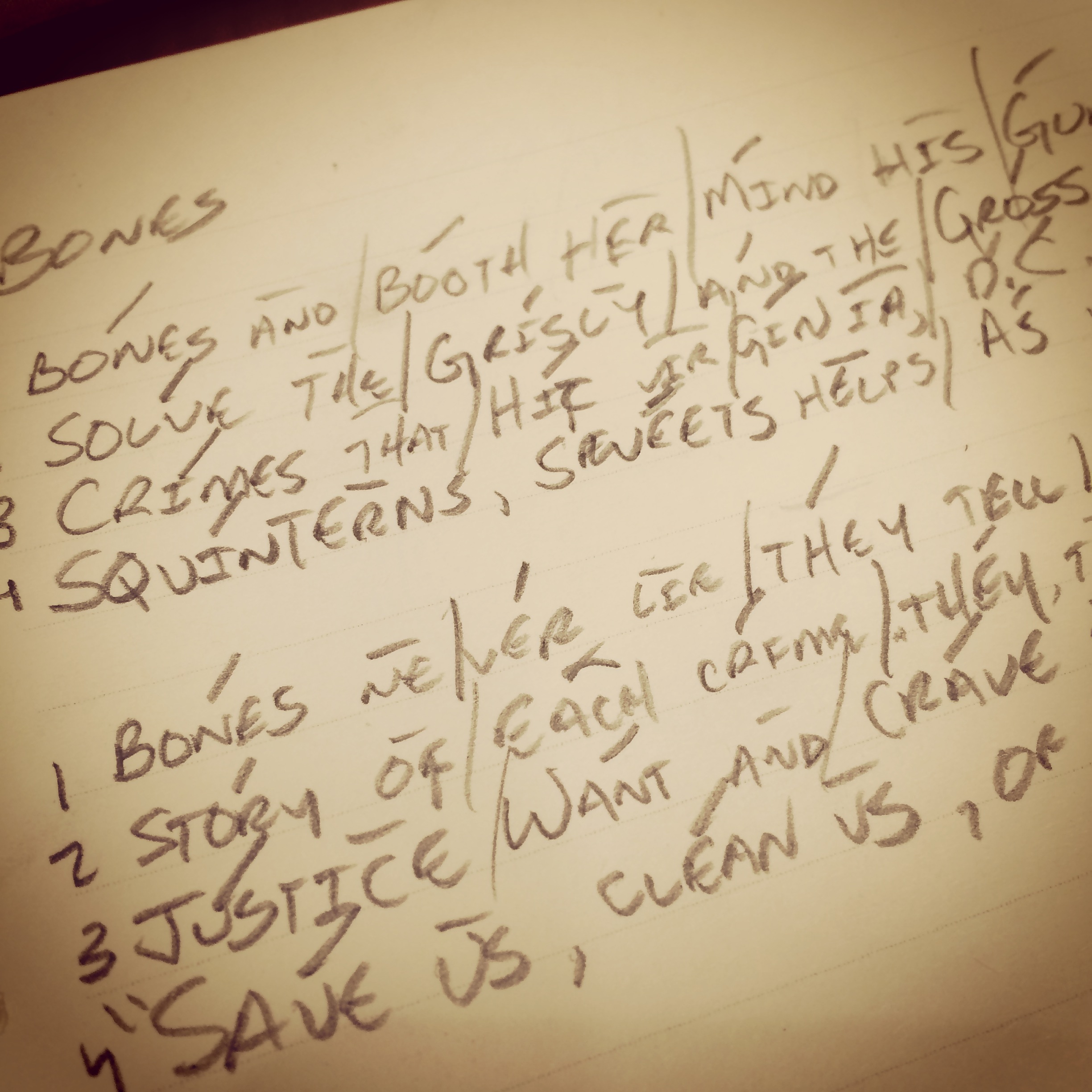
Bones

Bones and Booth, her mind his guns,
Solve the grisly and the grossest
Crimes that hit Virginia, D.C.
Squinterns/Sweets helps as well. Sometimes.

Bones never lie, they tell the truthly
Story of each crime. They, the bones,
Justice want and crave so mightily.
They cry: “Save us, clean us, of Sin!”


I was working with iambic tetrameter “Star Trek: Enterprise”, iambic tetrameter/trimeter “Chuck”, and trochaic tetrameter “Bones” if you were curious. Though, if you are good with scansion you might notice that none of these are consistent. Chalk it up to either bad form or creative license, depending on whether you mean me criticism or praise.


Little Poems

I sat down to sharpen a pencil, because I was depressed and couldn’t fathom anything more. I ended up with 12 lines of iambic pentameter and two little poems. There might be something to this. Seriously, these poems are not great or amazing, but I am so happy right now, in a depressed sort of way. Without further ado…

The Bills

The bills are stacked some ten or twenty high
they must be paid today or soon or else
someone may come to take away my funds
and leave me high and dry without much fun


Albatross

But you cannot take ‘way the sky from me
it is my home my life my everything

my little albatross is fair and wise
beyond her years she flies with me for luck
she reads the minds of lesser folk its true
but freak or not my River is my crew


The second poem is inspired by the TV show Firefly, and once I figured out that albatross had enough syllables to scan into iambic pentameter the rest of the poem kinda flowed. But like I said, these are rough and simple, but they make me smile because of reasons.


The Ode Less Travelled

Recently I have been floundering, awash in a sea of self-doubt, self-loathing, and self-not-going-anywhereness. These are symptoms of depression and part and parcel with a life lived with anxiety. The depressed individual often finds simple tasks difficult, and finds it difficult to do anything of any import. That has certainly been me.

But lately I have wanted to break free, to really lurch forward, and make a road for myself. I wrote previously about Joss Whedon, and that somehow he found the time while filming the Avengers 2 to write a simple little folk song called “Big Giant Me”, and is collaborating with the artist who performed it to produce an EP. If Whedon can find time and energy like that, surely I, in the midst of my depression and social anxiety, can find time to make my own road.

To that end I have blown the dust off a book I picked up in college entitled The Ode Less Traveled: Unlocking the Poet Within by Stephen Fry (and yes, the Stephen Fry of staggering Twitter celebrity, of Jeeves and Wooster, of A Bit of Fry and Laurie, and of V for Vendetta and the Hobbit trilogy). In this book, Fry helps the gentle novice explore the world of poetry from beginning to villanelle.

I consider myself more than a novice in the poetical world, but the truth is, I write mainly free verse, and I’ve never labored to master meter or many poetical forms. This is something that I would like to remedy. I would like to explore and push myself to learn and to obey the rules as the masters of the craft have done. Maybe I will still mainly write free verse, but I would like to know that I have done what I can to learn the ropes, as it were.

To that end, I will work through the Ode Less Travelled with Stephen Fry and learn what I can. When I am depressed and anxious, hopefully I can push myself to create just a little. Having a guide and a path easily marked usually helps the depressed individual move along, and the Ode Less Travelled should be such a guide and a path for me. Whatever else I may be, I want to be a poet. Perhaps I can unlock my Poet Within.

I tell you about it because I have a need to share most things, and because I want this to be real. I will be sharing what I write with the world, and I am starting at the beginning. Thus far I have mastered the introduction and end user agreement of the book. Well, almost. Mr. Fry wants his readers to have a notebook to keep with them always, as well as writing utensils, and I think buying a new notebook and new pencils will make this somewhat more real to me. To that end I must do something else I am loathe to do: enter the world of men and move around, but I think I will head to Barnes and Noble, a place certain to have what I need, and also a quieter place in the wide loudness of the world.

So pray with me, as I pray to the universe, to allow me this small breakthrough of my depression, that it may lead to greater and bigger things, or a least a little poetry.