The Power of a Like

I exist on a variety of social media platforms, (Facebook, Twitter, Instagram, I think I even have an unused Tumblr sitting around somewhere) and sometimes I post things and sometimes I get likes on them.

For instance, I recently posted this on Instagram, a picture of blue cake with yellow icing. I got a few likes, one from a cousin I haven’t seen since I was 7 or something, one from a friend I haven’t seen in a few years, one from an aunt I haven’t seen in a few years, one from a friend I haven’t seen since college, and one from a person I have never met.

But the in the instance of each like, I felt connected to each person, if only for the briefest of seconds.

My cousin just recently got married, in a very bohemian wedding, in a way that I have come to know is totally her. My friend loves Harry Potter and is a total NERD. My aunt is one of the best people I have ever known. She recently was at a beach. My college friend is a professional photographer, and I love seeing her work, mostly of weddings and other portrait sessions, but also of her dog in the snow and the early morning sun cracking over the Adirondack mountains. One person apparently likes blue cake with yellow icing and posting pictures of LEGO.

I’ve heard all the arguments about how people are glued to their phones and how they don’t interact anymore, and how the world is losing something in its increasing digitalization. But each time my phone notified me of a like on my silly Instagram picture of  blue cake with yellow icing I felt more connected in that instant than I had before.

Sure, two of the five people I’ve known since I was born. The others a few years. One I’ve never met. But I follow each on Instagram and thus see the slivers of their lives that they share through little square pictures.

Maybe that is the sad realization of the times, but look at who I was connected to: two friends, a cousin, an aunt, and a person I know only by screen name. The cousin lives in California, the friend and aunt in Virginia, the college friend in New York, and I haven’t the foggiest notion where the other person lives. And I, in frigid Wisconsin, was connected to them all in an instant. At that exact moment in time, I knew that each was doing what I was doing: looking at my picture on Instagram.

Their likes said that they saw a piece of blue cake with yellow icing and it made their moment. They “liked” it. In that moment, it compelled them to tell me that, only that, simply that, merely that. None of them felt the need to leave a comment or communicate further, and that is ok. This isn’t about comments or actual communication, this is about sideways communication, the power of a like.

A like is a very simple way of saying: “You put this in the world, where it didn’t exist before, and I like that”.

I like that, too. I also liked my blue cake with yellow frosting. It was delicious.

(By the way, if you are interested in following me, you can find me on most social media platforms as PhilRedbeard.)

League of Justice #1.3: “This Mortal Coil”

Smallville, Kansas

Clark was like any other boy, the first few years of his life. He burped, he messed his diaper, he learned to talk, he learned to walk. It was when he learned to fly that Ma and Pa Kent knew he really was from another world. Clark was five, and was hanging from the ceiling fan in his bedroom, spinning in a slow circle and giggling incessantly.

“Clark! Come down from there this instant!” Martha wasn’t going to put up with any horseplay. Not in the house, anyway. Clark released his grip on the fan blade and floated downwards. Martha snatched him out of the air.

“You know better than to do that!” It was only then that Martha realized what exactly had happened. She was so used to being unsurprised by anything that it took a few seconds for the surprise to hit her. She clutched Clark tight, who by now was squirming to be let go, and ran into the kitchen. There Jonathan was enjoying a ham sandwich for lunch.

“Jon…our baby can fly.”

“What?”

“I said, ‘our baby can fly’!”

“Yes. I heard you. Doesn’t look like it.” Jonathan gestured to the struggling toddler, still in his mother’s arms.

“He was hanging from his ceiling fan and when I told him to get down he just floated into my arms.”

“Well.” Martha expected her husband to say more, but he didn’t.

“Well what?”

“I don’t know. I’ve never encountered a flying baby before.”

“I’m not a baby.” Clark entered the conversation with indignity on his face. “Can I go play?”

Martha looked at Jonathan and he looked back. Eventually he turned to Clark. “Yes. But stay on the ground and inside, ok? No…” he searched for the right way to explain things to a child “…floating. Understand?”

Clark looked at him curiously for a second before he nodded and twisted out of Martha’s arms. He scampered off towards the playroom.

“So…our boy can fly. Or float, at least. That’s new.”

“Jon…what is he?” Martha, for the first time, appeared to be frightened.

“Our son, Ma.” Jonathan reached out to hold her hands. “No matter what else, he is our son. We always knew he was different. Now I guess we find out just how different he is. After all, he did come from somewhere else.” Jonathan gestured towards the ceiling, indicating the heavens. Then he paused. He remembered the capsule little Clark had arrived in.

“I wonder if there is anything in his basket.”

It took Martha a second to understand what he meant. “The capsule? Didn’t you say there wasn’t anything inside?”

Jonathan shrugged. “There was nothing inside where he was, but I never really looked anywhere else. I didn’t even open it myself. The canopy lifted on its own when I got close. It must have been set to automatic or something. I wonder now if there isn’t anything anywhere else in the thing.” He gave a half smile. “Well, we better look I suppose.”

Martha nodded. “Bring Clark, will you?”

“Why?”

“Well, it occurs to me that the canopy reacted to you approaching that night, and it would make sense that was a general sort of, I don’t know, trigger, to ensure the boy’s safety. Look, I don’t know, but whoever could build and launch that thing must have been smart and must have known about earth before they sent their child here. That’s what I figure. You wouldn’t just send your child off haphazard like. No mother would, without ensuring his safety.”

“Yeah…but what does that have to do with Clark?”

“Well, if there is any sort of information, about Clark or his parents or whoever sent it, doesn’t it make sense that it would only react to him? Maybe to keep it information secret until he needs to know it.”

Jonathan smiled. He loved that he married smarter. And prettier. “Sounds good to me. Clark! Come here!”

With a pounding of little feet, Clark ran into the kitchen and threw himself at his father’s leg. He clamped on and smiled, looking up.

“We are going on a little adventure. Your mom and I have something to show you.”

“A present?” Clark grinned, excited now.

“Sort of.”

The family headed towards the barn, little Clark suspended between his parents holding on to each by a hand. He would stand still while they strode forwards, then jump to land just ahead of them. Once in the barn, Jonathan led the way to a corner behind some old, rusted equipment. There he shoved a hay bale out of the way, revealing a cross patterned metal door. Grasping the handle, Jon heaved, opening the door. There was a quick rush of air as that beneath equalized with that above. A light flickered on, showing a ladder leading downwards.

“Ok, careful now.”

Jonathan descended first, then Clark, eagerly, but with halting steps as he slowly assessed each step before reaching with his foot. Martha came last. At the bottom of the ladder they turned, and saw a large, mostly dark room. Off to the side was an egg shaped object underneath a dusty blue tarp. Jonathan grabbed an edge of the tarp, and pulled it. It slid off the object, revealing Clark’s capsule, still as shiny as the day it crash landed.

“Wow.” Clark was wide eyed. He toddled towards it, reaching out a hand to touch it. As soon as he got within a foot, the capsule seemed to shimmer, and then, from nowhere, there stood a tall man, with a rugged white beard, long white hair, dressed in blue with a long, red robe. He spoke, in deep rich tones.

“Welcome, my son, Kal-El.”

Clark ran back to his mother, hiding in her dress, peaking out at the man. The man turned and assessed Jonathan and Martha.

“Identify.” Was all he said.

Martha looked at Jonathan, who himself seemed puzzled.

“Identify.” The man said again.

Jonathan looked at his wife. “I don’t think he is real. I think he is a hologram or something. A projection.”

At that, the man spoke. “I am a representation of Jor-El, of Krypton. I am father to Kal-El. Identify.”

Martha smirked. “I am Martha, of Smallville, and this is Jonathan. We are parents to Kal-El.”

The hologram man turned to her. “Martha of Smallville and Jonathan, I thank you for protecting my child. His mother and I were forced to send him into exile to save his life at the destruction of his home planet of Krypton. What you see here is how I appeared at Kal-El’s birth. I am an interactive information module. Over time, I am to inform Kal-El of his home world, of his nature, and of his history. Stored within this capsule is all the information Kal-El requires. It is time locked, so that when he is of age, he will know what he is meant to understand.”

Martha absorbed all of this. “But…he can fly. Is there information for us?”

The hologram Jor-El went silent and stared off absently. “Searching.”

After a moment he turned back to Martha. “It is suggested by the ancient scholars that at one time, when Krypton’s sun was yellow, it imbued the power of flight to all Kryptonians. Considered by many modern scientists to be mere myth, it appears my calculations were indeed correct. Earth’s sun has unlocked long dormant genetic abilities within Kal-El.”

Jonathan finally spoke up, but to Martha. “I guess it is some sort of computer. We ask it questions and it answers.”

Martha snorted. “Obviously.”

Overhearing, the hologram Jor-El spoke. “My interactions are limited. Please state a clear question.”

Clark stepped forward. “My name is Clark Kent!”

Jor-El looked down at him. “That is your earth name, and it serves you well. Your true name is Kal-El, son of Jor-El and Lara. You are from Krypton. You are the destiny of an entire planet, of an entire people. Return when you are of eight years and I will tell you more.”

The hologram of Jor-El abruptly vanished. Jonathan turned to go, but Martha called out. “Wait, what’s that!?”

The side of the capsule brightened, and a small door slid away. Inside was a leather bound book. Jonathan approached slowly and retrieved the book. The door slid back into place, once again presenting a smooth surface.

“Well, I’ll be damned.”

“What is it?” Martha came to see for herself. Jonathan was laughing softly. “I guess babies do come with instruction books!”

On the cover of the book it said, in large, friendly letters:

RAISING A CHILD OF KRYPTON, TO THE CARETAKERS OF KAL-EL.

Martha suddenly turned. “Clark! Stop!” Eschewing the ladder, little Clark was floating up to the barn, content to propel himself by pushing down on the ladder rungs. Martha caught up to him rather quickly and swatted his butt.

“No flying!”

On Gender Inequality in Modern Myths

I am not a scholar of myth, ancient – modern – or in between, nor am I a professional historian, sociologist, or qualified authority on gender. What I am is a keen observer of people and things.

The world is changing.

In my lifetime, I have seen the rapid empowerment of women in my society go from a backswell to a prominent and unignorable fact. In like manner, I have seen the treatment of women in popular culture change radically. When I was a kid, there wasn’t much being said about the lack of female roles, or the lack of gender diversity. Today: it is sneaking in everywhere. And I am not that old.

This battle for gender equality in life and fiction started long before me, though I hope desperately that it may grind itself to a halt in my lifetime. I will be grieved indeed if it does not.

However, my own thinking in this area has undergone change, and sadly I confess that I am not completely there. But lately a few things have caught my attention and have turned the lights on for me. I want to discuss the portrayal of females in popular culture, as well as their roles in popular culture. By portrayal I mean: what they look like. By role I mean: what they do.

Portrayal. It is the stereotype, and still the dominant way of displaying a female within pop culture, as an icon of beauty, of sex, and little else. Personally speaking, I sexually prefer women, and I think the female body is powerfully beautiful in all shapes and sizes. Therefore, for me, it is very hard to separate my personal enjoyment of the female body and the effect that has on my perception of women. Generally speaking, when one objectifies something, it becomes more difficult to see that something for what it really is. When one gets into the habit of recognizing women only for their sex appeal, one has trouble seeing them as people. (I only use women here in this context, because, like I said, I am a person who sexually prefers women. That’s how I understand this paradigm best. I works for men who prefer men, men who prefer women, etc.)

To analogize a bit, I’ll put this in other terms that I am also quite familiar with. I use, and am quite a fan of, Apple products. That is iPhones, iMacs, iPads, iPods ad nauseum. I tend to objectify them, if I am not careful, and hold them up as exemplars of modern technological engineering. In certain cases, Apple has made some fantastic products. Some of them are quite good. But I can tend to see them as objects of beauty rather than what they are: a phone, a computer, a music player, a tablet, and really, when you get down to it, no better at their job than anything any other company makes. In this modern era what any piece of technology is able to do is pretty amazing. My point is that I see my iPod as a gorgeous object for something which merely allows me to experience my music.

Yes, I just compared beautiful women to iPods. I apologize. Please don’t send me hate mail or refuse to have sex with me (simply because of that). I only try to wake up the mind to what I am realizing: women are so much more than just a hot body. They are people, precious souls, and irreplaceable members of human society and advancement.

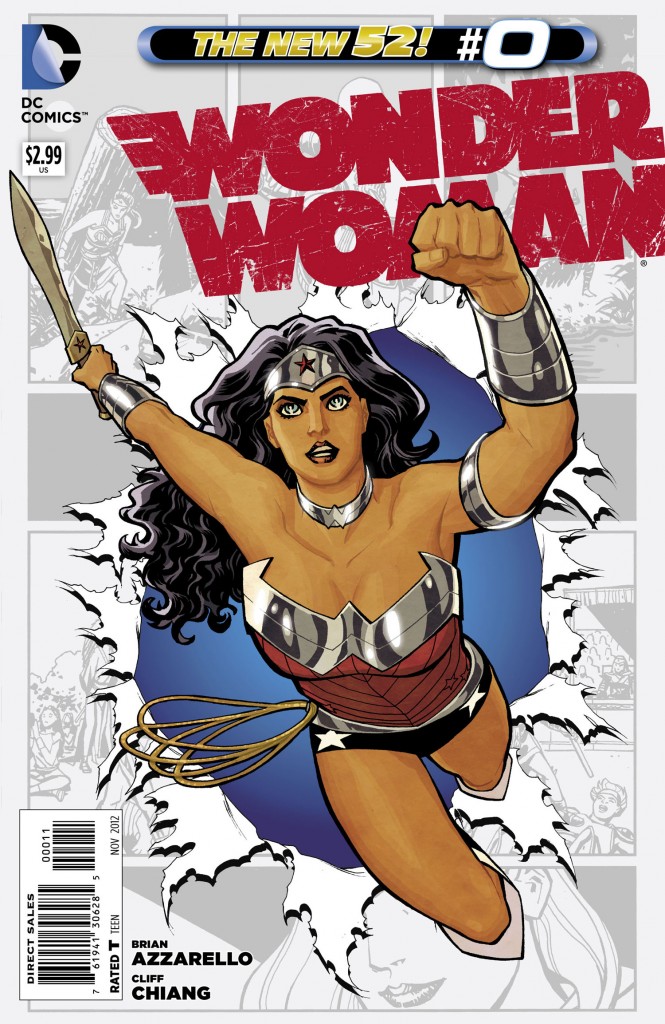
Consider this picture, a recent comic book cover:

Wonder Woman
Wonder Woman
This is the brand new, Issue #0 reboot of DC Comics’ Wonder Woman from last year, 2012. It tells me three things, visually. One: Wonder Woman has massive breasts. Two: she has a thing for chrome. Three: she can fly? To be clear, that is exactly what I am supposed to notice and in that order. When I first see the comic book, I won’t have time or capacity to read the title. There, staring me in the face, are breasts. Then I see other things, then I read “Wonder Woman” and go “well, yeah”. This is wrong. Wrong. I shouldn’t need to have a massive pair of mammaries thrust in my face for me to be interested in a comic book about a woman. What isn’t wrong is that she is beautiful. That is all well and good. But beauty is skin deep, culturally defined, and transient. What is really important about Wonder Woman? She fights for truth, justice, and gender equality. Her magic lasso makes it impossible for anyone ensnared in it to tell a lie. Wonder Woman fights crime. Wonder Woman, being a powerful woman herself, is very committed to making sure every woman is given respectful treatment. So why show her boobs first?

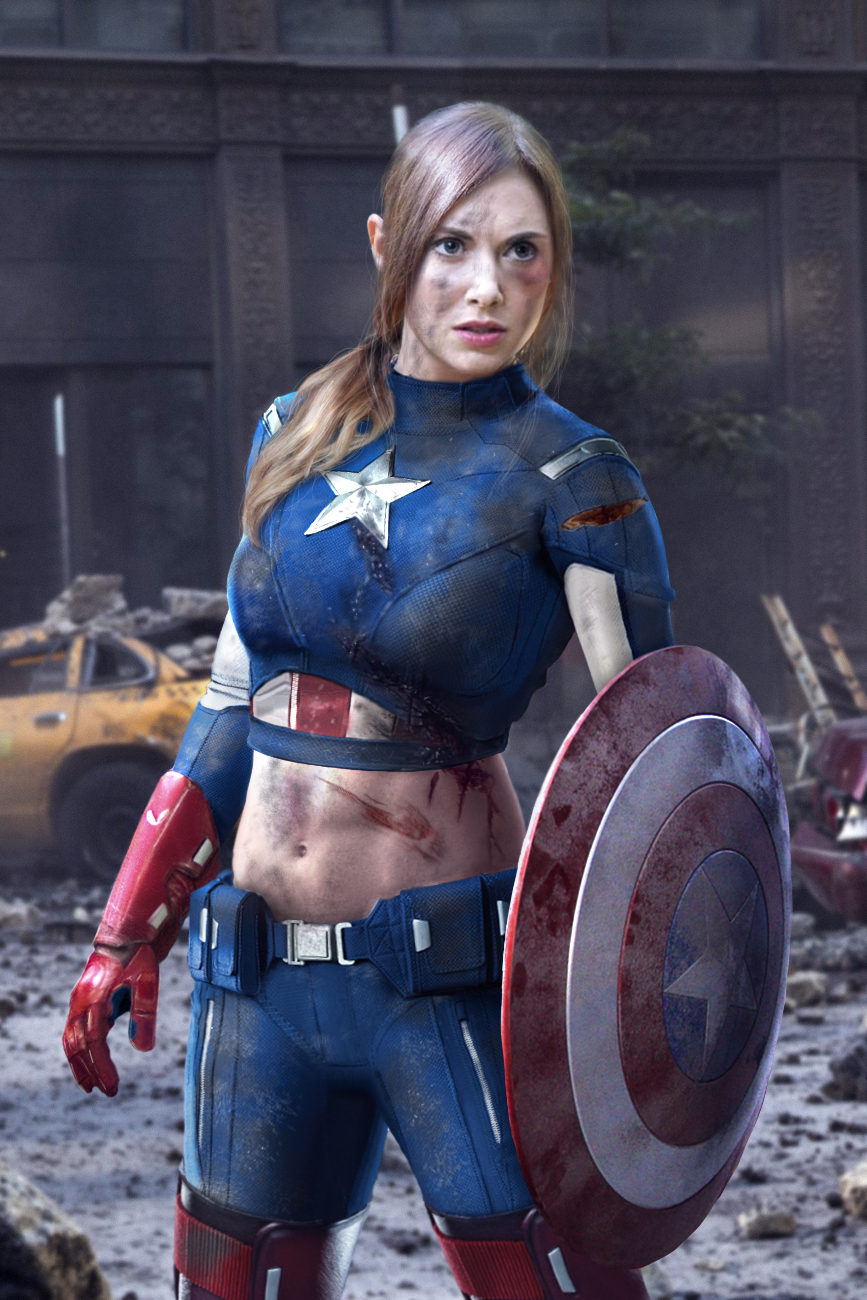
I’ve been aware of images like that my whole life. It didn’t really bother me or make a dent in my brain until very recently. Sure, I had an intellectual understanding that such comic book covers objectified women and that it was wrong, but it didn’t mean anything to me until this week when I saw another image. This is entitled Miss America and comes from Fan Art Exhibit.

Miss America
Miss America
This is a digital manipulation of a shot of Captain America from the recent Avengers film. Obviously the creator has merged a female body with that of Steve Rogers to give us Miss America. I noticed two things about this picture. One, she has a bare midriff. I have no idea why she also doesn’t have a low cut top and copious cleavage as that seems more standard for female superheroes, but she does have a bare midriff, which is Item No. 2 on the “Make Her Look Uber Sexy” checklist comic book artists apparently have. This is the image that lent a machete to my intellectual thicket. Why the hell would a soldier wear body armor of any type that leaves such a vital (to life) area of the body completely exposed. This makes no sense whatsoever. The “sexy for sexy sake” did not pass the “it makes sense” test for my brain and I short circuited. I could almost buy a super hero like Wonder Woman wearing less than a bathing suit because, usually, she has a Superman level of invincibility. Therefore, armor is irrelevant (even if her wardrobe makes no sense for other reasons). But a genetically enhanced super soldier leaving the gut exposed? No way. And two, why is she called “Miss America”? The artist named her so, but why not Captain America? Captain is a rank and is gender neutral. And then the lights flashed on and I went “Ooooh.”

Don’t judge me too harshly, please. My point here is that society my entire life has been feeding me this idea of women and it is hard to break. By the way, I do want to point out that men have it no better, but it is less kosher to point it out, mostly because, as a society, men still have a majority of the power and influence so it is boorish to whine. But, do walk through a comic shop sometime and see if you can find a realistic looking man on the cover of anything. Go ahead, I dare you. I could not look like Captain America as he usually looks any more than any girl could hope to look like Wonder Woman.

Role. Most women in popular culture are eye candy, the damsel in distress, or non-existent. They exist to look pretty, to be rescued so the man looks heroic, or they simply aren’t there. I really, really enjoy the Lord of the Rings, both in book and film form. Do you know how many females there are in the main cast, in the Fellowship of the Ring? 0. Nine males. How about the Hobbit, how many women in the main group? Yeah, 0 again. There are 13 male dwarves, a male hobbit, and a male wizard. Even in Star Wars the ratio is still 5 to 1. (Han, Luke, Chewie, R2, C-3P0 to Leia). And what does Leia do in the first film? Gets captured by men and gets rescued my men. In the Empire Strikes Back? Gets rescued by men. In Return of the Jedi? Tries to rescue a man, gets punished by way of brass bikini, gets rescued my men and male ewoks. I love Star Wars, but it has a gender equality problem. Only recently, and very slowly, has this changed. Even the mighty Joss Whedon, who elevated women so spectacularly in Buffy the Vampire Slayer, was shackled when he made Avengers because, yep, women were outnumbered on the super hero team 5 to 1. But Joss did what he could and made that one woman one of the most important and smartest of them all. Men break things, men fix things, men are the heroes. That is the message I’ve heard my whole life. And not only does it not make sense, it is stupid, and ignores completely the role women have wrested for themselves at great cost. Even in our long, patriarchal history there were women who did great things and stood high above men, but mostly they are ignored or marginalized. For shame.

How did this happen? That is a very long discussion. But, I blame two things: biology and laziness.

Not to ruffle feathers, but you can’t argue with evolution. The male part of the human species, rather generally, has more muscle mass than does the female part. Way back when we were fighting for evolutionary survival, that mattered. Men led because men could kill more, hunt more, build more simply because they were stronger. And, because all who gain power fear to lose it, once women let men fight for the power, men never gave it up. The majority of societies built since our meager beginnings have been male dominated (to my knowledge). Once we, as a species, kill our predators, kill our food, and build a fire, we like to be entertained. So we tell stories. We are smart, but not that imaginative, so our stories reflect everyday life. They are about warriors, hunters, builders. And, since what we see every day are men in those roles, men take those roles in our stories, our legends, our myths. Hence, laziness.

Since the dawn of history, until now, very rarely have we as a species deigned to allow women into our myths in any significant way, just like in real life. Sadly, it is only recently, and then only a little, that this is changing. Modern comics, tv, film, books are the myths of old retold again and again. Why else is Wonder Woman the lone female member of the Justice League (in popular consciousness) why else is Black Widow the only female member of the Avengers (again, in the popular consciousness, I am vaguely aware that in the comics Wasp was also a founding member)?

Humanity is a species slow to change. It has taken me 25 years. It has taken us millennia. I hope not much longer before women are in power, realistically portrayed, alongside realistic men is simply the way of everyday life and the stuff of legends. I advocate not for a reversal of the binary, but a destruction of it. Men and Women are equal in every way that matters biologically speaking. We should be socially and mythologically as well.