
Palpable was the excitement of going to see Star Wars Epsiode I: The Phantom Menace in the spring of 1999. I distinctly remember riding in the back seat of my father’s car, driving along the highway towards our local theater. I remember sitting on the end seat, next to him, and my brother on the other side of my father as the lights of the theater dimmed and the opening crawl floated up the screen. Despite my high excitement, disappointment followed. I was twelve years old then, and had grown up watching the original Star Wars trilogy so many times that my first experience with Star Wars had long been forgotten. It seems I had always loved watching Star Wars.
It is now nearly the end of 2015, and with it a new era has been born. Unless you’ve been hiding out on Dagobah with a broken holonet receiver, you know that the sequel trilogy has been launched with Star Wars Episode VII: The Force Awakens. I’ve seen it twice now, once in regular old two dimensions, and once in IMAX 3D. If you want to stop reading now to avoid spoilers on the story, I will simply say this: it was better than the prequels and a true Star Wars film full of the space adventure and fantasy we’ve come to love from that galaxy far, far away…
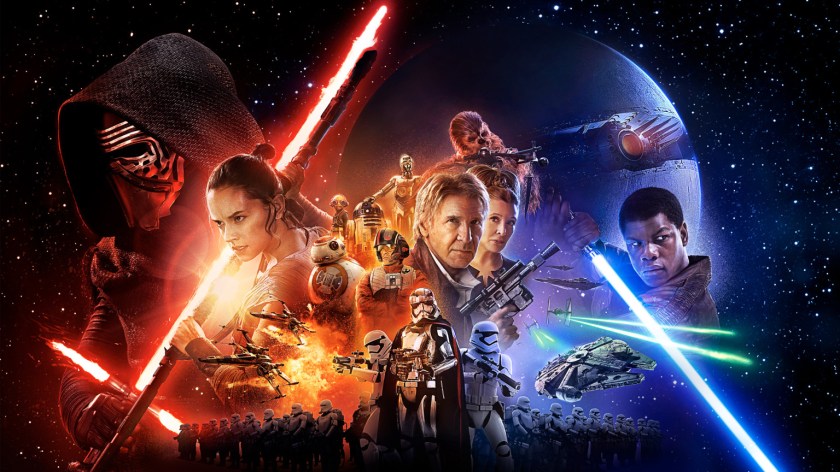
What has made the Star Wars universe great and has allowed it to endure for generations are the iconic, memorable characters. From the beginning of The Force Awakens, we receive terrific new characters that I believe will live on in the zeitgeist of the world consciousness just as have the original characters from the original Star Wars.
Right away we are introduced to the first non-human character that will drive a large portion of the film as a Macguffin and that is the orange and white ball droid BB-8. Early on in the marketing and releases about The Force Awakens we saw BB-8 and I must admit I was less than impressed. I thought the robot was overly cute, and was attached to my nostalgia for R2-D2 and C-3P0. But from those first few moments on screen, BB-8 captured my attention in exactly the same way Artoo and Threepio did in the beginning of Star Wars. Moments later we meet Po Dameron, the heroic and dashing X-wing pilot and Kylo Ren, the angry, yet strangely compelling new Dark Lord. At this point, I got caught up in the story and the film, and wondered where these characters would take me. Again, early on, as these characters were revealed, I thought that Kylo Ren in particular was trying too hard to be the new Darth Vader, but seeing him on the big screen, as the story unfolded, I saw an angry, hurting young man trying desperately to live up to a legacy he admired, albeit for all the wrong reasons. As the film progressed we were introduced to the main characters, Rey and Finn the defecting stormtrooper. Rey is a simple human living in the literal shadow of a decades old galactic war, scavenging for survival and awaiting her future. Finn is rejecting the only life he has ever known and seeking a way to freedom. Both meet up, and the adventure really gets going as they steal a familiar piece of space garbage and outrace the new Empire: the First Order. Reintroducing the Millennium Falcon and previous owners Han Solo and Chewbacca was less a slavish devotion to past glories, but an acknowledgement of the age of the universe and the passage of time. Things move on from our lives and sometimes old friends return in unexpected ways. Later we meet Leia Organa, less princess and more general, and even she feels like a totally new character. She is no longer young and feisty, but now strong and resolute with the burning fervor of conviction and experience. I loved the thousand year old Maz and her little cantina on a backwater world, her unexpected wisdom and yet shadowy side as someone who hung out with the dregs and downcast. She was the dark mirror to Yoda, ancient and wise and somehow a young outlaw on the back edge of the galaxy. All of these new characters immediately became as interesting and compelling to me as the droid duo, Luke Skywalker, Ben Kenobi and Yoda, and Han Solo from Star Wars. I desperately wanted to know their stories and follow them on their adventures.
Secondly, the locations hearkened back, in a good way, to the the original trilogy. There was the desolate desert world of Jakku, the ice planet/superweapon of Starkiller Base, the forest world of Takodana, all mirroring Tatooine, Hoth, and Endor. This became a theme to the Force Awakens: revealing the new through the lens of the old. There was the Millennium Falcon given new life as the fastest hunk of junk in the galaxy racing along the Jakku dunes and derelict Star Destroyers and the new planet destroying super weapon. Far from drudgingly repeating the past, the new Star Wars gave me quick tutorial in what I already loved, setting me up for something that I will never have imagined in Episodes VIII and IX.
Thirdly, there was plenty of new twists and further revelations of the galaxy far, far away, which is far more vast and old and lived in than I imagined. I loved the brief introduction to other smugglers and outlaws aboard Han’s new freighter, the rathtar beasts Han was transporting, again, hearkening back to Jabba’s den of despicable denizens and the rancor which lurked below. I loved the X-wing/TIE fighter battles, the exchanges of blaster fire, the familiar yet new First Order risen from the ashes of the Empire, Jedi mind tricks, and unexpected stormtrooper humor, no longer clones but real people fighting for a cause they believe in.
I thought the acting in this film was superb, and that is what ultimately won me over to the classic nature of the new Star Wars. Harrison Ford, Daisy Ridley, John Boyega, Adam Driver all did fantastic work in breathing into their characters the breath of life. I believed all of them. But the real surprise was the reveal of Luke Skywalker at the end. Mark Hamill communicated so much without saying a single word that I was totally blown away. The shot lingered on his face as he turned to see Rey and what her outstretched arm held and I saw sorrow, pain, recognition, remembrance, resolution and so many more emotions in his eyes. He realized the fullness of what his failure to train Ben Solo had wrought on the galaxy, he acknowledged what his absence fostered in current events, he recognized his lightsaber, and with it the pain of his failure and loss against Darth Vader so long ago, and he made the choice to no longer look to the past but to rejoin the present in hope of a better future with Rey and the Resistance.
Finally, the death of Han Solo, which I completely expected to happen given Harrison Ford’s complicated relationship with the character, was still shocking and emotionally gutting. Here was everything that was awesome, funny, and beloved about the original trilogy being brutally murdered by its own offspring, the sequel trilogy, and the message was clear: despite the winks, the references, and the familiar, this is not your father’s Star Wars anymore. This is a new beast altogether and in the future, nothing is certain. Here the brilliance of Lawrence Kasdan’s writing and JJ Abrams’ direction was shown in full: this was the narrative being constructed below the cool space story above.
I know I just said finally, but I must shoutout to the stellar John Williams and his amazing score. If the special effects and characters are the body of Star Wars, Williams’ music is the soul. One of the greatest composers of our time, Williams brings the best of his genius to underscore every beat of the Force Awakens and I will enjoy his new music just as much as I have loved the original soundtracks.
The Force Awakens is not without it’s flaws, but for every seeming plot hole or convenient occurrence, I am reminded of similar aspects to the films I love: Star Wars, the Empire Strikes Back, and Return of the Jedi. The original trilogy succeeded on the spectacle, heroics, and characters we loved, not from perfect plotting or consistently complete logic. Star Wars is a space opera, a grand fantasy adventure among the stars, and should be loved as such.
 a simple man