League of Justice #0.6: “That Flesh Is Heir To”

Near Smallville, Kansas

Thursday, August 12th

The hot summer night would have been oppressive were it not for the sweeping breezes that swooshed back and forth across the prairies. Kansas was beautiful in the summer: stalks of corn growing to the sky, thousands of stars lighting that sky at deep midnight when the summer sun finally set. The grass grew green under the summer rains, and the dirt turned deep red, rich with clay. One could smell the living earth and hear the countless souls that lived on the prairie: the endless cricks of crickets, the racketing of cicadas on the trees, the singing of the birds, the buzz of lazy flies.

Martha Kent relaxed on the porch of the Kent house, a low modest farmhouse rising out of a Kansas plain. Rocking back and forth in her rocking chair, she sipped on a lemonade, the glass slick with rivulets of sweat as the cool glass condensed the humid air around it. From inside she could hear the gentle clinking of dishes as her husband Jonathan cleaned up from dinner. The steak from last fall’s slaughter was tender and juicy, the corn from last harvest rich, and the greens from the spring garden were crisp. Martha loved eating what Kansas gave her, and what she and her husband had cultivated from Kansas’ bosom. If ever there was a woman of the earth, of simple things, it was Martha Kent.

She had loved her husband from the moment she saw him, an awkward gangly teenager just entering the ninth grade at Smallville High School. He and his family had moved from Metropolis, the midwest’s bustling city. Larger than New York and Gotham, the East Coast’s metropolitan jewels, Metropolis was a shining example of the American dream and prosperity. But things hadn’t worked out so well for the Kent family, and they moved into the country seeking a harder, but more rewarding, life. For his part, Johnny Kent noticed Martha Clark almost immediately: a wispy, but hard prairie girl. Lovely, but not beautiful, graceful, but not delicate. However it took a few years before his big city swagger turned into a country lope. John worked his way through almost every cheerleader and prom princess at the school before his city charms failed him completely. When he came back down to earth, Martha was there, as always, waiting. The two were passionate lovers throughout their final year of high school and married soon after graduation.

Jonathan and Martha moved onto the Clark family farm, at that point overgrown with weeds and neglect as her grandfather could no longer till the large fields. The newlyweds brought a breath of fresh air and blew off the dust of the plains. Soon the fences were mended, the barn painted, and new crops growing. Martha envisioned children, a large family, and a happy ever after. She got everything but the children.

Now nearing her 50s, Martha was content. She and Jonathan had lived a full life, and she loved only him more than Kansas herself. She missed the opportunity to raise her own children, but she became a surrogate mother in Smallville. Active in the community, at the schools, and in church, she always seemed to attract the kids that others didn’t know how to deal with. With the gentle love and persistent care of a farmer, she watered and tended those children until they grew into well-adjusted adults. Living on the plains was a hard life in more ways than one, but the honest labor and consistent love of the Kents softened many a growing heart.

The screen door creaked open and slammed shut behind Jonathan as he joined his wife on the porch. Leaning against the railing, back to the darkening fields, he sighed. He turned his head into the breeze and breathed deep.

“Kitchen’s all cleaned up.” He said just for something to say. That much was obvious.

Martha smiled. “Thank you, dear. It was nice to get off my feet.” John didn’t smile, but his eyes twinkled. To Martha it was the same.

“Beautiful evening.” He said, again to break the air. Martha giggled.

“I know it’s a nice evening. I’m out here enjoying it.” She teased. John wasn’t much for conversation, but he tried and that made Martha feel loved. She set her glass down, now mostly empty, and stood up. In a stride she was in John’s embrace. She relaxed into his chest, and stared off into the corn. As one, they breathed the warm Kansas air. There was no longer any need of conversation. John was relieved, as he had run out of things to say, and Martha was glad to communicate with love instead of awkward words. Some languages said things no words could convey.

*BOOM*

*crack*

Something flashed brightly in the sky before streaking behind the barn. Seconds later a fireball snapped into the blackness and a rumble shook the ground.

“What the hell?” John was already off the porch, running for the barn. A warm glow warned of fire. Martha went the other way, for the farm truck. She opened the door, jumped in, and twisted the spoon. The truck was old and beat to hell. Many years ago the key had broken off in the lock, and rather than fix it, Jonathan had welded an old spoon onto the ignition. The engine was worn, but it roared to life. Martha threw it in gear and sped off towards the glowing night.

She got there just as Jonathan was slapping out the last of the embers with an old blanket. Martha pulled a fire extinguisher from the truck bed and hosed down the grass, just to be sure. Fires weren’t anything to play with on an open field of dry grass and young corn. So intent was she with the putting the fire out, she failed to notice the shining capsule half buried in the dirt twenty yards away until she was returning the fire extinguisher to the truck.

“John: what is that?” Her voice was matter of fact. Being a solid woman of the earth, even the wildly unexpected didn’t usually faze her all that much. What John said next certainly fazed her.

“I don’t know. But there’s a baby inside.”
League of Justice #0.5: “By Opposing, End Them”

Gotham City, November the 15th

“Hahahaha! Eat it, suckers!”

The playground doors opened, and a bunch of middle school students ran out into the winter snow. Frigid temperatures and icy precipitation had come early to Gotham, dusting the usually dreary city in a covering of white fluff. For a time, the grit and filth of Gotham was buried. The pupils of St. Joseph the Apostle didn’t much care about anything but the snow. Recess was a chance to burn off scholastic boredom in a flurry of snow angels, snow men, and winter frivolity. Except today, a few high school students had remained outside during a free period following lunch.

Among the school’s bullies, they had carefully planned their afternoon torment of the smaller kids. They had built a wall of snow across the playground doors. Stockpiling snowballs, into which they had placed shards of ice, they lay in wait. The minute the recess bells rang, shrill in chill air, they armed themselves. Seconds later, the doors opened and kids ran out, expecting fun.

The first few, instead, got pelted. A snowball caught a girl in the eye. She stumbled and slipped on the ice, moaning. Two missiles of snow smacked into a young boy’s face. He screamed, and wiped away snow and blood. The ice inside the snowballs had cut into his face. A few more students ducked and weaved, but were assailed all the same. By now the front running children had scrambled to a stop, forcing the ones behind to run into them. The first wave of students tried to turn and run back into the school but were barred by those behind.

“I am Mr. Freeze!” shouted one of the bullies, standing up from behind the snow wall. He was unidentifiable behind ski goggles and a heavy white parka. “Die, sissies!” He threw more snowballs, most with cruelly accurate aim. He laughed as each snow bomb struck another small kid, forcing a whimper, a wail, or a shout of rage. His cohorts lay in the snow, mostly watching their leader, and lobbing the occasional snowball.

Seemingly from nowhere, a dark figure tore through the crowd and leapt across the snow wall. A blur of action, his long black coat swept behind his furious motion like a gigantic cape. Arms that ended in thick, black leather gloves were clenched into hard fists.

“Fuck you, Freeze!” The specter growled. A flying kick caught one bully in the chin. Kneeling in the ground, he spun and threw a punch into another antagonist’s groin, followed swiftly by a jab to the solar plexus. The boy crumpled into a whimpering ball. Standing up, the fighter faced the kid calling himself Freeze.

“Run!” The kid in black snarled at the kid in white.

“Not a chance, Wayne. Come and get it.” Freeze put up his hands in a mock boxer stance.

Bruce Wayne closed the gap in seconds. His fists blurred as he pummeled Freeze. The kid’s ski goggles cracked, and then were torn from his face. Soon bright red blood spurted from his nose, trickled from his lip, and gushed from a cut above his eye. He went down into the snow. Bruce didn’t let up. He slammed his knee into Freeze’s gut, and continued to smash him in the face. Freeze’s blood smeared across his leather gloves.

Fortunately for Freeze, teachers alerted by the middle school kids had pushed their way through the crowd. They rushed toward the fighting boys, and hauled Bruce away from Freeze.

“Bruce! Stop!” Two of them had to restrain the flailing Wayne. Three more knelt down over Freeze. “Better call an ambulance. This kid’s gonna need stitches.”

Twenty minutes later, Bruce Wayne was standing on the school steps, hunched in his black coat against the winter wind. A large Bentley turned into the school parking lot and pulled up to the front door. Bruce waited for a few seconds, but it soon became obvious that he had to let himself into the car. He walked down the steps and yanked open the back seat door. Swiftly he got in and slammed the door. He didn’t look up to see Alfred Pennyworth’s stern glare in the rearview mirror.

“Early release today, Master Wayne?” Somehow the old butler managed to make the casual observation into a sarcastic joke. Obviously he knew that his charge had been expelled for bad behavior.

“Yeah, snow day, Alfred.” Bruce still didn’t look up. After a few moments silence, during which the car remained motionless, Bruce looked up. His eyes met those of his butler’s. Alfred always appeared refined and gentle, but today there was a fire smoldering behind those eyes.

“You’re better than this, Master Wayne. Your father would be ashamed to have his son expelled for brawling.”

“I had to do something, Alfred. There were bullies -”

“There will always be bullies, Master Wayne. The trick is to stop them without being a bully yourself. Today you were no better than he was.”

Alfred turned back to the steering wheel. His foot pressed the accelerator, and the Bentley crunched snow and sidewalk salt as it pulled away from the school.

Bruce hung his head in shame. He’d beaten Freeze, but had lost the battle.

League of Justice #0.4: “Slings and Arrows”

A streak of green light flashed across Krypton’s dark sky. Jor-El, head bowed in thought as he walked, did not see it. He did, however, hear the gentle whumph behind him. Slowly he turned. Standing before him, clad in green robes and a darker green cloak, was Maskill, of the Green Corps. Maskill was the Lantern whose jurisdiction included Krypton. Like the Kryptonians, he was humanoid. He was an old man, worn and tired.

Jor-El bowed to him. “Hail, Lantern.”

Maskill bowed back. “Hail, Jor of the House of El.”

Pleasantries aside, the confrontation began. Jor-El exploded quietly.

“What the hell are you doing, Maskill? The Black Corps stands ready to destroy Krypton! Is this justice? You know I don’t agree with the expansion, not in the way it was handled, but Krypton is a democratic society. I was overruled! Certainly there are many millions more who are innocent of the havoc our emissaries visited on the galaxy. Should they die to pay for the injustice of a few?”

Maskill stood quietly, absorbing Jor-El’s anger.

“Perhaps General Zod was wrong to refuse the Green Corps’ overture of peace, but is it a crime to fight for one’s sovereignty? Now that the Black Corps has forced us back to our own planet, have we not felt our punishment? You know the Black Corps will only stop once every last Kryptonian is dead. Where is the justice of the Lanterns?”

Maskill waited for the fury to dissipate into the night.

“The White Lantern has spoken. The crimes of Krypton’s children are too great to be pardoned. You stole what was not yours to steal. Your excessive mining operations severely damaged the progress of many worlds. Who can say how long you have doomed them to primitive dwelling in your lust for consumption?”

“The time for that argument is long past, Maskill! Your White Lantern is a fool if he cannot see that wiping out an entire planet for its sins is not justice. It is genocide.”

Jor-El had unconsciously strode forward, closing the distance between himself and Maskill.

“Regardless of what was decided, our end is at hand. The Black Corps will destroy us! Will you stand by and let it happen?”

Maskill regarded Jor-El silently.

“It is not for the Green Corps to interfere once the White Lantern has ruled. What was decreed shall be.”

“Damn the White Lantern! Damn his decree! My wife is with child, yet unborn. Shall he die without tasting life to satisfy the justice of the Lantern?”

For the first time, Maskill betrayed emotion. A flicker of sorrow tightened his brow, if only for an instant.

“I did not know your wife was pregnant. But the White Lantern will not relent over one life. The needs of the many outweigh the needs of the one, especially one who is unborn. The unborn die on countless worlds in countless numbers. This is the way of life. Even those who taste the air of their spheres do not often taste it for long.”

“Dammit, Maskill. Will you do nothing? You have been my friend and mentor since I was a young lad. I’ve always heeded your advice, your counsel. Will you abandon me now?”

“I have already spoken, Jor. The Green Corps cannot interfere. One lantern does not assail another. To invite infighting is to invite chaos.”

Jor-El whirled suddenly, pacing back up the street, then down towards Maskill. He grabbed the Green Lantern by the shoulder and stared into his eyes.

“Will you do nothing? Not the Green Corps, you. Will you allow an evil thing to pass because another has deemed it in a greater good?”

Maskill said nothing. He stared back into Jor-El’s eyes. Moments passed, the air charged with emotion as the two men waged silent war. At long last, Maskill spoke, putting a hand or Jor-El’s shoulder.

“I will not abandon you, Jor of the House of El. Long we have been friends. I will plead your case before the White Lantern. It may be that he will relent and recall the Black Corps. Only his word can stop their destruction.”

Jor-El sighed mightily. He pulled Maskill close for an embrace.

“Thank you, my old friend.”

The moment was shattered by the roar of retro-rockets. The men parted to stare up into the sky. A small craft was descending through the sky. It’s markings identified it as belonging to the Kryptonian navy.

“Zod!” Jor-El breathed. Turning to Maskill, he spoke urgently. “You’d better leave before he lands. Zod has no love for any lantern. He will kill you.”

Maskill smiled playfully. “I’d rather like to see him try, actually.”

Jor-El was in no mood for humor. “I do not jest! Lanterns can die. Zod has personally accounted for many Black Lanterns in this war already. One old Green Lantern would not delay his wrath for long.”

Maskill stood his ground, shrugging, but saying nothing.

Before either could act, the descending vessel opened its bay doors, and five dark shapes leaped towards the ground. Commandos. In an instant, Jor-El and Maskill were surrounded. The commandos were encased in armor, the heads hidden behind dark helmets. Jor-El tried to take command of the situation.

“I am Jor of the House of El, an elder on the Council of Free Peoples. What is your business here? You may not accost citizens without charge.”

One of the five stepped forward, his face mask sliding upwards as he did, revealing the scarred visage of Krypton’s greatest warrior: Zod.

“You may be free to wander dark streets alone, but the green one is named a criminal against Krypton and is a mortal enemy of her people. Are you claiming allegiance to an enemy?”

“Zod, Maskill the Green Lantern is guiltless here. It is the Black Corps that threatens us, not the Green.”

Zod roared. “ONE CORPS! ONE THREAT! I care not for colors and shades of morality. THEY attacked US. Their black knife is at our throat. I am charged with defending Krypton to my last breath. Move aside, Jor, or suffer his fate. Decide immediately.”

Zod lunged forward, battle knife drawn.

League of Justice #0.3: “In the Mind to Suffer”

The constant beeping of the medical monitors intruded into what was an otherwise serene hospital room. A young man around 15 years old stood at the foot of a patient bed, watching. The patient was an older gentleman. His features were strong, noble. His dark hair was flecked with grey at the temples, and streaks of grey mottled otherwise uniformly black locks. His eyes were closed. His breathing was regular and strong, which wasn’t surprising as it was machine regulated. The youth was very much a younger version of the man in the bed. His hair hung long around his shoulders, but otherwise their faces could have been mirror images.

The Martha Wayne Long Term Care wing of Gotham General Hospital was named in honor of Gotham’s beloved first lady. Martha Wayne hadn’t been a politician’s wife, or anyone of any royal bloodline. What she had been was nurturing, caring, and completely selfless. While her husband, Thomas Wayne, ran his multi-billion dollar corporation and worked at Gotham General as a surgeon, Martha cared for the gutter dwellers of Gotham. The nation’s most populous city, Gotham was also knee deep in poverty, crime, and suffering. Martha had devoted every second of her time to bringing hope to a destitute population. Her bright light was snapped off in an instant. Everyone in Gotham knew the tragic story: a family caught in a mugging, a nervous and desperate gunman, and Martha was slain. One of the very souls she tried daily to save snatched her away.

Her husband was also cut down that day. But Thomas Wayne hadn’t died. The gunman’s bullet bored a hole straight through his brain, leaving him alive, but in a coma. Thomas rested in his wife’s loving arms as a long term patient in her wing. Bruce, now a teenager, was orphaned that night in the alley. He buried his mother in the ground and his father in the hospital. Neither would see him grow into a man.

Bruce watched his father breathe and thought dark thoughts. As it did every week when he visited, the sight of his father fueled a growing rage in the young man’s heart. In his head, his parents’ murders played on an endless loop. A scraggly beard. A ragged man. Booming gunshots. Blood. The senseless nature of the act stabbed in Bruce’s brain like an ice pick. The violence of the act burned in his soul like a churning volcano. The gunman had never been caught. Alfred told him later that his parents’s murderer ran past him as Alfred sprinted into the alley. Waiting in the car, he had heard the gunshots. But Alfred was more concerned with his charges than running down a fugitive that night. The police response, though rapid, was poorly coordinated. The panic over Gotham’s most prominent family being murdered overshadowed police procedure. The gunman simply disappeared into the overgrown fraternity of crime. Bruce seethed at the law enforcement ineptitude that allowed a killer to escape justice. He cursed them for their failure, their inability to provide safety at the Opera House and their inability to provide legal closure.

It became too much. Bruce turned abruptly and nearly ran out of his father’s hospital room. He ignored nurses and doctors who nodded or offered greetings on his way out. Though the Gotham day was bright and crisp, all Bruce saw was darkness. All he felt was the gnawing bite of injustice.

In his room, at midnight, on the night of his parents’ death, Bruce vowed vengeance. He was only a boy when he left for the Opera, but he returned a man. He promised the world that he would avenge his parents and that he would never let anyone suffer that pain again. But it galled Bruce to wait. He was only a boy, then. He could do nothing. He was powerless, weak, and small. And so he waited. He grew, he aged, and he matured. As a teenager his childish impatience hardened into careful preparation. He studied everything he could. He buried himself in school, in athletics, in the Gotham Central Library stacks.

Bruce knew that the secret to fighting evil lay in forging the perfect weapon. Having nothing but himself, Bruce dedicated every minute to forging himself into the perfect weapon. Outwardly, everyone saw a young man living life for the parents that he lost. They saw a star football player, a gifted baseball player, a devastating wrestler. They watched a master debater, a chess champion, an artistic prodigy. They saw a young Wayne emerging from tragedy to be every inch his father with all the heart of his mother. That Wayne was a lie, a disguise, an alter ego for the monster of anger, rage, and vengeance that was his true self.

Only Alfred saw both sides of Bruce. The loyal butler cared for his charge as best he could as surrogate parent, guardian, and caregiver. He heard Bruce’s nightmares. He heard Bruce’s fits of rage. He heard Bruce’s sobs of sorrow. Bruce would never openly betray the depth of his feelings to Alfred, but he did relax a bit of his facade at home. More than anyone, Alfred saw the real Bruce Wayne. As much as Bruce loved the family valet, he kept him and everyone else at a distance. Alfred also understood, to an extent, the depth of Bruce’s feelings. He gave the boy space to find himself again, to remake his life. Alfred saw the opportunity to mold a man out of the boy who suffered, and ever so gently and patiently, Alfred guided Bruce’s evolution. As crudely as Bruce built himself into a weapon, it was Alfred who tempered the process, refined the build, and sharpened the edges.

Bruce exited the hospital through whooshing automatic doors. Across the drop-off circle, Alfred was standing patiently next to the family Bentley.

“How is your father today, Master Bruce?”
“He’s still dead, Alfred.”
“The dead only sleep, Master Bruce.”
“Whatever you say.”

Alfred opened the door for Bruce, and the young man slid into the backseat. Entering the driver’s seat, Alfred regarded his ward in the rearview mirror. Bruce’s eyes flashed behind his hair. His face was grim.

“Where to, Master Bruce?”
“Home. I have work to do.”
“Very well.”

Alfred engaged his turn signal and gently pressed the accelerator. The large luxury car purred and pulled forward into the road.

League of Justice #0.2: “To Take Arms”

In the beginning as the universe coalesced, when all was wild energy and expansion, there arose the Guardians the first beings to inhabit space and time. The Guardians were wise with new wisdom, were strong with new power, and were alive with new life. For the first million years they watched stars and planets and moons and nebulae take shape. Over the next millions of millions of years, they watched life evolve in all its forms and wonders.

Of all peoples and forms of life that sprung from the fertile universe, the Guardians were the eldest and the first to die. Though their civilization endured long, it could not endure forever. When the first sun collapsed into a black hole and began to suck everything into its dark maw, the Guardians knew that they too would pass into darkness. They bent all their will, all their thought, all their knowledge into safeguarding the universe.

With a science that none since has learned, the Guardians manufactured a source of creation which they called a lantern, a caster of light. With this lantern they forged rings, small portals that were linked to the lantern. Each ring, when activated, drew upon the lantern. The function of the rings was to draw energy from the universe, energy that had been consumed by black holes, and make it useful again. The rings could convert the energy into matter, or matter into energy, and thus were unlimited in the scope of their power.

The Guardians long studied the beings of the universe throughout every galaxy and solar system. To those who were deemed worthy they entrusted a ring, that thereby they may guard their corner of the universe.

Each being who received a ring was called a Lantern, symbolizing that as the one great Lantern guarded the universe, they were to be a smaller lantern to guard their space. In the beginning all Lanterns were white, as light that is combined of all other colors and wavelengths is white. As time progressed, Lanterns chose methods of protection that to them seemed more fitting to their race, or their culture, or their strength, and they chose for themselves new colors. As time progressed, the Green Lanterns guarded justice throughout the universe. The Red Lanterns inspired growth and progress in the universe. The Blue Lanterns worked to heal the hurts of the universe. The Black Lanterns guarded the sanctity of death in the universe. Still there remained the White Lanterns, who to all others were looked to as the wisest, and eldest, and in all matters the ones to uphold the tradition of the Guardians.

Thus the Guardians died, content in the knowledge their time was full, and that the universe would be protected for the billions of years yet to come by the Lantern’s light.

The Guardians were wrong.

As eons passed and the universe grew old and worn, the light of the Lantern waned. The purity of its light was corrupted. Its true purpose was forgotten. In dusty corners of distant galaxies legends of the Guardians remained, but few remembered where to look, and even less cared. Science passed into legend and myth and became magic. The Black Lanterns soon courted death and waged wars in her name. The Red Lanterns built to themselves monuments and great halls and honored their own grandiosity. The Blue Lanterns receded into mist, content to heal themselves for eternity. The White Lanterns vanished in the expanding blackness of space. The Green Lanterns endured to their purpose, but each to his own understanding and knowledge of morality. To most they became haughty, self-righteous, and capricious enforcers of galactic law and order. Some were no better than thugs.

As each Lantern, according to their species, died they passed on their ring to a successor. Some chose heirs, some left the rings as heirlooms to be found, others hoarded them in secret places. The light of the Lantern diminished further.

And yet there were a few who organized themselves into the Green Corps. These rebels still remembered the ways of the Guardians and held to the true Lantern’s light. Relentlessly they waged war against their fellow Lanterns, but not a war of death and destruction rather a war of ideals and understanding. Slowly they conquered the wayward factions. Slowly they rebuilt the Lantern’s light.

The eldest of the Green Corps, the leader who first waged war was named the White Lantern and to him it was given the task of governance. He made the Black Lanterns into the Black Corps, an army of last resort when a plague or injury too grievous to heal emerged. As a surgeon amputating a part to save the whole, the Black Corps was to purge the universe. What could yet be saved, the Blue Corps was tasked with restoring. Remaining secluded as monks, they came forth at times of great need. The White Lantern made the Red Corps agents of advancement, tasked with aiding only the most advanced of societies with reaching heights of which they could not yet conceive. They became scholars and masters of knowledge. The Green Corps stayed as they were, guardians of justice and order in the galaxy, mandated to be pure of purpose and will.

Such were the grand designs of the White Lantern. And as man seeks to reach and a child grasps, the various Corps stood to their purpose yet imperfectly. The light of the Lantern shone half brighter than it used to yet still only half as it should.

And yet, to the darkness, even a weak light is a welcome illumination.

To remind themselves of their purpose each Lantern was given an oath to pledge. To this oath they held themselves bound and by this oath were they judged:

In brightest day, in blackest night,
No evil shall escape my sight.
Let those who twist Lantern’s light,
Beware my power…
Great Lantern’s Might!

League of Justice #0.1: “To Be”

The summer night clung to the city like a warm, wet blanket. Tall skyscrapers and narrow streets cut off most of the inner city from cooling bay breezes. In the summer, downtown Gotham City was not the most comfortable place to take a walk, especially when one was confined to a uncomfortable suit, and one’s sweaty neck was nearly choked by an oppressive tie. Bruce Wayne would have rather been anywhere but where he was at that moment. Some friends at school were attending a baseball game at Heights Field, home of Gotham’s baseball team the Gotham Rogues. Bruce had an affinity for the sport, an affinity his affluent parents did not share. Instead, determined to infuse a higher culture into their son, Thomas and Martha had attended a performance at the Gotham Opera House, compelling Bruce to join them.

Bruce didn’t harbor any negative feelings towards his parents. He appreciated that they were invested in his life. He just sometimes wished they would invest in his interests as well. At the moment, anyway, he was much more interested in reaching the street. He knew that Alfred Pennyworth, the family butler, would be there waiting for them. The family Bentley would be rumbling gently, and Alfred would have the air conditioning tuned just perfectly. The car would provide a welcome refuge from the sweltering summer sauna. Also, Bruce hoped, he could talk Alfred into a bit of ice cream once the family returned to Wayne Manor, the mansion in which his family had lived for generations on the rural outskirts of Gotham.

Bruce’s formal shoes crunched on bits of glass and grit that had begun to form a jagged covering to the crumbling asphalt that paved the alley. The Wayne family had exited the Opera House via a back door so as to avoid the paparazzi spotlight. Thomas Wayne, while a practicing medical doctor, was also a businessman and one of the wealthiest persons in the nation. There always seemed to be someone who was hoping for a salacious story and a scandalous photo. The alley was lit only by a light at the Opera House door, a pallid pool of yellow luminance, a light now behind the ambling family. Ahead, at the entrance to the alley, the lights from the city streets streamed into the alley, broken occasionally by passing pedestrians. The resulting illumination jumped down the alley like gnarled, grasping fingers. In between was a hazy grayness. Little starlight filtered from the sky above.

Bruce was staring down at his formal shoes, ignoring his parents who walked a few paces ahead and talked quietly to themselves. He was lost in his own thoughts, and paying little attention to his dingy surroundings. He very nearly walked into his father’s legs.

Thomas Wayne had stopped abruptly. Standing in front of the family, appearing as a specter out of nowhere, was a thin, gangly man. He wore a hooded sweatshirt which was several sizes too large for his frame, and a scraggly beard reached out from his face like so many greasy tentacles.

“Your money. Quick.” He rasped. It was then that Bruce saw the gun. It was a .38 calibre revolver, snub nosed, not all that large of a gun, but to Bruce, it was a cannon. From between his mother and father he stared into the gaping barrel. The gun shook, the mugger apparently weak from malnutrition and nervousness. Martha Wayne had frozen in fright, neither speaking nor moving. Thomas held up his hands slowly.

“Take it easy. I’m reaching for my wallet.” Thomas, keeping his left hand aloft, slowly reached his right hand into his formal jacket, and withdrew his billfold. Betraying none of the fear he must have felt, he reached out his arm, offering the leather wallet to the mugger.

The ragged man groped for the wallet, not taking his eyes off the elder Wayne. His fingers brushed it, knocking it to the alley floor. With a muttered curse, he tried to reach down for the wallet while keeping his eyes, and gun, trained on his victims. He couldn’t locate his prize by touch. Looking down for a split second, he tried to spot the wallet on the ground. Taking advantage of the momentary distraction, Thomas simultaneously shoved Martha backwards while he stepped to the side. Martha, caught off guard by her husband’s split second defensive motion, shrieked. She also stepped inadvertently on Bruce’s foot, not knowing he was there. She began to fall. The commotion caused the mugger to snap his head up. Not taking time to realize what was happening, he panicked.

Boom.

Boomboom.

His first shot was a bit wild, but it caught Thomas Wayne in the temple. The man went down without a sound, his body crashing into the brick wall of the alley, falling into a twisted heap on some garbage. The second shot went through Martha’s chest. The third her head. She continued her backwards fall, collapsing on top of Bruce.

Bruce’s world was suddenly one filled with noise and terror. While his father was talking and moving he had only been slightly alarmed by the situation. He never for a second doubted that his father would remain in control and keep him safe. His father had never once in Bruce’s memory been out of control. Everyone always did whatever his father wanted, usually as soon as he asked. The suddeness of the attack and the loud report of the gun startled him. He watched in horror as his father twisted and smacked against the wall, while at the same time his mother was crashing into him. He felt her body jerk under the impact of the bullets, and then he was crushed under her weight. Martha wasn’t a large woman, but Bruce was small for his age. He felt smothered. He could hardly breathe. The gunshots rung in his ears and he couldn’t hear. The world through his eyes smeared and seemed to jumble itself.

Bruce struggled to lift his mother and squirm out from under her. He pressed a hand into the ground and succeeded in scraping it against the glass and grit. With effort, he freed himself.

“Mom! Mom!” He started to shake her, but his hand slipped across her chest and he fell face first into something sticky. Pushing himself up, he stared into a gaping chest wound. He looked at his hands: they were covered in bright blood. He looked at his mom’s face. Her mouth was contorted, an expression of terror. The top of her skull was blown away and blood covered her face.

Bruce could make no sound. The terrible sight of his mother unnerved him. For a second the world stopped and all he could see was blood and death.

Then something heavy hit him from behind. Adrenaline spiked and Bruce flailed wildly.

“Get off! Get off me!” He struggled against a a firm grip. He was aware of a strong hand grasping each bicep.

Then he heard a whisper, the first sound he perceived clearly following the bang of the gun.

“It’s ok, Master Bruce. It’s ok.”

“Alfred…” The name was more sob than sound.

Bruce Wayne, orphan, crumpled into his butler’s arms. Burying his face into Alfred’s rough, woolen jacket, he broke down in tears. He wasn’t aware of the rush of police boots, nor the strobing of squad car lights.

Beneath Martha and Thomas Wayne, blood pooled, crimson glinting darkly in the dim light.

Disturbed by the commotion, a few bats who nested beneath an overhanging fire escape further back in the alley fluttered off into the Gotham night.

League of Justice #0.0: “Or Not to Be”

[Revised 29 July 2013]

Earth is not unique. Humanity is not alone in the universe. Logically, it is absurd that evolution could only produce one intelligent species in a plethora of galaxies and a myriad of planets. Practically, space is so vast that most intelligent life is too far away from Earth to make contact possible. Realistically, near-Earth intelligent life does not care to intrude into the matters of a backward, primitive population. Humanity will either grow up and stop killing itself long enough to look around itself and thus become worth the universe’s attention, or humanity will annihilate themselves and the universe will wait for the next intelligent species to arise.

On the outer edge of the near-to-Earth inhabited region of the Milky Way galaxy, a small Earth-like world orbits a red dwarf star. The star is called Rao by the inhabitants of Krypton, the planet which orbits the star.

Compared to the more primitive Earthlings, Kryptonians are gods. They live for ages. Their bodies are immune to most biological and environmental pathogens. Their living tissue and bones are nearly indestructible. They are highly intelligent. Ancient Kryptonian history, from before their star turned red, speaks of other innate abilities that Kryptonians once possessed: the power of flight. Hypersensitive sensory abilities. Heat vision. Freeze breath. Most Kryptonian scientists dismiss such claims as ancient evolutionary myth or as subspecies that went extinct long ago, merely tales of mutant variations, freaks of nature.

It is only a matter of time before the entire discussion will reside in the academic halls of some other galactic species. The Kryptonians are fighting a war that they are quickly losing. While the Kryptonians are known throughout the galaxy for their scientific advances, they are also known for their arrogance. Superior knowledge and understanding does not always breed superior magnanimity. While preserving their home planet, agents of Krypton spread throughout their corner of the galaxy as ravaging locusts. Every planet they encountered they exploited completely. Every natural resource, every unique element, every single thing of value they took. In the face of such ecological disaster, the leaders of Krypton were unapologetic. “The universe exists to be used” was their refrain. To their credit, Krypton’s mining crews left inhabited worlds alone, but any uninhabited moon or planet in their path was doomed. Other planetary societies were forced to mine their own planets to the point of disaster because there were no extra-planetary resources for them to cultivate.

There exists in the universe a military force whose duty is that of the preservation of peace. Their origins are told in other tales, but a corps of their ranks, the Black Corps, is tasked with death. When diplomacy and goodwill fails, when military intervention is necessary, the Black Corps advances. The Black Corps pursues total victory. Against them, there is no survival.

Led by the fearless and ruthless General Zod, the Kryptonian army has lasted longer than any other force the Black Corps has engaged. But it cannot last. Zod has ordered the full scale retreat of every Kryptonian warship. Amassed in orbit of Krypton, they make their final stand.

General Zod, assailed from without, is attacked from within. Leading the civilian population of Krypton is an elder statesman, and one of the top Kryptonian scientists: a man called Jor-El. From the beginning, Jor-El opposed war. When the diplomatic Green Corps first approached Krypton and demanded they cease exploitation, Jor-El favored acquiescence. Zod, a warrior from birth, argued for unlimited Kryptonian sovereignty. Zod persuaded Krypton’s ruling council to his way of thinking. Now that the war was nearly at an end, and Krypton herself on the brink of destruction, Jor-El cried louder for an armistice. “Surely we can yet sue for peace and save our civilization!” he cried. Zod was too proud to bow. Zod was ready for his last stand.

Jor-El is a man of peace. But even if he weren’t, he would still be fighting harder than anyone to ensure the continued existence of his planet for one simple reason: Jor-El is also a father. His unborn son will be born to a dead world. The pregnancy was a fluke, a one-in-a-million chance. Bringing a baby into a galactic conflict intentionally would have been unwise and cruel. But, life is not restrained by the eventualities of an impersonal universe. Life explodes wherever it can. At the moment when the Black Corps destroys Krypton, new bacterium will be created. Skin cells will regenerate. A flower will bloom. A seed will germinate. An insect will be hatched. Therefore, the unlikely fertilization of Kryptonian egg and sperm is no wondrous event. When Krypton explodes it will take with it a newly born baby boy.

“Fuck that.” Jor-El murmured to himself.

Jor-El strode with purpose down the deserted streets of Argo City, one of Krypton’s largest centres of population. Martial law was in effect. Every able bodied person was serving in the war. The young, the old, the infirm: they were sequestered in-doors. Jor-El was careful to remain undetected. As a member of the ruling council, Jor-El technically wasn’t under the military’s authority, but he could still be stopped and questioned. In these calamitous days, treason was a popular criminal charge, and Zod wouldn’t hesitate to remove Jor-El’s dissenting voice from the council.

Jor-El clasped his hands behind his back, beneath his cloak. The style of dress demanded a long cloak, or cape. It lent an air of regality, of formality. Jor-El’s cape was a deep crimson, contrasting with his long blue robes. On the chest of his robe, a stylized “S” character was embroidered. The crest of the House of El, it symbolized hope. In this case, hope for Jor-El’s unborn son.

Jor-El hoped he would not be the last son of Krypton.

On Gender Inequality in Modern Myths

I am not a scholar of myth, ancient – modern – or in between, nor am I a professional historian, sociologist, or qualified authority on gender. What I am is a keen observer of people and things.

The world is changing.

In my lifetime, I have seen the rapid empowerment of women in my society go from a backswell to a prominent and unignorable fact. In like manner, I have seen the treatment of women in popular culture change radically. When I was a kid, there wasn’t much being said about the lack of female roles, or the lack of gender diversity. Today: it is sneaking in everywhere. And I am not that old.

This battle for gender equality in life and fiction started long before me, though I hope desperately that it may grind itself to a halt in my lifetime. I will be grieved indeed if it does not.

However, my own thinking in this area has undergone change, and sadly I confess that I am not completely there. But lately a few things have caught my attention and have turned the lights on for me. I want to discuss the portrayal of females in popular culture, as well as their roles in popular culture. By portrayal I mean: what they look like. By role I mean: what they do.

Portrayal. It is the stereotype, and still the dominant way of displaying a female within pop culture, as an icon of beauty, of sex, and little else. Personally speaking, I sexually prefer women, and I think the female body is powerfully beautiful in all shapes and sizes. Therefore, for me, it is very hard to separate my personal enjoyment of the female body and the effect that has on my perception of women. Generally speaking, when one objectifies something, it becomes more difficult to see that something for what it really is. When one gets into the habit of recognizing women only for their sex appeal, one has trouble seeing them as people. (I only use women here in this context, because, like I said, I am a person who sexually prefers women. That’s how I understand this paradigm best. I works for men who prefer men, men who prefer women, etc.)

To analogize a bit, I’ll put this in other terms that I am also quite familiar with. I use, and am quite a fan of, Apple products. That is iPhones, iMacs, iPads, iPods ad nauseum. I tend to objectify them, if I am not careful, and hold them up as exemplars of modern technological engineering. In certain cases, Apple has made some fantastic products. Some of them are quite good. But I can tend to see them as objects of beauty rather than what they are: a phone, a computer, a music player, a tablet, and really, when you get down to it, no better at their job than anything any other company makes. In this modern era what any piece of technology is able to do is pretty amazing. My point is that I see my iPod as a gorgeous object for something which merely allows me to experience my music.

Yes, I just compared beautiful women to iPods. I apologize. Please don’t send me hate mail or refuse to have sex with me (simply because of that). I only try to wake up the mind to what I am realizing: women are so much more than just a hot body. They are people, precious souls, and irreplaceable members of human society and advancement.

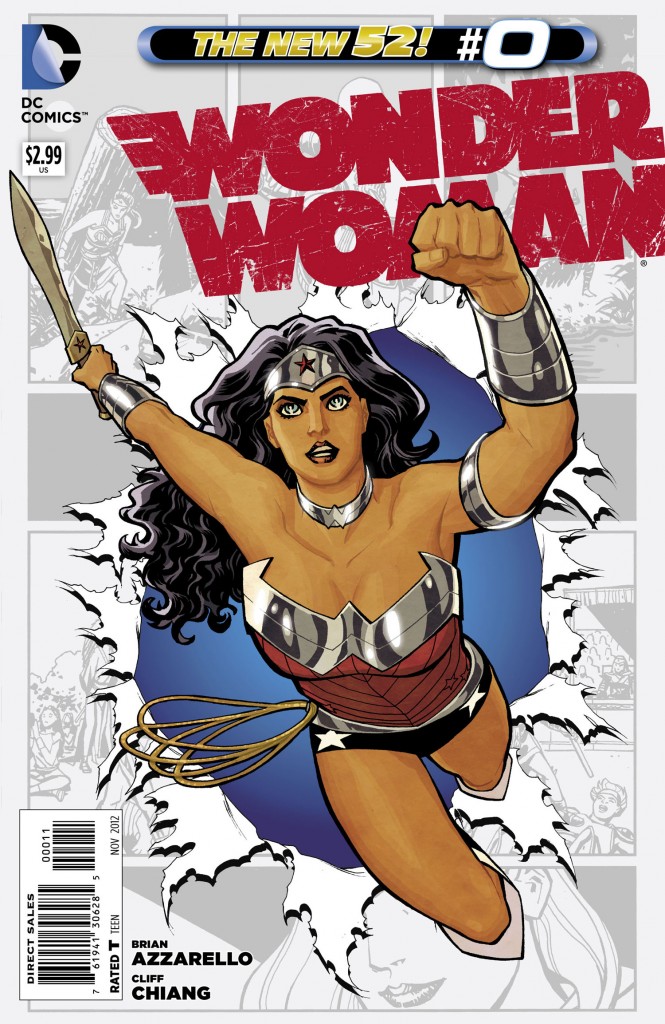
Consider this picture, a recent comic book cover:

Wonder Woman
Wonder Woman
This is the brand new, Issue #0 reboot of DC Comics’ Wonder Woman from last year, 2012. It tells me three things, visually. One: Wonder Woman has massive breasts. Two: she has a thing for chrome. Three: she can fly? To be clear, that is exactly what I am supposed to notice and in that order. When I first see the comic book, I won’t have time or capacity to read the title. There, staring me in the face, are breasts. Then I see other things, then I read “Wonder Woman” and go “well, yeah”. This is wrong. Wrong. I shouldn’t need to have a massive pair of mammaries thrust in my face for me to be interested in a comic book about a woman. What isn’t wrong is that she is beautiful. That is all well and good. But beauty is skin deep, culturally defined, and transient. What is really important about Wonder Woman? She fights for truth, justice, and gender equality. Her magic lasso makes it impossible for anyone ensnared in it to tell a lie. Wonder Woman fights crime. Wonder Woman, being a powerful woman herself, is very committed to making sure every woman is given respectful treatment. So why show her boobs first?

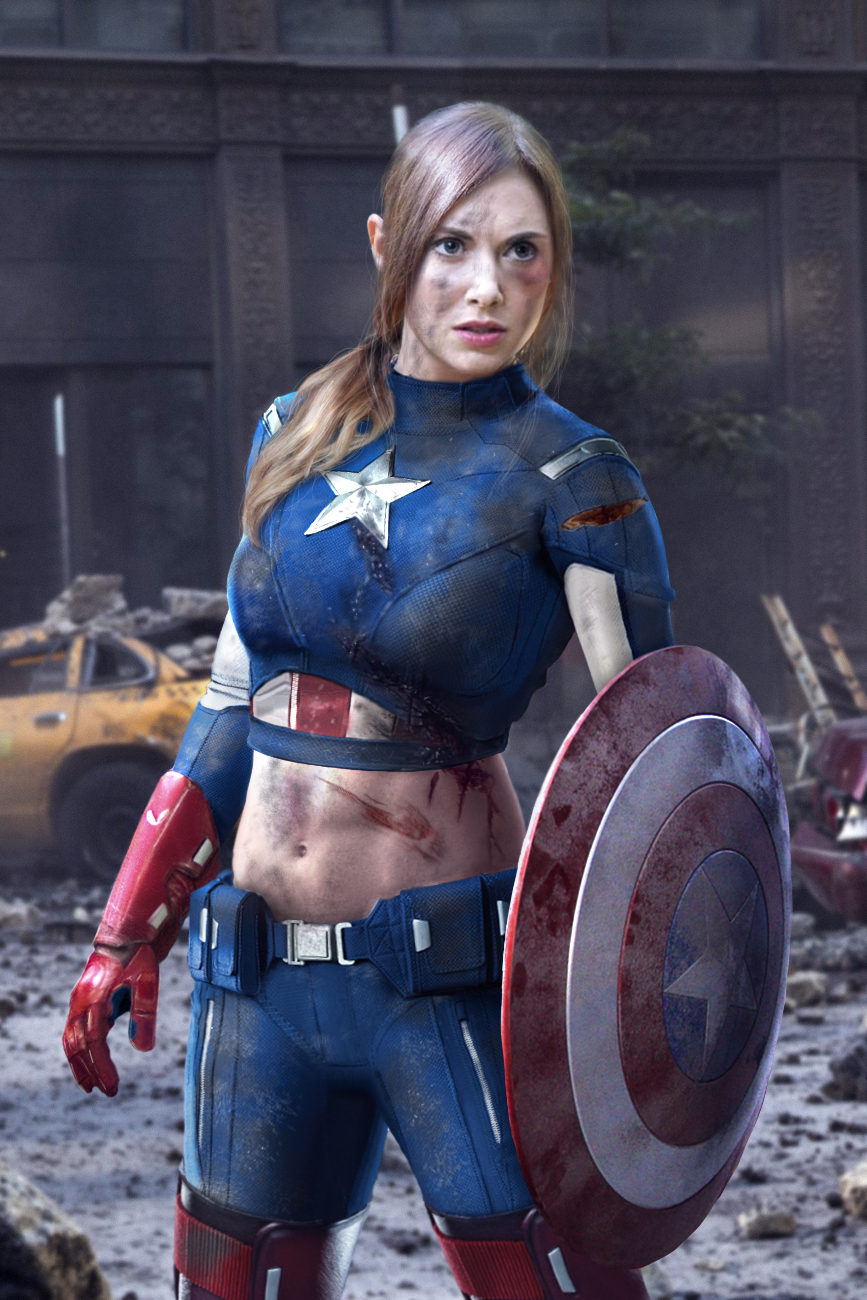
I’ve been aware of images like that my whole life. It didn’t really bother me or make a dent in my brain until very recently. Sure, I had an intellectual understanding that such comic book covers objectified women and that it was wrong, but it didn’t mean anything to me until this week when I saw another image. This is entitled Miss America and comes from Fan Art Exhibit.

Miss America
Miss America
This is a digital manipulation of a shot of Captain America from the recent Avengers film. Obviously the creator has merged a female body with that of Steve Rogers to give us Miss America. I noticed two things about this picture. One, she has a bare midriff. I have no idea why she also doesn’t have a low cut top and copious cleavage as that seems more standard for female superheroes, but she does have a bare midriff, which is Item No. 2 on the “Make Her Look Uber Sexy” checklist comic book artists apparently have. This is the image that lent a machete to my intellectual thicket. Why the hell would a soldier wear body armor of any type that leaves such a vital (to life) area of the body completely exposed. This makes no sense whatsoever. The “sexy for sexy sake” did not pass the “it makes sense” test for my brain and I short circuited. I could almost buy a super hero like Wonder Woman wearing less than a bathing suit because, usually, she has a Superman level of invincibility. Therefore, armor is irrelevant (even if her wardrobe makes no sense for other reasons). But a genetically enhanced super soldier leaving the gut exposed? No way. And two, why is she called “Miss America”? The artist named her so, but why not Captain America? Captain is a rank and is gender neutral. And then the lights flashed on and I went “Ooooh.”

Don’t judge me too harshly, please. My point here is that society my entire life has been feeding me this idea of women and it is hard to break. By the way, I do want to point out that men have it no better, but it is less kosher to point it out, mostly because, as a society, men still have a majority of the power and influence so it is boorish to whine. But, do walk through a comic shop sometime and see if you can find a realistic looking man on the cover of anything. Go ahead, I dare you. I could not look like Captain America as he usually looks any more than any girl could hope to look like Wonder Woman.

Role. Most women in popular culture are eye candy, the damsel in distress, or non-existent. They exist to look pretty, to be rescued so the man looks heroic, or they simply aren’t there. I really, really enjoy the Lord of the Rings, both in book and film form. Do you know how many females there are in the main cast, in the Fellowship of the Ring? 0. Nine males. How about the Hobbit, how many women in the main group? Yeah, 0 again. There are 13 male dwarves, a male hobbit, and a male wizard. Even in Star Wars the ratio is still 5 to 1. (Han, Luke, Chewie, R2, C-3P0 to Leia). And what does Leia do in the first film? Gets captured by men and gets rescued my men. In the Empire Strikes Back? Gets rescued by men. In Return of the Jedi? Tries to rescue a man, gets punished by way of brass bikini, gets rescued my men and male ewoks. I love Star Wars, but it has a gender equality problem. Only recently, and very slowly, has this changed. Even the mighty Joss Whedon, who elevated women so spectacularly in Buffy the Vampire Slayer, was shackled when he made Avengers because, yep, women were outnumbered on the super hero team 5 to 1. But Joss did what he could and made that one woman one of the most important and smartest of them all. Men break things, men fix things, men are the heroes. That is the message I’ve heard my whole life. And not only does it not make sense, it is stupid, and ignores completely the role women have wrested for themselves at great cost. Even in our long, patriarchal history there were women who did great things and stood high above men, but mostly they are ignored or marginalized. For shame.

How did this happen? That is a very long discussion. But, I blame two things: biology and laziness.

Not to ruffle feathers, but you can’t argue with evolution. The male part of the human species, rather generally, has more muscle mass than does the female part. Way back when we were fighting for evolutionary survival, that mattered. Men led because men could kill more, hunt more, build more simply because they were stronger. And, because all who gain power fear to lose it, once women let men fight for the power, men never gave it up. The majority of societies built since our meager beginnings have been male dominated (to my knowledge). Once we, as a species, kill our predators, kill our food, and build a fire, we like to be entertained. So we tell stories. We are smart, but not that imaginative, so our stories reflect everyday life. They are about warriors, hunters, builders. And, since what we see every day are men in those roles, men take those roles in our stories, our legends, our myths. Hence, laziness.

Since the dawn of history, until now, very rarely have we as a species deigned to allow women into our myths in any significant way, just like in real life. Sadly, it is only recently, and then only a little, that this is changing. Modern comics, tv, film, books are the myths of old retold again and again. Why else is Wonder Woman the lone female member of the Justice League (in popular consciousness) why else is Black Widow the only female member of the Avengers (again, in the popular consciousness, I am vaguely aware that in the comics Wasp was also a founding member)?

Humanity is a species slow to change. It has taken me 25 years. It has taken us millennia. I hope not much longer before women are in power, realistically portrayed, alongside realistic men is simply the way of everyday life and the stuff of legends. I advocate not for a reversal of the binary, but a destruction of it. Men and Women are equal in every way that matters biologically speaking. We should be socially and mythologically as well.