From a Distance

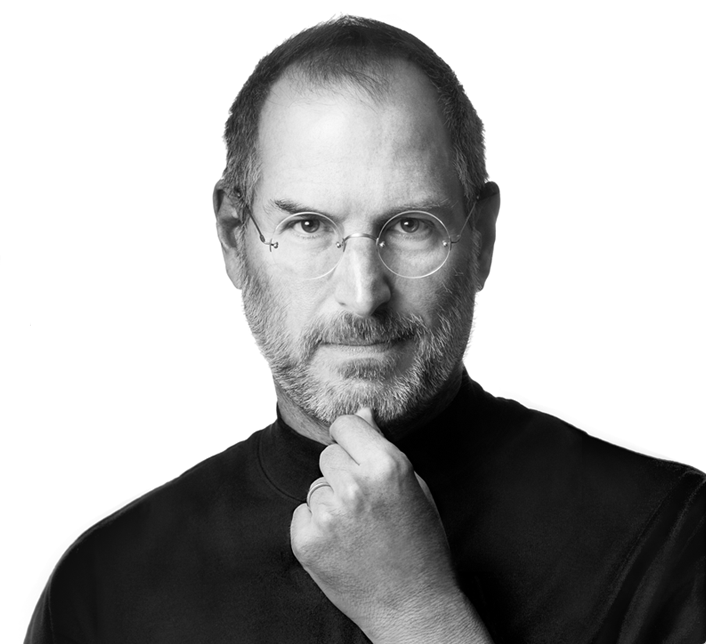
Steve Jobs
Steve Jobs
Steve Jobs is dead. Apparently he passed away sometime this morning, and it seems obvious that his death is a result of his recent and prolonged battle against pancreatic cancer.

I first learned of his passing on my iPhone, and confirmed that the report was more than rumor on my iMac. I suppose this is as fitting a legacy as any for the man who changed the modern world. If I say that my life has been irrevocably changed because of Steve Jobs, I am not exaggerating or being sensationalist. The first computer I ever bought was an iBook (the laptop) back when I was 16. The first digital media player I ever bought was an iPod, classic Jobsian hardware. My first purchased desktop was an iMac, the great grand computer of Jobs’ Apple Computer saving computer. The first, and only, cell phone I have ever owned was an iPhone. I watch TV via my TV.

All my life I have been immersed in new technology, hardly surprising for a kid who grew up in the 90s. Most of my life has been shaped directly by Apple products. It should come as no surprise, then, that Steve Jobs’ death is hitting me harder than even I realized that it would.

I have been sitting here tonight, reading tributes to Steve on Twitter and FaceBook, and trying to figure out why I am on the verge of tears. Steve Jobs was a business man. He made products and sold them and made billions of dollars doing it. If the founder of Nike or McDonalds died tomorrow, I doubt I would give it much thought. It would be a footnote to my day. So why is Jobs’ death affecting me so much? Probably because Jobs did so much more than just make and sell a product. He has changed life itself.

I watched the keynote address from yesterday’s iPhone 4S product launch, and something Phil Schiller said is replaying itself in my brain: “we created the iPod because we love music”. Steve Jobs helped to create the digital music player because he liked music. Sure, the money he could make selling it must have been in the mix somewhere, but I really don’t have a problem believing that Steve’s primary motivation wasn’t the money, but the music. In all the keynotes I have ever heard Jobs give, one thing always seemed to be at the forefront of his presentation: enjoying life. Sure, he talked about how Apple was doing, and how many products they had sold, but always the emphasis seemed to be on the lives of the people using the products, and not on Apple’s bottom line. Jobs’ eyes sparkled when he talked about living at the intersection of technology and the liberal arts. He got choked up after demonstrating how his innovative FaceTime allowed people to talk face to face. He was like a giddy kid when he announced that he had brought the entire Beetles catalogue to iTunes, and not from the greed of pennies filling his bank account, but from finally being able to bring some of his favorite music to millions of people in a format that would allow some of the most popular music of all time to be preserved for hundreds of years to come.

I don’t know if this is true, but I’ve heard that Jobs’ annual salary from Apple is only $1. Not that he didn’t benefit from his company’s success, he surely did, but what was important to him was designing the world of tomorrow, and in creating new ways to enjoy the things that make life worth living: family, creation, and innovation.

I think because I was 16, in the prime of designing my life, when I first started to adopt Apple products, that I also started to design my life around Apple’s, and Jobs’, philosophy: think different. Create. Stand out from the crowd. Live life. My life has become a life in which I immerse myself in my creative endeavors because I find them stimulating. I think that is all Steve Jobs ever really did.

This man I never knew changed the world I live in. Steve Jobs changed my life.

I will miss him.

Twitter has been full of some awesome quotes from Steve Jobs. These resonate most with me:

“Your time is limited, so don’t waste it living someone else’s life.”

“We don’t get a chance to do that many things, and every one should be really excellent. Because this is our life.”

“Remembering that you are going to die is the best way I know to avoid the trap of thinking you have something to lose. You are already naked. There is no reason not to follow your heart.”

Against Censorship in Schools with an Eye Towards Education

Against Censorship in Schools with an Eye Towards Education

My son brought home a book
It sat all innocent in its aged leather binding
the paper pages cracked slightly with age
but the gilded print on the cover damned it
Huck Finn by Mark Twain
oh! the horror – for therein
is a black man called nigger
a slave to the white man
hideous and repulsive to modern sensibility
after all, we’ve lived through the 1960s
we marched with Dr. King, or at least learned
to share a water fountain, or a bus seat
we’ve grown beyond our racist past
surely now we can teach our kids
that niggers is no longer slaves
and that certain words debase and vilify
surely now we can teach our children
tolerance and love and acceptance
and that hatred is even more disgusting
than slave owning ever was
surely through Huck Finn
a fictional boy from our past
we can educate our children –
surely

My daughter brought home a book
It sat neglected in her tattered backpack
the pages were crisp and unbent
but the dust jacket’s lettering damned it
A Study in Scarlet by Sir Arthur Conan Doyle
oh! the horror! for therein
are Mormons treated with suspicion
rank intolerance and ignorance
an old man refuses to allow his girl to marry
a member of his own adopted congregation
as if who we marry is matter of another’s opinion
but the Virginia school board banned it
the book teaches hatred of Mormons
we can’t have that in our schools
we can’t have children reading that – though
surely now we can teach our children
tolerance and love and acceptance
and that fictional characters with heinous opinions
need not be our own
surely through a STUDY in Scarlet
a fictional book from our past
we can educate our children –
surely

Why I Dislike Derek Jeter

It isn’t anything personal, mostly because I have never actually met the man, but I dislike Derek Jeter, (the professional baseball player).

Derek Jeter
Derek Jeter

I actually have a very hard time articulating this fact because my personal belief is that it is a waste of time to like or dislike people I have never met. What is the point? I don’t know them. Obviously, I lack information, and any lack of information leads directly to a weak or false conclusion, especially about people. How then do I continue this post without hypocrisy? I am not really sure, but I have this theory: people are constantly and naturally making evaluative decisions every day, about things and people we encounter and so this is, if not completely rational, at least consistent with basic humanity.

Feel free to judge me similarly without knowing me; I assure you, I will be unperturbed for as long as I know nothing about your judgments, and if I do become aware of them I am certain my reaction will be to arch an eyebrow (or possibly run off to a corner in which I will huddle and weep annoyingly while rocking back and forth). Either way, you are free to your own opinions.

Anyway, back to Derek Jeter. Derek Jeter plays the shortstop position for the New York Yankees, and has for his entire professional baseball career which began in 1995. Coincidentally, I really started to be interested in baseball as a sentient being in 1994 (when I was seven) and have, consequently, been watching Derek Jeter play baseball my entire life, especially during the 90s when it seemed like almost every year Derek Jeter and the Yankees were in the world series (96, 98, 99, 00, 01, 03) and Jeter was in the All·Star Game (98-02, 04, 06-10). Furthermore, Derek Jeter is unquestionably one of the greatest shortstops to play the game, purely from an athletic and statistical point of view. Just recently he capped his career to this point by reaching a mark never before attained by a shortstop or a New York Yankee: Jeter hit his 3000th hit.

But my problem with Jeter lies not in his performance on the field, but rather his persona off the field, and his revealed personality in interviews and the public forum, the most recent example of which revolves around the 2011 All·Star Game. Jeter won the popular vote for starting shortstop for the American League All·Stars by a large margin. He then proceeded to decline to play, or even to appear during the opening ceremonies, citing fatigue and a recent injury. He then proceeded to play several games in which he hit several more hits, including a home run for number 3000.

I can fully understand a player declining to play in an exhibition game for reasons of injury or fatigue. But, the players who show up for, and who have the option of playing in, the All·Star Game are voted for by the fans, fellow players, and coaches. Being selected for the All·Star Game means that a great number of people want to see you there, in that context, and cheer your success as a baseball player. Declining to play is understandable (some are even forced to not play due to rules to protect player health) but declining to show is a snub.

Jeter absolutely was recently injured. I understand that. But, he returned from injury to play long enough to reach a personal and professional milestone (3000 hits), and become one of only 28 hitters to reach such a milestone in over 114 years of professional baseball in America. If he could return from injury to hit a few more hits, and in so doing endure the rigor of a few games in order to do so, why could he not merely be present for the opening ceremonies of an exhibition game?

Declining to even be present, stay in a nice hotel for a few days, enjoy some exclusive privileges, put on a uniform and tip your hat to millions of cheering fans when they call your name is just arrogant and an extreme lack of class. Baseball players would be nobodies without a job if it were not for the fans who pay them to play a boy’s game via ticket sales and other revenues. Derek Jeter’s name would not be a household name if it were not for his millions of fans. And he just told them he did not care about them at all.

Lastly, while Jeter may be a future candidate for the Baseball Hall of Fame (based on his stats and records), and he may, in the past, have been an All·Star calibre player, this year he is playing well below form and well below the level of many other shortstops in baseball. This year, despite his 3000th hit, his performance did not merit an All·Star invitation. And when he was invited anyway, Jeter then spurned the invitation.

Derek Jeter displayed his arrogance and his contempt for the very people that employ him and make it possible for him to have the money, prestige, and acclaim that he enjoys. His is the insult of the kid given a present that he did not deserve by a loving caregiver who then turns up his nose at the giver and says “no thank you, I don’t feel like opening it, give it to someone else, I can’t really be bothered” and then goes to play in a corner.

And that is why I don’t like Derek Jeter.

I sincerely hope that if I ever get a chance to meet Jeter, I may come away with a completely different perspective. Knowing someone has the potential to make all the difference in the world in the way that person is understood.

Reflections in Film: Transformers 3

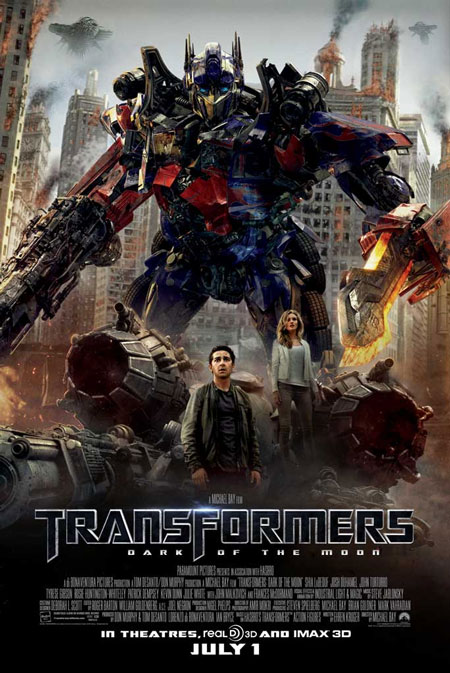
Transformers: Dark of the Moon

T3
T3

History: Transformers began as Hasbro toys. Then they became a much beloved TV show. In the past four years Transformers was remade into the action fest, explosion orgy that are Michael Bay films. The first movie was released in 2007 and resembled Bay’s 1998 success Armageddon: plenty of senseless action, a little heart and emotion, and almost everything blowing up. It was a solid pop-corn, summer blockbuster action flick. The plot centred on hapless Sam Witwicky (Shia Lebouf) who buys his first car in high school which turns out to be an incognito alien robot, Bumblebee of the Autobots. The Autobots are locked in a centuries long conflict with a bunch of evil robots, the Decepticons. Once the Decepticons realize Bumblebee and his Autobot friends are hiding on Earth, they launch an all out assult, hoping to destroy the Autobots and reclaim a powerful alien tech cube called the All Spark (also hidden on Earth).

The film was good, for what it was.

Transformers 2: Revenge of the Fallen was released in 2009. By this time, Sam had entered college, the Autobots, having vanquished (but not destroyed) the Decepticons are partnering with the American military to hunt down and destroy any remaining enemy robots. Unbeknown to them, an ancient evil robot called the Fallen has been waiting in stasis on a broken starship. He returns to earth hoping to find an ancient tomb of powerful dead robots and reclaim a powerful object that will allow him to harness the sun’s power, but destroy earth in the process. The Autobots, and Sam, rally with the US military to overcome this new, and more dangerous, threat.

The second Transformers film had much more action, a little more emotion, and a lot more things exploding. It was as good of a story as the first film, but suffered from an unrestrained Michael Bay. There really is a certain level of over-the-top filmmaking that Bay can get away with, but T2 really pushed that boundary.

Hype: I was expecting another solid entry in the Transformers franchise with Dark of the Moon. Early trailers showed some sort of NASA coverup involving more alien robots on the moon, which seemed like an interesting plot device. Trailers also showed completely absurd action sequences inside of falling building. I was at once intrigued and dismayed.

Megan Fox, who had played Sam’s love interest in the first two movies, had been replaced for the third movie. While Fox has sex appeal, she seemed increasingly bored in her scenes, and her contempt for Bay and Shia off camera oozed into palpable distaste for Sam on camera and I was glad to see her go. I was hoping for a stronger female character to counteract Sam and the rest of the male characters (ie, every other character). Mostly I was wishing that the story would be strong, and the action restrained to normal Bay amounts.

The Good: Alan Tudyk was in this movie. He had a bit part, but it was a hilarious part, to me anyway. I know Tudyk from Joss Whedon’s TV shows Firefly and Dollhouse. In Firefly he played a space ship pilot who was a funny, wacky, oddball. In Dollhouse he played a psychotic serial killer named Alpha who had multiple personalities, some of which were funny, oddball, wacky, creepy, weird, hilarious, or pyschopathic. In this film, he seemed to be continuing his performance as Alpha, albeit reformed somewhat. Whenever he talked, I totally lost it. There was one scene in a bar when Tudyk’s character, for no reason whatsoever, snaps and does some awesome kung-fu and snatches a few guns away from some bad guys only to suddenly “wake up” and mutter “Sorry, that was the old me” and that was pure Alpha. I wonder if the writer’s did in fact rip off the Whedon character, but even if they didn’t, Tudyk was funny as hell.

Oh yeah…the good. Hmm. Megan Fox was not in this movie. Some of the action scenes were restrained and more on par with T1 than T2.

I’m still thinking.

Oh, the recreation of the Apollo 11 moon landing was fantastic. I loved seeing that intercut with archival footage and recreations of JFK in the White House. Best cinematic opening sequences and the movie only went down from there into a deep, dark, hellish abyss from which there was no escape.

The Ugly: The first hour of the movie consists of Sam living with a Victoria Secret model who works for a car museum and who totally despises him for not having a job. Sam then whines about not having a job despite having marginally helped to save the planet twice and having got a medal from Obama. Sam whines a lot. And then he meets a totally psychotic John Malkovich who has no reason to be in the movie. At all. There is some very unfunny stuff in the first hour with employees at a place where Sam does some stuff. I seem to remember something about the color red. Oh, and a murder that involved a man flying out of skyscraper window which the writers tried to make quite a few jokes about, but the scene was played sort of seriously, but then they also tried to make jokes. It was awkward and wrong and bad and clunky and completely unnecessary.

After Sam stopped whining about not having a nice car and a job working with the Autobots, the Autobots find the alien robots on the moon which nobody thought to mention to them, and then they find this ancient robot who they revive thinking he will be nice and helpful for them in their fight against the Decepticons, except that this guy made a pact with the evil robots back in the day and he totally betrays everyone and goes to the dark side.

Then for no reason he and his Decepticon pals destroy Chicago (for no reason) and demand that Earth expel the Autobots. The Autobots then leave on a special space shuttle (despite the fact that they themselves can fly into space or transform into space flying robots) which the Decepticons then destroy. But not to worry, because right as Sam is infiltrating Chicago basically on his own to rescue his uncaring girlfriend, the Autobots return, declaring that they allowed Chicago, and millions of humans to be murdered horribly, simply to show the Earth that the Earth really needs them…to save millions of humans from being murdered horribly.

Then some action happens, none of it believable, which is par for the course on a Bay film except that half the time it seemed like Bay was directing normal Bay scenes and someone else was directing totally-off-the-charts scenes. Seriously, this movie felt like it had 3 directors all fighting with Bay who was trying to make a T1/Armageddon scale movie.

Eventually, the incredibly evil former-good guys and the criminally inept US military win the day, and Optimus Prime, the leader of the Autobots, stands as victor over his original enemy, Megatron, and his new enemy, Sentinal Prime. Both surrender, and Optimus Prime pulls the spine out of Megatron and shoots Sentinal Prime in the head execution style. After both surrendered to him.

The story was good, except for the bits where Sam whined about being unemployed for an hour, the irrelevant characters, and, oh yeah, the events of the first two films being completely invalidated because if the facts of this film really were known by people during the first two films, then the first two films would not have happened like they did. This was one of those sequels that makes the prequels incomprehensible.

The Personal: I didn’t connect with this film at all. Sam whined like a bitch. One of the heroic soldiers from the first two movies transformed into a coward. And the heroic leader robot turned into an accomplice to mass murder before he summarily murdered two of his enemies who had just surrendered to him.

Final Thoughts: Sentinal Prime, the new villain, was voiced by Leonard Nimoy, Spock from the Original Star Trek. The writers used this as an excuse to steal Spock’s most famous lines from Wrath of Khan and completely misunderstand them and misuse them, which in addition to making the writers look stupid, also made them look completely lazy.

Sam whining about a job seemed selfish in the wake of massive national unemployment, especially when he had a few good job offers that he completely pissed on because he felt he deserved better. When millions are out of work, it makes your writers look like douches when their “hero” character won’t work available jobs.

There is a low standard for Michael Bay films, and this film worked way too hard to not meet that standard. This film could have been as “good” as Armageddon but whatever was happening with the especially horrible writing and inconsistent directing made this movie so much worse. All the way through, it seemed like there was a Michael Bay Transformers movie in there somewhere, but it kept getting interrupted by someone else’s idea of what would make a funny, or cool, or something scene, most of which didn’t belong or have anything to do with anything else in the film. Shia Lebouf has said that he is done making Transformers movies, and I hope that Bay is too. I think that someone else could bring a fresh vision to Transformers, but hopefully not for 20 years. We need more original stories right now and we need to forget about giant fighting CGI robots for a while.

Final Score: 1.5 of 5 transforming car robots (entirely due to Alan Tudyk’s presence and Megan Fox’s absence and the uber cool recreation of Apollo 11 and a cameo by the real Buzz Aldrin).

Reflections in Film: X-Men First Class

X-Men: First Class

First Class
First Class

History: The X-Men film franchise began over ten years ago in 2000 with the first X-Men film, directed by Bryan Singer, which introduced the world at large to one of the largest pantheons of comic book heroes: the mutant “x-men”. Gruff Wolverine aka Logan (Hugh Jackman) and scared, traumatized Rogue aka Marie (Anna Paquin) were the world’s first look at the mutant problem from an intensely personal angle. Mutants were people who were given extraordinary, lethal, or inconvenient “powers” through alterations in their DNA, making them the next wave of human evolution.

The movie sought to answer one question: what would a mutant do with their powers? Would they seek to overthrown humanity? Would they seek to hide from ridicule, hate, and prejudice? Or would they work for world peace? Two of the most powerful, and oldest, mutants were Erik Lehnsherr (Sir Ian McKellen) and Charles Xavier (Patrick Stewart), the former a manipulator of metal and a Holocaust survivor, the latter an English professor and a telepath. Erik was Magneto, and due to his personal trauma and superiority complex he sought to rule over mere humanity. Xavier took the high moral ground and worked his entire life for mutant and human peace.

The first film revolved around Magneto’s plot to induce mass mutations in the world’s leaders at a peace summit on Ellis Island, and his nefarious scheme to use Rogue to do it, an action that would result in her death. As an incidental figure, Wolverine moved from a life of personal exile on the fringe to a member of a group larger than himself. The film was a little campy, but it had its humor, emotional impact, and solid character development.

X2, released in 2003, was about one man’s vendetta against the mutant community with a side lesson in accepting people for who they are coupled with Wolverine’s search for his past. Colonel William Stryker (Brian Cox), a long time military man and hater of mutants, hatches a plan to wipe out all mutants everywhere using Xavier and his immense telepathic power. Wolverine discovers that he was once a mutant experiment of Stryker’s while a new mutant character, Bobby Drake aka Iceman (Shawn Ashmore) deals with “coming out” to his family about his being a mutant. X2 was solid. It had the best opening sequence of any X-Men film, and of most films, and the character development continued from the first film and set up the third one nicely. It had plenty of good action, but I feel that the plot to use Xavier to kill all the mutants was a little thin.

X3: The Last Stand, released in 2006, was about a final battle between Magneto and humanity over a new cure for mutantism. Xavier’s students get caught in the middle as some are desperate for a way to be normal and some offended by the very idea of a cure. A massive subplot of the film focused on the resurrection of Jean Grey (Famke Janssen) as the most powerful mutant alive, Phoenix, and her place as an force of nature while both Xavier and Magneto try to control her to their own ends. Wolverine completed his story arc from loner to leader and became a full-fledged member of Xavier’s school. Overall X3 rushed its way through a story that should have been handled with care and relied too much on mutant power eye candy instead of real story to drive the film. Bryan Singer had handed over directing duties to Brett Ratner and the film suffered for it.

Staying on pace with a release every three years, X-Men Origins: Wolverine was released in 2009. This film went back to basics, literally, to tell the story of the first ever mutant (as far as anyone knows): Wolverine. Logan’s back story was explored extensively throughout the trilogy, but only so far as his interactions with Colonel Stryker were concerned. Little was shown or told about this life before the 1970s, mostly because at some point Wolverine had contracted a little amnesia.

Wolverine focused on Logan, obviously, and his half brother Victor Creed aka Sabretooth (Liev Schreiber), who were children in 1845 era Canada. Following a drunken outburst and a case of mistaken identity, young Logan murders his father and he and Victor go on the run. Through the decades the duo fight in, and survive, every major war from the American Civil War through Vietnam due to their shared mutation of claws, and the ability to endlessly regenerate. Throughout their history, Victor shows tendencies of becoming more and more violent and animalistic, as does Logan, though Logan resists his darker impulses. During Vietnam, Victor loses control and kills and officer and both are condemned to death. Surviving their execution, they receive an offer from young Colonel Stryker (Danny Huston) who admits them into his mutant black ops team. The story then follows Wolverine as he quits, sickened by the killing, and Stryker who endlessly experiments on mutants, ultimately trying to create the perfect mutant killer who is a combination of the most powerful offensive mutations he can identify. Along the way he conns Logan into an experiment which results in the grafting of an indestructible metal called adamantium onto Logan’s skeleton. Eventually Logan hunts Stryker down and tries to kill him, but the Colonel manages to shoot Logan in the head with adamantium bullets, which erase his memory but fail to kill him.

Wolverine excelled in that it focused on three men fairly exclusively and kept the mutant eye candy to the peripheral. Logan’s character arc was good, but a bit quick, in my opinion; I loved the brother dynamic between Logan and Victor. The acting was good, and the action was even better.

Hype: With all the past 9 years had produced, I was looking forward to a second origin story in First Class, this time focused on Xavier and his school and Magneto. All new actors for the two mutants were introduced, James McAvoy for Xavier and Michael Fassbender as Magneto. I had seen McAvoy before, and was having trouble accepting him as Xavier. Fassbender was new to me, and he seemed to at least look the part. It wasn’t until I started seeing previews that I began to see the potential genius in the new casting choices. Centering the story around the Cuban Missile Crisis made me nervous as Hollywood movies which make money on glitz and action rarely pay the proper respects to history.

Also, I was looking, as always, for character development over mutant flash.

The Good: The casting was the most excellent part of First Class. McAvoy and Fassbender absolutely nailed their roles, paying homage to the performances that Stewart and McKellen gave the world without actually copying them. They both made me believe their passions and struggles were real. McAvoy’s talent for portraying emotion is on a very high level. The villain of the film was Sebastian Shaw (Kevin Bacon) and the casting choice there was brilliant. Bacon was able to make his villain suave, ruthless, gentlemanly, and completely insane without ever breaking the camp barrier.

The movie revolved primarily around Xavier and Magneto, with most other mutants barely tripping the radar. The title became a bit of a misnomer as the entirety of Xavier’s first class with his mutants was relegated primarily to a montage of scenes with a strong musical background, but I loved seeing how Xavier was able to personally connect with each person and help them find their calm centre, and the secret to controlling their mutations in beneficial ways. I especially loved the few educational interjections Magneto made along the way, which gave the audience a chance to see the future villain contributing in benevolent ways to other people.

The action was good, but mostly only were necessary and never too much out of control. Also, despite the superhero nature of the film, the CGI was kept as unobtrusive as possible. I always appreciate a director who can keep the computer in the back room.

Finally, while Bryan Singer did not return as director, he did produce the film and engineer the story, which is part of why I think this film succeeded where X3 and Wolverine suffered.

The Ugly: For me the failing of this film was setting the action around the Cuban Missile Crisis. Shaw personally meets with key members of both the American and Russian governments and threatens them into the series of actions which became the Crisis in an attempt to start World War 3. I found this scenario extremely unlikely, and it was also unfair to the historical period, which was one of extreme paranoia and not at all as simple as the film made out.

I just couldn’t see one mutant, no matter how flashy or persuasive, being in a position to influence governments to that degree, and, if he could, I fail to see why he couldn’t have simply pushed the launch buttons himself. Ultimately, I wondered why he even bothered with an extremely clumsy plot to try to force two superpowers into a reluctant war when he could have started one singlehandedly without any coercion at all by utilizing just a little misdirection. When one has a teleporter and a telepath as one’s friends and collaborators, one usually doesn’t need to muck about with bureaucratic and governmental middle-men.

The Personal: As Professor X says: “I believe the true focus lies somewhere between rage and serenity.” This film gave me a chance to understand and explore the power both rage and serenity provide and understand a way to incorporate both into my psyche. Being a human is all about balance, and while society, religion, or culture might want to eradicate evil and darkness entirely, I think that humanity would be incomplete without both sides of innate natures. Ultimately, that is what the X-Men franchise is all about: everyone has the power to do great things, and the question is, how do we handle that power? If X-Men: First Class achieves anything, it is that it makes that dilemma accessible to its audience by cloaking it in mutant struggles, bypassing mental defense through the guise of entertainment, and that is what art and film should be all about.

Bonus:
Xavier: “Want to see another parlor trick?”
Man in Black: “Sure!”
Xavier (exerting telepathic effort): “Get in the car.”
Man in Black: “What a great idea!”

Final Score: 3 out of 5 Jedi mutant mind tricks.

Reflections in Film: On Stranger Tides

Pirates of the Caribbean: On Stranger Tides

On Stranger Tides
On Stranger Tides

History: Pirates of the Caribbean: Curse of the Black Pearl premiered in 2003, based, absurdly enough, on a ride down at Disney World, but the idea was sound despite the perception that the conceit of a pirate movie (like westerns once upon a time) was thought dead and gone. Brilliant writing, better acting, and great cinematography was all it took to put pirates back on the silver screen and back into popularity.

Pirates was cast very well with Johnny Depp as the perpetually drunk and crazy Captain Jack Sparrow, Geoffrey Rush as the villainous and classic pirate Captain Hector Barbossa, Orlando Bloom as the naive, pirate hating Will Turner, and 17 year old Keira Knightly as pirate loving, society restrained Elizabeth Swann. Rounding out the cast, Jonathan Pryce as Governor Swann, Jack Davenport as Commodore Norrington, and Kevin McNally as Joshamee Gibbs all were perfectly cast for their characters. Pirates was full of colorful, well rounded, and excellently performed characters.

The story was straightforward and filled with extremely humorous dialogue and plenty of rousing, swashbuckling action. The film also knew when to be silly and when to be serious, and Geoffrey Rush’s Barbossa was often at the heart of the most emotionally heavy scenes. He revealed the full extent of the curse of the Aztec gold to Elizabeth in dialogue and gripping story before the effects revealed his skeleton form. He brought the sword fighting to a stand still when Jack’s last pistol shot echoed through the Isla de Muerta cave and he realized he could feel, but only until death took him.

Pirates was such a risky venture at the time that they did not plan on sequels, and thus when it exploded at the box office and the studios revealed that they could make more films that would be profitable, everything made for the first film had to be recreated for the sequels, down to ships and Captain Jack’s wardrobe, none of which had been saved.

Pirates of the Caribbean: Dead Man’s Chest and At World’s End, the second and third films in the franchise, formed a single storyline and were filmed concurrently. It was an epic four hour adventure on the high seas that advanced the character arcs of all of the major characters and quite a few of the minor ones. The film introduced the character of Davy Jones, played by Bill Nighy, as well as brought to the story Will’s father (only mentioned in the first film) Bootstrap Bill, played by Stellan Skarsgård.

The humor of the first film remained, as did the fun and adventure, but it took a back seat to heavy, epic story lines and character development. The scope of the films expanded to Lord of the Ringsesque territory, as did the action and CGI sequences, though the effects didn’t ever completely overwhelm the storytelling. Despite that, many people didn’t like the “complexity” of the plot twists. Personally, I absolutely love the films, and think that the plots are still actually fairly simple and easy to follow, though why who is doing what sometimes gets a big tangled, but Gore Verbinski, director of the first three films, did a magnificent job of keeping track of and paying off almost every single plot point.

Also of note, Hans Zimmer created perhaps one of the most iconic film scores of all time as he overproduced Klaus Badelt’s score of Black Pearl and completely took over the musical parts of Chest and End. His music is fun to listen to completely outside of the movies, the scores being every bit as fun and epic as the films they were written for.

Hype: As a huge fan of the Pirates films, I was excited for a fourth movie, but given the way that At World’s End sort of brought the sea-faring house down, I wasn’t entirely sure how a fourth film could find an authentic way to continue.

The third film left off with Captain Jack half-heartedly pursuing his beloved ship and also contemplating a quest for the mythical Fountain of Youth, so it was pretty obvious what the story would be, and also given the completed story arcs for Will Turner and Elizabeth Swann (also given the actors themselves bowing out of the franchise) it was clear that any further movies would be mostly about Jack and probably Barbossa.

Once more of the story was revealed, mainly through trailers, and the new character of Black Beard the Pirate was announced, along with mermaids and a privateer version of Barbossa, I was definitely intrigued and excited. Most of all, going in, I was curious as to the tone (as it was still unclear) and I also wanted answers as to why Barbossa seemed to have unilaterally given up the pirate life in exchange for formal employment by the King of England. I also wanted good treatment given to the Fountain and the mermaids.

The Good: Once again, the casting was spot on. In addition to the returning cast, Ian McShane was cast as Black Beard and there could be few other more perfect actors to play the notorious, and for once, completely historical pirate. Black Beard could have been over the top, or completely lame, but he was chilling, mysterious, and evil, and all of that is due to the great acting of McShane. Penelope Cruz was cast as Angelica, a former lover of Captain Jack, and she brought the character to life and played her well, despite being very pregnant during most of the shoot.

Once more, the effects were great, but not overwhelming, and Hans Zimmer continued his strong tradition of great scoring. The locations were picturesque and the story was simple and easy to follow.

I won’t spoil the plot points of Barbossa’s decisions, but suffice to say that the man has been and always will be the classic pirate in every way. His story arc was perhaps one of the best parts of the plot. As promised, more of Captain Jack’s sordid past was revealed and explored, and his character development, begun in Dead Man’s Chest is continued in this film in different, but still progressive ways, as compared to At World’s End.

The Fountain, and its rituals, were written well: it was everything that an Indiana Jones quest is all about, and just as legendary. The mermaids were handled very well, and actually contributed to the film in several significant ways, and weren’t just eye candy. Also, suffice to say, don’t ever make mermaids angry. Ever. “All I hear is the nesting of seagulls.”

The Ugly: For me, On Stranger Tides lacked something and it took me a while before I was able to put my finger on exactly what was missing, but I eventually realized that this film was not fun. It was enjoyable, satisfying, and well done, but it was not fun. I had watched each of the three films in the days leading up to my excursion to the theater, and I had honestly forgotten how hilarious Curse of the Black Pearl was, and even the other two, while epic and heavy, never forgot the mad-cap fun that was Pirates. While Tides tried a time or two, the only moment in which it came close was when Jack [did something daring at the beginning of the film which is slightly spoilerish]. There was no clever and humorous back and forth dialogue that was the heart, and bread and butter, of the first three films, and there was hardly any levity at all. For a film franchise built on a theme park ride and birthed in fun and humor, this fourth film was quite a departure.

The Personal: I love pirates and the sea, and one of the best parts of the entire seafaring saga for me was the attention to detail that the creators paid to their art. Very many allusions and references are made to classic pirate lore, literature, and legend, and in the fourth film that continued. Black Beard was shown to be a practicer of Voodoo, and though this is not historical, it was accurate in how it was portrayed and how it functioned, even down to the original idea of a zombie. Everything else about Black Beard was fairly spot on to the historical accounts of him. Even the mermaids were closer to their original origins in the different myths about them and classic stories (being man eating, vicious and tricksy creatures) than to modern ideas. For me, all this depth and detail is part of the immense attraction of the pirate films, and On Stranger Tides certainly delivered.

Final Score: 2 and 1/2 out of 5 really angry mermaids

Reflections in Film: THOR

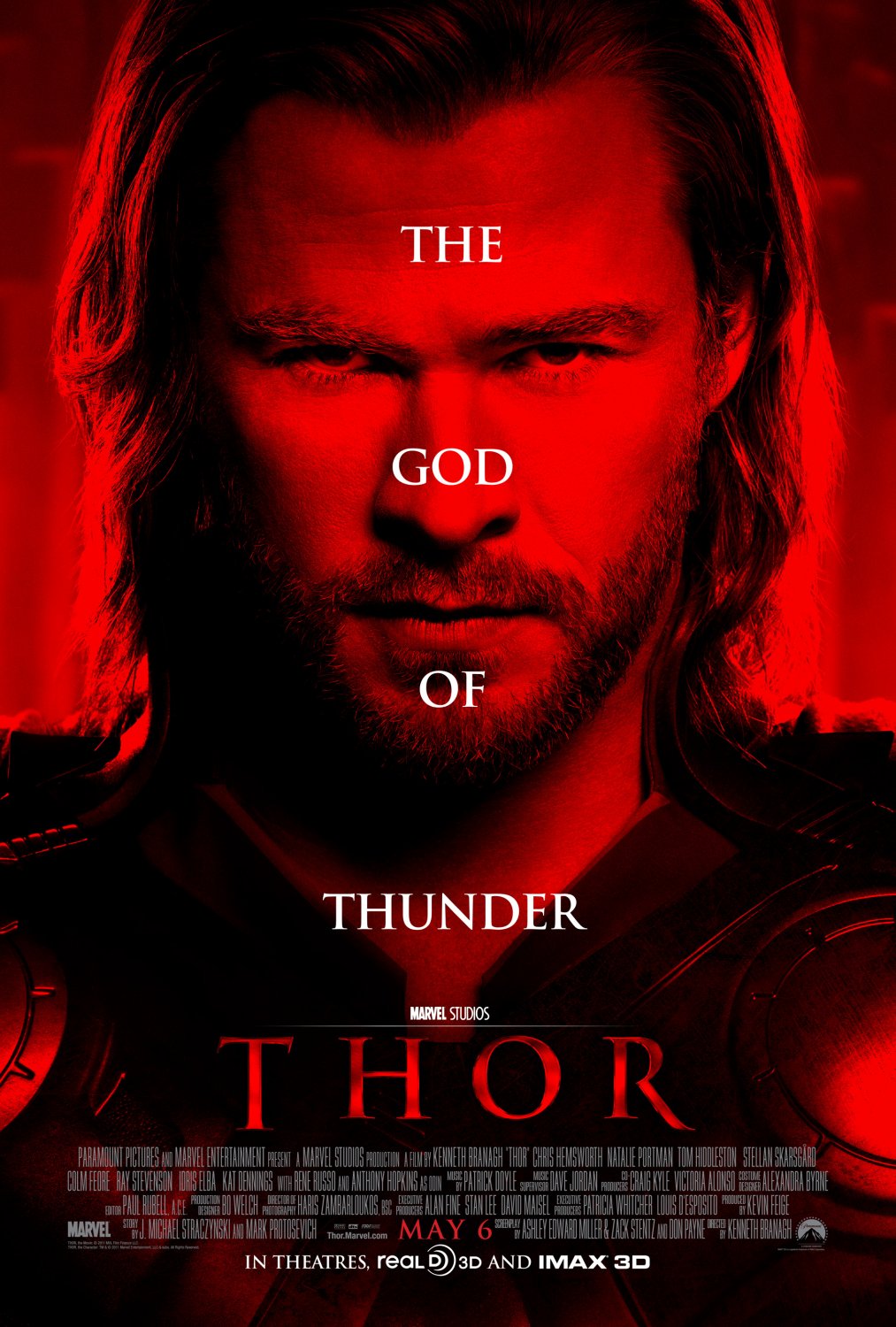
Thor: God of Thunder

Thor
Thor

History: Not having been a comic book reader or fan, my first knowledge of Thor was in the context of the Viking myth of Asgard, Valhalla, and a pantheon of gods, of which, one was Thor, the God of Thunder. But, once Iron Man debuted and the general public became aware of Marvel’s pantheon of gods, it was revealed to me that one such comic book hero was based on the Viking myth. Other than that, I knew little, except that he used a hammer, and was generally considered to be pretty hard core.

Hype: I really enjoyed Iron Man, and Iron Man 2 to a lesser degree, but once I heard that Joss Whedon, master of Buffy, Angel, and Firefly, was to write and helm Avengers, I have grown interested in all of the Avengers, and not just Iron Man. I re-watched the Hulk movies (and was disappointed that they weren’t much to write about), but this summer was very excited for Thor and Captain America. I went into the theater expecting the same level of writing, effects, and sense of story that Iron Man had delivered.

The Good: Casting. In a word, the casting of Thor was excellent. You could not ask for a better All-Father Odin than Anthony Hopkins, Chris Hemsworth was fantastic as Thor, Tom Hiddleston was excellent as Loki. The supporting cast was well chosen, with veteran presence coming from Stellan Skarsgård, and Natalie Portman playing a fairly easy role as the scientist girlfriend. Even Rene Russo’s fleeting screentime as Frigg, wife of Odin and mother of Thor, fit well. Everywhere one looked in this film one saw quality actors.

Overall, Tom Hiddleston’s Loki stole the film. He was fantastically devious and totally realistic/consistent. It took me half the film to remember that Loki was pretty much orchestrating everything, but because of the way things were set up, Thor really made it easy for him to do pretty much everything he did. I liked him way better than Thor, and the fact that I liked the villain more than the hero says something about how badly this film was written.

The Ugly: Plenty. I wanted to like Thor so badly, but I just couldn’t. The budget for this film was very small, and it seemed like most of it was spent on making it 3D. I have said it many times, but special effects, especially these days, can more easily ruin a film than anything else and modern studios just don’t get that effects DO NOT make a movie. By now the CGI thing is so tired that the audience just doesn’t care and isn’t wowed, but the execs continue to push for big effects because they think that is what will draw audiences. Unfortunately, they are right, but only if they want a big opening day payday and don’t care about anything after that (which, sadly, is also often the case with execs). An audience will pay for the spectacle once, but will pay several times for story. Case in point: Titanic and Dark Knight both had effects but also had much stronger stories, the former appealed to the romantic in every housewife and the latter appealed to pretty much everybody as it broke Titanic’s records. Exceptions do exist, but my point remains: story will trump special effects, and Thor would definitely have benefited from better story.

Lack of proper character exploration was another weakness in this film. Natalie Portman is some sort of scientist studying some sort of phenomenon, but we are never really told what or how or why it matters. She is all excited about her research and notes, but the significance is lost on the audience. Second, pretty much as soon as Thor dropped to Earth, she started going all gooey over him, and it completely contradicted her strong scientist character to have her all gaga over his well defined physical appearance. On the other side of the strange love coin, I have an extremely hard time figuring out why a god such as Thor would immediately become enamored with the first human female he encounters on his exile. Thor strikes me as the kind of dude that has several girls on several planets.

Furthermore, scope killed this movie where it stood. Everything that happened on Earth happened in a sleepy western town in the desert. Everything that happened in Asgard happened in the transporter room or the throne room, or on some ice planet that no one cared about (even the characters in the movie didn’t care about it). The movie felt restricted and small. Iron Man traveled the world twice in as many movies; Thor was cast down to exactly one spot on Earth.

Given the fact that this movie was supposed to be about a god learning humility, it could have been perfectly justified and probably a bit more likely to have Thor quest around the Earth learning humility from the down and out and the wise gurus of the Earth. Instead, he acted like a jerk and hung out in a coffee shop, a pet store, and a scientist crash pad.

Speaking of Thor acting like a jerk, that is pretty much all he did. He was a jerk in Asgard and jumped at the weakest incitement to try to start a war. And then he was a jerk to his dad when he was called on his arrogance. And then he acted like a jerk on Earth by beating up nurses and doctors (honestly, that was the exact moment when I started to not like Thor) and few soldiers. And then he did one semi heroic act (I say semi-heroic because he supposedly sacrificed himself to save everybody, but there were only about 10 people in the little diner that the old scientist evacuated, and the rest of the people who were “in danger” were his god-pals and Foster, so I didn’t really see the peril inherent in the situation), was killed for it, was reinstated as a god, and then continued to pretty much act like a jerk. I really didn’t see any character development in what was supposed to be film entirely about his character’s development.

Lots of other things made this film superfluous, for instance, the annoying intern who managed to have the best line in the film. No, not the one about “pretty cut” or “freaking me out” or “Facebook” but: “I’m not dying for six college credits”. Also there was the whole thing about Thor sneaking into the S.H.I.E.L.D.’s desert compound to try to recover his hammer and basically beating up a bunch of people for no reason (not to mention endangering Jane Foster for no reason). Finally, there was Thor’s total bewilderment of some Earth things but not others (ie, pet stores but not cars). It was inconsistent. Either he is a god or he isn’t, but he couldn’t be that selectively clueless.

Finally: the whole thing with the ice planet and stuff, I don’t get it. I know that Thor has to be shown being completely reckless and arrogant, but the ice planet ended up somehow being a part of the plot and it seemed odd and out of place. It was one thing too many in a film that was already going many different directions and it didn’t seem necessary at all.

At that is just the few things I have highlighted that made Thor a less than stellar outing. There were many more.

The Personal: I barely connected with this film. I should have been able to connect much more strongly. A movie about intense and fundamental personal change within a strong character should have been a movie to connect with and project oneself into, but this movie was so poorly done it was like watching a gaudy spectacle happen with detached interest at best.

In the final analysis, Loki was more relatable than Thor because he was the non-favored son who was stolen from his real parents and was lied to all of his life. He radiated real confusion, pain, suffering, and a loss of identity, all of which are visceral and human emotions that one encounters all to often. I connected with his pain, and understood his conflicts. I think he should have reacted better, but he in fact acted according to character, and thus was devious and angry. Also, he was actually somewhat cathartic as a character: I am a younger brother who many times has wished I could take my favored older siblings down a notch or two in the eyes of my parents. Loki actually succeeded, so I like him for that, despite the fact he was sort of evil.

Final Score: 1 out of 5 thunderous Viking hammers.

SWD: Strained Relations

The next 15 minutes or so of screen time encompasses one entire day on Coruscant for Anakin Skywalker. He is conflicted at every turn, and is pulled in several different directions by those he loves and respects. More than anything, this section of the film is meant to show that Anakin feels out of control and at a loss for a solution to the burden being placed on his shoulders. Ultimately, the solution he grasps will be the promised power of the Dark Side.

I will plug the novelization of the film again at this point because Matthew Stover does an outstanding job of making us feel the pain and internal struggles of Anakin in a way that makes his outbursts and neurotic behavior in the film take on meaning and depth. This section of the movie is a valiant try at a brooding, political, personal drama, but it simply falls flat due to heavy handed directing, cardboard acting, and clunky dialogue.

I am going to discuss each of the scenes in this day separately, though they do tell a contiguous story. The final scene of the day, a night at the opera, I will handle apart from the others as it requires a bit more unpacking than the rest.

Star Wars: Revenge of the Sith (00.33.17-00.42.39)

SCENE 1, Early Morning. Location: Yoda’s chambers. (00.33.17-00.34.41)

I really like the film noir look of this scene. The slatted blinds and the bright shafts of light filtering across the dark faces of Yoda and Anakin is a classic technique. It enhances the dark nature of their conversation, and helps to set the mood of the coming day: a few bright spots on an otherwise dark canvas. This is an almost perfect example of a character moment: brooding music, suggestive lighting, and deep, emotional problems. For a scene that is mostly two characters sitting and talking, it feels like more is happening, and that is a good thing.

It seems that after his bad dreams, Anakin stayed up all night, and in the early morning has turned to Yoda for guidance, despite having rejected Padme’s suggestion to ask Obi-Wan for help. The discrepancy there doesn’t make complete sense: why reject Obi-Wan and go to Yoda? The only possible reasons I can think of are these

1) in universe, Yoda is definitely seen as more wise and powerful, so maybe Anakin wanted to go straight to the top, 2) Anakin didn’t want to put Obi-Wan into an awkward position by revealing his code breaking by asking for help or 3) George Lucas remembered, very late in the game, that Obi-Wan had said something about training Anakin “as well as Master Yoda” and that Yoda seemed to know about Anakin, but to this point in the sequels they have shared less than 10 minutes of screen time together, so there needed to be a seen in which Yoda was “training” Anakin.

Despite the flaws revealed here about the screenwriting, I feel comfortable with a hybrid of choices 1 and 2 to contextualize this curious scene. It still doesn’t fully explain Anakin’s reaction to Padme earlier, but it certainly seems plausible. Ultimately, Yoda’s advice to Anakin is to learn to let go of things. If nothing else, George Lucas has certainly shown that to be one of Anakin’s primary flaws, so this is actually a payoff of two movies worth of conflict. (Yes, I did just say that George got one right.) This also helps to set up the allure of the Dark Side power that Palpatine will offer later: Anakin can save his cake and eat it, too.

SCENE 2, Morning. Location: Briefing Room. (00.34.41-00.35.41)

After communing with Yoda, Anakin rushes to a war briefing that has just ended. This scene is a good example of exposition done well. During the initial war report, which reminds the audience that there is a war, there is a visual of planets and information which is the remains of someone’s holographic powerpoint. It is rule #1: give the audience something to look at while you talk to them. Then, the conversation naturally flows from the exposition to setting up the next scene: Obi-Wan mentions that Palpatine is making a move for more political power, and oh, by the way, Palpatine wants to see Anakin about something.

Not only is the Jedi’s problem with Palpatine power grabbing introduced and made clear, but also Obi-Wan’s problem with Anakin’s relationship with Palpatine is brought up. Lastly, Anakin’s naiveté about said relationship is revealed, because for the first time he is sensing negativity about it. Obviously, up to this point, Anakin has considered himself lucky to be on the Chancellor’s radar, and despite his assertion in Attack of the Clones that Obi-Wan feels like a father, it is really Palpatine that is his surrogate father. The Palpatine/Skywalker relationship is very much a manipulative one, but Anakin, like all who fall into a bad relationship in innocence, won’t realize it until too late, despite the warnings of friends.

SCENE 3, Noon. Location: Palpatine’s Office. (00.35.41-00.36.46)

The major problem I have with this scene is the way it begins: a long tracking shot in the interior of the office in which nothing is said. And then the characters start talking. It is awkward and silent and slow. I feel like the editor should crop the first eight long seconds.

Palpatine asks for Anakin’s trust, and then reveals that he is going to ask the Jedi Council to instate Anakin as one of their members so that Anakin can represent Palpatine’s interests on the Council. Politically, this is a smart move, but as Anakin points out “the Council elects their own members, they’ll never accept it” (00.36.36). But, Anakin fails to realize the political significance of what is going on between the Chancellor and the Jedi. More than anything it seems like he got caught up in a situation he never wanted and doesn’t understand. Not to elevate this part of Revenge of the Sith beyond its reach, but this almost feels like Gladiator, in which Russell Crowe’s character wanted nothing of the political scene after Caesar’s death, and wanted only to be a soldier or a farmer. Anakin here feels like the soldier being asked to be an in-between, and he doesn’t know why.

SCENE 4, Afternoon. Location: Jedi Council Chambers. (00.36.46-00.38.19)

Anakin has returned to the Jedi Temple where apparently the Jedi Council was already informed of the Chancellor’s request and is now informing Anakin of their decision: to whit, he is made a member in name, but not rank. He sits on the Council but has no standing as a Jedi Council Member. Again, all Anakin sees is the facade of events, and is slow on the real inner intrigue. He lashes out at the seeming slight at not being made a Jedi Master without realizing that this has nothing to do with him. I give Anakin the benefit of the doubt here, because while it seems like he shouldn’t be this naive, it is understandable that as this is happening so quickly that he would be still trying to catch up. Furthermore, he is probably still more than a little concerned about his pseudo-prophetic nightmare. The hits just keep coming and he hasn’t had time to recover from any of them.

After his outburst, a bit more exposition is slipped in while significant looks are exchanged around the council chambers. Seriously, the non-verbal dialogue of this scene is pretty good. Without having anything said, the audience has a definite idea of what Mace Windu, Yoda, and Obi-Wan are thinking. Somehow this scene manages to be terrible and terrific all at the same time.

True to plot, Grievous is the red herring bad guy whom the Jedi are chasing while the annoyance in the Senate chambers is the real villain they should be examining. How the Jedi could be this stupid is still staggering.

This scene also illustrates something else more fundamental about Revenge of the Sith: it can’t decide if it is a personal drama, a political thriller, or an action adventure, and nailing down genre is vital to a film’s success. Because this movie is multiple things it feels distracted, undefined, and ill-contrived. It is all over the place, and here it is clear: Anakin is having a moment, there is political stuff, and oh yeah, something about Wookies. One wishes someone had made up their mind about what kind of movie this was before they made it.

SCENE 5, Afternoon. Location: Jedi Temple. (00.38.19-00.40.15)

After the council meeting, and now outside the chambers, Anakin vents his frustration to Obi-Wan while Kenobi tries desperately to salvage an increasingly deteriorating situation. Clearly Kenobi understands everything that is going on here, and is just as conflicted as Skywalker, but on much deeper levels. Obi-Wan reveals the catch of the council appointment to Anakin: the Jedi want him to spy on Palpatine just as much as Palpatine wants him to spy on the Jedi. Anakin rails against the Jedi and against Obi-Wan, and somewhat justifiably. He simply wasn’t prepared for this level of infighting and is ill-prepared to handle it. The Jedi are losing some of their high morality, and Anakin knows it. Having been a late inductee into their monastery, he maintains an outside perspective of sorts. Unfortunately for Obi-Wan, this means most of Anakin’s angst is going to be leveled at him as Kenobi is the closest most obvious avatar of the Jedi in Skywalker’s life.

Obi-Wan might have clearer insight, but he doesn’t know what to do anymore than Anakin does. The difference, however, is that Obi-Wan trusts the Jedi and Anakin does not. Thus, Obi-Wan has some external strength, peace, and stability while Anakin holds to none of the supports that he possesses. Anakin would have been much better off if he simply trusted someone, whether Obi-Wan, Padme, or Palpatine, but he doesn’t trust anyone much at all except himself, and he is very inadequate. While in Attack of the Clones he tried to ignore it, here he can no longer deceive himself, and he doesn’t know how to make up his perceived lack of power.

SCENE 6, Late Afternoon. Location: Republic Gunship en route to Staging Area (00.40.15-00.41.16)

Here Obi-Wan travels with Mace Windu and Yoda to a staging area where Yoda will meet up with the clones and Wookies he will lead in a reinforcement campaign to Kashyyyk. Obi-Wan is discussing his misgivings about Anakin’s “assignment” and Mace Windu is reasserting his misgivings about Anakin.

Personally, I had been waiting for this moment ever since Phantom Menace: “with all due respect, Master, is he not the chosen one?” The prophecy and Anakin’s status as a chosen one was the drive behind everything Qui-Gon Jinn did, and the reason why the Jedi decided to train Anakin. It was all but forgotten until here, and it is brought up to question whether or not their judgment had, in fact, been correct. This is all well and good, but isn’t it a bit late for this? Why didn’t they ask and answer this question 11 years ago? If the prophecy is such a galactic deal, and the ultimate fight between good and evil seems to be that big of a deal, then you would think that this would have been a priority of the Jedi Council. Only now does Yoda admit that the chosen one is “a prophecy, that misread could have been”. I wrote at length about my problems with this prophecy as a plot device during my analysis of Menace and Clones and here I reiterate that it should have either been a huge part of the story, or eliminated entirely, but when just hinted at and occasionally referenced, it is confusing and pointless and, ultimately, is a dangling, unresolved plot device.

The look on Windu’s face after Obi-Wan claims that Anakin has never let him down is priceless. Really, Obi-Wan, really?

SCENE 7, Early Evening. Location: Padme’s Apartment. (00.41.16-00.42.39)

This day ends where it began, essentially, in Padme’s apartment and between Anakin and Padme. Ostensibly he has returned to tell her of his appointment as a Jedi Council member and as Palpatine’s closest friend, but little else. (This scene begins exactly like Scene 3 began: with a long, silent tracking shot with an awkward silence. Again: should have been shortened. Don’t make the audience wait to find out why they are watching any particular scene.)

Anakin admits that he thinks this situation is bad, and that it is eroding every value that he claims to uphold. However, when Padme says the exact same thing, he yells at her. Hypocritical much, young Skywalker? Seriously, that exchange just makes him seem like a jerk, and does nothing to help the audience like their psychopathic, murderous, naively conflicted, wife abusing hero.

At least it makes sense seconds later when he refuses to agree to speak to Palpatine on Padme’s behalf; “make a motion in the Senate where that kind of request belongs”. Sure, he is being a jerk again, but at least it naturally flows out of his frustration at being the solution to everyone’s problem. He is obviously and rapidly losing control.

The scene ends exactly like it ended nearly ten minutes ago, with Padme and Anakin embracing. But this time, Anakin is not focused on Padme, he is looking beyond her, focused somewhere else. I can’t argue that there is no character development in this film, because there is, but it is very clumsily done.

The sun sets, but Anakin’s day is not quite over. He still has an opera to attend.

(00.42.39)

SWD: Only A Dream

May the 4th Be With You! On this international day of Star Wars, I am working the entire day on SWD: Revenge of the Sith. “Hold on to your butts!” – Lando Calrissian.

Having somewhat dubiously saved the day, Anakin spends a troublesome night with his wife, and the focal point of the plot is revealed. These ten minutes mostly focus on Anakin and Padme, but in the middle there is a short scene with General Grievous. I will discuss that first, and then move on the heart of the segment.

Star Wars: Revenge of the Sith (00.24.52-00.33.17)

Grievous, having apparently escaped from Coruscant, lands on an unidentified planet, Utapau, and immediately makes contact with Darth Sidious. All of the imagery and set dressing here is meant to foreshadow the way Darth Vader interacts with the Emperor, and as I have already talked about that at length, I won’t elaborate here.

Immediately Sidious tells Grievous to move the Separatist leaders to Mustafar. This is said as if it has meaning, but because the audience doesn’t really know the Separatist leaders, or care about them, and don’t know where or what Mustafar is, or why it matters that they be moved, this statement is meaningless to the audience. In fact, the only reason the Separatist leaders need to move to Mustafar is because Palpatine is about to have Kenobi and his Clones descend on Utapau and doesn’t want the leaders caught in the crossfire. So, why not already have them on Mustafar and avoid an unnecessary communication? Why not have Sidious chew Grievous out for letting the Chancellor escape and at least let the audience have a laugh because they all know that Sidious is Palpatine? It is even unclear why Grievous wasn’t in on the plot to kill Dooku (making Grievous’ confusion here amusing). Nothing is said that wasn’t already obvious or unnecessary. In my opinion, all dialogue must be relevant and plot related and absolutely necessary, and this dialogue is none of those things, which makes this a wasted and pointless scene.

Meanwhile, back on Coruscant…Palpatine is explaining to Mace Windu why the war must go on. This dialogue is entirely exposition and is entirely for the audience’s benefit, and thus it is very boring. While all movies have to handle exposition at some point, this movie handles it badly, because the trick is to make the exposition interesting and not coma inducing. Think of Ocean’s 11, when Danny Ocean is explaining how impossible it is to get into Terry Benedict’s casino vaults. That scene is pure exposition, but what makes it interesting are all the visuals on the screen, the sound of George Clooney’s voice, and the revelation that the entire heist seems impossible. The audience has something to look at while all this exposition is going on, and at the same time they are thinking that Steven Soderbergh (the director) has shot himself in the foot by creating an impossible robbery. In one fell stroke, Soderbergh explained a bunch of necessary information, and got the audience very invested in his movie by making them think that there is no way the caper can be pulled off.

None of that happens here. The audience of Revenge of the Sith just has to look at some old guy and some black guy and listen to them drone on about politics or war or something. Very boring.

But then Anakin disentangles himself from Bail Organa, having been largely ignored by the politicians for whom he was supposed to be a poster boy of Good Jedi Work (again: setup, but no payoff), and meets up with Padme in the shadows.

Padme looks so relieved because there were “whispers that [Anakin] had been killed” (00.26.12). Sigh. No, there weren’t. Anakin is supposed to be a hero, and as such, very visible to the galactic media. Also, Padme is a Senator, and his wife, and you can’t tell me that she hasn’t cultivated enough sources so as to be kept well informed about Anakin’s movements. There is no way she was worried that the whispers were true. It is just like no one thought about this dialogue at all.

And, there is more exposition here, which, as it is whispered amongst heavy breathing and between kisses, is absurd. I know I just said that exposition is best when something else is going on, but it has to be the right something else. No one talks with that many words about such mundane things in the first few moments of passionate greeting after years (?) of separation. I know, ’cause I am married. All the boring stuff waits for halfway through the ride home.

But, suddenly, Padme remembers that their relationship is secret (“No, not here” 00.26.26), and she objects to Anakin snogging her in such a public deserted shadow. Seriously, she is worried about being seen and there is literally no one around. They are even behind a pillar in a dark shadow and if anyone did see them, they aren’t really identifiable. Just one more laughable bit of bad writing.

Anakin responds with “I’m tired of all this deception; I don’t care if they know we are married” (00.26.31). Um, “all this deception”? What constant deception has there been? He has been off in war; she has been alone on Coruscant: neither has had to actively deceive much. I know that Lucas is trying, desperately, to set up big problems here, but as the problems don’t really exist, it is so much smoke and mirrors and the audience knows it. Believe me: an audience knows when it is being scammed.

And Padme reveals that she is pregnant. And Anakin responds by looking murderously blank. I don’t know if this is the acting or the directing, but nothing in what is said or emoted here makes me believe that Anakin is happy about the “happiest moment of [his] life” (00.27.27).

After the Grievous interlude, the action shifts back to Coruscant and Padme’s apartment, where she is being the stereotypical pregnant woman: super consumed with her baby and hormonally in love with her husband. The dialogue here is really cheesy, but I actually buy it because it sounds authentically like two young people in love: they say dumb and cheesy things that only they think are cute. The audience might be groaning, but at least they recognize two people in love. I honestly would prefer a bit more adult and romantic language here, but Lucas needs all the help he can get, so I will cut him a break and move on to the dream.

This whole thing with Padme’s pregnancy is a bit odd and ill conceived; it is introduced and handled in a very heavy handed way, and Anakin’s troubles are not adequately explored. He gets a very general dream about Padme giving birth. Lucas doesn’t reveal the whole picture here, because Anakin jumps right to Padme dying in childbirth when all that the audience has seen is what looks like a normal, physically tumultuous birth. He freaks out about it, and we are supposed to understand that this is why he eventually turns to the Dark Side, but really he just comes off as paranoid and a little nuts. And, since he is a confirmed psychopathic killer, the audience has trouble really caring. Padme comes off as the sensible one when she has a hard time herself taking Anakin seriously.

Padme finally speaks aloud the fear that she and Anakin both have: that when the baby is born, the Queen will make Padme step down as Senator and the Jedi Order will expel Anakin. Really? Since when would a legally married, duly elected Senator be unfit for public office if she is pregnant? I get that Anakin has a code that he is breaking, but is there some sort of no pregnancy clause in the Republic constitution? They are acting as if this whole thing will be one big scandal, but I don’t really see it, and for the audience to buy that this is a big enough deal for Anakin to turn evil over, then it really needs to be set up, and there is absolutely no set up at all.

Lastly, given the impossible situation that they have created for themselves, rational and level-headed Padme looks for solutions and thinks of the wise, mentor guy that they both know and respect: Obi-Wan Kenobi. Maybe he could help, but for some reason Anakin gets all scowl-y and declares “we don’t need his help” (00.33.08). For the love of the Force, why not? I know that Anakin and Obi-Wan’s relationship is supposed to be strained and whatever, but that has not been shown. Up to this point, Lucas has actually been going to great lengths to show that these guys are real pals. For Anakin to reject Obi-Wan at this point, and so strongly, makes no sense.

But, their baby is a blessing, and all evidence to the contrary, who’s to argue?

(00.33.17)

SWD: Damage Control

May the 4th Be With You! On this international day of Star Wars, I am working the entire day on SWD: Revenge of the Sith. “Hold on to your butts!” – Lando Calrissian.

Having dispatched Count Dooku, George Lucas sets about extricating himself from an increasingly embarrassing situation. Unsurprisingly, he makes an absolute mess of it. However, there is one scene in these next ten minutes that I actually do like.

Star Wars: Revenge of the Sith (00.15.06-00.24.52)

Palpatine makes a show of trying to leave Grievous’ increasingly doomed starship as fast as possible, but Anakin, somewhat naturally, is more concerned with saving his partner (who has conveniently slept through Anakin’s latest murder). I am uncertain how being thrown into a balcony, and having it crush your legs, would necessarily knock a person unconscious, but convenient occurrences are nothing new in the prequel trilogy. Despite being mysteriously unharmed, Kenobi remains unconscious. Palpatine tries desperately to get Anakin to leave said sleepy Jedi. I think he is trying too hard, and it is a wonder that Anakin isn’t more suspicious, but then, I suppose Skywalker has more on his mind at the moment.

Moving outside the ship, for a moment, we see that Grievous’s ship is about to endure some major hurt. I can’t help but wonder what Palpatine’s exit strategy was, assuming that he orchestrated this entire event. He arranged to be captured by his mortal enemy and his secret servant so that he could lure Skywalker in to a trap that ends with Skywalker murdering Dooku. Now, he is stuck with his budding protege aboard a ship commanded by his mortal enemy that is under attack by the loyal Republic fleet. So, what? Did Palpatine expect to simply escape from under Grievous’s nose with some ship in the hangar bay? Was Palpatine counting on Anakin to actually rescue him? Why not have a communicator to simply call for backup from the surrounding fleet? Why doesn’t Anakin try to contact the surrounding fleet? And, more to the point, why doesn’t the surrounding fleet make sure that the ship they are so eagerly destroying doesn’t contain the Chancellor of the Republic? You would think that an attacking commander would want to confirm the status of the Chancellor before blowing the ship to pieces. Stepping outside of the movie, this is what happens when a screenwriter doesn’t think through his script. Nothing makes sense, but it happens anyway.

Back inside the ship, there is a momentary return to the madcap elevator, as if Lucas hadn’t already exhausted that joke. First, it doesn’t work. Then our heroes run down the shaft. Then, in magically works. Then our heroes exit the shaft. The whole time Anakin is yelling into his communicator at Artoo, I suppose for comedic effect, but I don’t know because none of this is funny unless you are four. There isn’t even any tension in this scene because the audience knows without a doubt that every single one of these characters survives. This is the definition of mindless action.

There are two more homages to the original trilogy, first with the repelling line trick and second with Artoo’s periscope. Lucas is going crazy with the replica scenes here.

Finally, someone does something smart: the droids locate the Jedi inside the ship and Grievous confines them in a ray shield. Obviously he was under orders not to do so earlier, but now that Dooku is dead and the Jedi are “escaping” he has a different game plan, which only seems to include the Chancellor in an incidental capacity. One wonders why Darth Sidious did not give Grievous more firm instructions concerning the safety of Chancellor Palpatine, considering what happens in a few minutes.

“Wait a minute! How did this happen? We’re smarter than this!” Oh, Kenobi, you crack me up (00.18.00). This is a perfect example of a character asking a question that the audience wants to know the answer to, but in this case, the audience doesn’t mean the ray shield: they mean this entire situation. The Jedi should be way smarter than this, but they still fall for the most obvious ploys and misdirections. But, I actually like this exchange, which begins with “I say patience,” because role reversal of the student/master paradigm is a classic buddy cop technique. Anakin, the hot-headed impatient one is counseling the cool, suave one in patience (00.18.03). It is simple, and that is why it works, especially when Kenobi retorts with a perfectly deadpan yet sarcastic “do you have a plan B?” (00.18.31). This is the definition of partner repartee, not that inane “loose wire” dialogue. I wonder who wrote this section of the screenplay that was not George Lucas because it is light years beyond the stuff around it.

Anyway, the captured Jedi soon find themselves on the bridge and face to face with General Grievous. For some reason Grievous calls Kenobi “the Negotiator”. This moniker is never explained, and certainly doesn’t seem justified, given Kenobi’s easy hand to violence. What is funnier here, though, it what Grievous says next: “Anakin Skywalker…I expected someone of your reputation to be a little older” (00.19.04). I strongly suspect that this is George Lucas making a snarky reference to every critic who said that Anakin was way too young.

Then: Artoo goes nuts, the Jedi Force grab their lightsabers and slash everything in sight, and Grievous escapes through the window into space. Leaving his captured Chancellor behind to probably die. What were his instructions from the Chancellor again? Honestly, you would think that Palpatine would have made certain he would stay alive during this whole gambit, but maybe I give him too much credit.

Homage alert: escape pod POV.

With the crew gone or in pieces, and the ship about to break apart, Kenobi and Skywalker decide to try to land the ship. I really would like to know why they didn’t contact the nearest cruiser and call for backup. Even Anakin says it: “under the circumstances, I would say my ability to pilot this thing is irrelevant” (00.21.42). Maybe this is supposed to be another example of “the best star pilot in the galaxy” but when that same star pilot is saying that this isn’t even flying, I seriously doubt the premise. This is is an irrelevant demonstration of “skill” and when the character knows that, and tells the audience that, then the screenwriter really should change what happens. Especially when what happens is also ludicrous in every way.

Blah blah blah ship breaks up blah blah blah “another happy landing” – except, that is, for the tens of thousands of innocent bystanders who died when the other half of the ship slammed into the city scape (00.23.39). Perspective matters.

Blink and you will miss the Millennium Falcon’s cameo in the bottom right hand corner of the screen at 00.23.53. George Lucas has confirmed that the ship seen there is actually the Falcon, and not some random YT-1300 class Corellian freighter.

“Hold on, this whole operation was your idea…” (00.24.21) Yeah, really, hold on, what? That makes no sense at all. It was Kenobi’s idea to mount a two man rescue mission? If he was on the outer rim, how? And why? If this was his idea, the Kenobi is the most moronic general in galactic history. Bad writing. Poor planning. Careless craftsmanship.

And the rest of this dialogue is meant to remind people that Anakin the Killer is really Anakin the Hero and that the audience really should like him. Sorry, doesn’t work.

Anakin walks off to be the “poster boy” and Kenobi flies off to make his report to the Jedi Council.

(00.24.52)