SWD: Disrupted Communications

I had originally intended to cover ten minutes of screen time in a single post, but judging by how my previous post went, I can see that my plan needs tweaking. In preparation for this post (and the previous one) I watched the first ten minutes of the Phantom Menace about ten times. On each viewing I have paid attention to different things. On one viewing I turned down the sound and watched in silence. It is amazing what I notice when I am not distracted by auditory signals: body language, for one thing. Even with uncomfortable masks and prosthetics, the actors portraying the Neimoidians (Trade Federation agents) did an amazing job portraying their fear of both the Jedi and Darth Sidious. Ewan McGregor also stands out with his facial expressions, perfectly channeling Sir Alec Guinness (check out A New Hope, when Han makes his outrageous Kessel Run boast, and you will see what I mean). With that said, I am still working in the first ten minutes of the film.

Star Wars Episode One: The Phantom Menace (00.02.00-00.10.00)

I mentioned in the previous post that Chancellor Valorum’s choice to send Jedi to handle the blockade of Naboo seemed puzzling. It appears I am not the only one. When TC-14, the silver Threepio clone, informs his masters that the ambassadors are Jedi, Nute Gunry is surprised and immediately thrown off his game (00.03.44). He is clearly scared, and immediately wants to contact Sidious. It is reasonable to assume, like me, he expected to deal with a bureaucrat or agent of the Republic Tax Office. Valorum, for all the possible illegality of sending Jedi, is no fool, and clearly understands how to deal with the Trade Federation. However, it still doesn’t explain why the Jedi are unaccompanied.

Next, after the Jedi take their tea, Jinn mentions that he senses an “unusual amount of fear for something as trivial as this trade dispute” (00.04.16). I wouldn’t want to live in a galaxy where trivial disputes involve military blockades. I chalk this up to bad writing because it is a direct contradiction of the opening crawl seen just minutes before, where the galaxy was in “turmoil” and the Senate was debating “alarming” chains of events. They should have relaxed, sipped some tea a la Jinn and realized that this actually was just a trivial matter. I could be majoring on a minor here, but this bad writing is a serious flaw throughout the film. Anything that causes a viewer to surface from the experience of watching a film and scratch their head is a failure, because all movies demand a level of willful suspension of belief, but there is a breaking point, and the Phantom Menace reaches that point several times.

My claim about the “coerced cowards” that the Trade Federation are is vindicated as soon as Sidious picks up the phone. Gunray’s lieutenant has already crumbled, and does not want to “go against the Jedi” (00.04.35). That makes sense. What doesn’t is Sidious’ response a few seconds later. He says that this turn of events is “unfortunate” and that the Chancellor should never have involved the Jedi. Now, given that Sidious is almost always lying through his teeth to almost everybody he could just be manipulating the Trade Federation further. But, given that when he hangs up here and calls Amidala, he tells her that he has “assurances from the Chancellor” that the Ambassadors arrived (00.09.09). My assumption is that Palpatine, for all his scheming, didn’t know that Valorum would ask the Jedi to be his ambassadors. This, if true, makes his decision to have Gunray snuff them confusing. Killing a few tax lawyers would be one thing, but assassinating Jedi is a much bigger deal. I know that eventually Sidious’ plan is to murder every last Jedi, but starting with Jinn and Kenobi is clumsy and premature. Surely it would alert the Chancellor to the fact that something bigger is happening here, the Council would launch an investigation, and this becomes a liability. If Gunray is brought to justice, he would be called to answer for the death of two Jedi, and could possibly expose Sidious. It seems a much better plan to simply lock them up, force them to return, or simply stall them with more tea. Ultimately, I think this is poor plot planning. Besides, we haven’t gotten to see a lightsaber yet, and by this time in A New Hope there was already a battle, so perhaps Lucas just wanted to get to the eye candy.

Gunray follows Sidious’ command and destroys the Republic cruiser in the hold. Why? This is simply more evidence that the blockade is not legal or trivial. In any case it immediately alerts the Jedi that they are in danger, though not really because they can hold their breath long enough to outwit a few dumb droids who are hopelessly outmatched anyway. Also somewhat amusing here is that Gunray apparently has poison gas already placed in the vents to his conference rooms. Perhaps that is how he routinely takes out rivals. Hostile takeover indeed. I also like that his new lieutenant has a very healthy respect for Jedi. However, the Jedi soon run for cover, crawl through some ventilation shafts, and arrive at an unlikely conclusion. Dropping into a hold of the Federation battleship, they see a whole lot more droids. Jinn identifies them (Good work, Sherlock. Seriously, this guy has some of the dumbest lines ever. More bad writing.) and Kenobi assumes that they are “an invasion army” (00.07.35). Despite this being another dumb thing to say (are there different types of armies? invasion, defense, pretend?) how does he come to make that assumption? All he knows is that they were being stalled, then being threatened and then suddenly “invasion”? Except for the fact that I know he is right, I see no way he could possibly know that. If I see a bunch of droids right after I see a bunch of droids try to kill me I would assume that they are being organized into search and destroy parties. But, the head-scratching doesn’t stop there. Jinn recognizes that if it is an invasion, it doesn’t make sense (hooray! someone else gets it!) but then he wants to “stow aboard separate ships” to “warn the Naboo and contact Chancellor Valorum” (00.07.47). Um good idea, but by the time the invasion ship lands, won’t the Naboo already know making it too late? And, what real good would it do to warn them anyway? Surely he knows they don’t have a standing defense force (it is absurd to think that he didn’t get a briefing before he left). Given that he is going to spend about 15 minutes of screen time trying to warn the Naboo this makes this more bad plotting. This has echos of Artoo trying to take the Death Star plans to Kenobi, but his mission made sense. This one does not.

While Jinn and Kenobi are stowing away, Amidala calls the Trade Federation. She mentions that she knows the ambassadors are there and that they should be negotiating, not answering the phone (00.08.22). Gunray lies about the ambassadors and lies about his blockade being legal. It obviously isn’t, and Amidala has been and will be talking to Palpatine about it, so why say nothing at Gunray’s lies? Odd, but then, she is a young queen. Again Gunray’s lieutenant is the voice of reason, stating that the Senate would not approve something as blatantly illegal as their blockade. I like this guy.

Lastly, there is this whole business of disrupted communications. Gunray seems to think it is a good idea (00.08.53) and as soon as the phone lines are cut, Sio Bibble assumes an invasion, in fact, such failure can “only mean” invasion (00.09.25). I guess the Naboo palace has never experienced a blackout, bad storm, faulty equipment, or any other of 100 other things it could be. Like Kenobi, people just assume invasion. There is no reason for them to think this, everyone from the Jedi to the Federation themselves have said that this whole situation is odd, so I see little precedent for them to draw on. I know that Palpatine is trying to force a crisis so that he can usurp the galactic throne, but surely there must be a more elegant solution (like Order 66) that relies on a lot fewer parts and a lot less entanglements. The more I analyze this, the more I think that Lucas just never thought twice about what he was writing. I think the great strength of the Original Trilogy is simplicity. There are very few complications to what happens in A New Hope, particularly, and that film makes so much more sense than this one.

But, Amidala vows to avoid war at all costs until she decides to wage it at high cost, and the invasion fleet descends.

00.10.00

SWD: Opening Crawl (TPM Part One)

I want to tackle a deconstruction of the six-film saga of Star Wars. I have decided to start with the Phantom Menace. I have always been one to begin with the most unpleasant of options and move towards the most pleasant. I am expecting to have my work cut out for me, in terms of dealing with tangled threads of story and convoluted logic, and I hope that cutting my teeth on the relatively simple first episode will be just the way to do that. In another note, I am not intending for this to be an academic-level work, though what I write could certainly be geared that way at a later day. It is also not my aim tear apart these films with malicious glee: I personally believe that the Prequel Star Wars are not as terrible as people imagine. In order to assist those who would want to watch/follow along, I will give the time stamp of the specific clip that I am talking about in hh.mm.ss. I will cite the film in terms of a specific timestamp when appropriate.

Star Wars Episode One: The Phantom Menace (00.00.00-00.02.00)

The familiar opening crawl of Star Wars begins at 00.00.28 and already I have a slight feeling of discomfort. The film is titled “The Phantom Menace” and my problem is this: it is non-specific. This could be dismissed as a minor problem, except that it will be indicative of a serious flaw in the film as a whole: there is no clear protagonist or antagonist.

I believe that George Lucas is trying, with each of the prequel films, to parallel the original series. This will be an ongoing point, but the first instance is seen at this time, with the titles. Episode Four is entitled A New Hope. This is also a non-specific title, but throughout the film, the audience comes to understand that Luke Skywalker is the Hope for the Rebellion. Here, there really is no clear Phantom Menace, unless it is Darth Sidious/Senator Palpatine, but the audience sees Darth Maul being a clearer antagonist. I think it would be more accurate to say that the Phantom Menace is actually the rise of the Sith or the onset of “dark times” in the galaxy, but that implies that the main character of the film is the “bad feeling” to which members of the Star Wars galaxy are prone. Hardly the best choice of a main “character”.

But, that is a small quibble. The first paragraph of the crawl says that “turmoil has engulfed the Republic” and that turmoil is the “taxation of trade routes to outlying star systems” (00.00.58). Really? I live in America, and to me, this is the equivalent of saying “turmoil has engulfed America due to the taxation of freight flights to Alaska” and I find it difficult to believe that the entire nation would be in turmoil over that. Certainly the entire business world would be, and maybe the residents of Alaska, some of whom live in remote places and are dependent on supplies being flown in. Magnify that situation to a whole planet, and it seems truly preposterous. I don’t even have any idea what tax burdens exist in Russia, or China, and frankly, I don’t care. Magnified again to a galactic scale, and this becomes a truly ludicrous statement. Maybe the Senate is in turmoil, but even in America, unless you watch C-SPAN, you really have little idea what is turmoiling the Senate.

Again, one could say that this is a minor point, but this opening crawl is crucial to the film. This is Lucas’ way of setting up everything that comes after. This is the foundation upon which the action, intrigue, and story are built. If it is not rock solid, it does not bode well for the rest of the film. Read A New Hope’s opening paragraph, and you get “civil war…Rebel spaceships…evil Galactic Empire”: one hundred percent solid.

Next we read “hoping to resolve the matter with a blockade of deadly battleships, the greedy Trade Federation has stopped all trade” (00.01.11) To return to my previous illustration, this would be like UPS deciding to send tanks up and stop all shipments into Alaska. I wonder what makes this the Trade Federations’ fight? With the Empire, they didn’t really need a reason. Most people already think that imperialism is bad, and are familiar with evil governments. Most importantly, there isn’t much evidence to support the claim of a “greedy” Trade Federation. In fact, within the first ten minutes, they will be shown to be coerced cowards who are ready to surrender at the first mention of Jedi. Furthermore, this grossly illegal action seems like a very dumb way to try to protest, or even combat, the taxes. Most legislation hinges on voting support, and not many senators will get away with voting against helping Naboo when pictures of destitute, blockade-weary Nubian children are plastered over every single news station. As far as I can tell, this is simply the wrong choice. But, this is just the first hint that things occur during the narrative of Phantom Menace simply to get to a future occurrence, as will be demonstrated. There is another thing that troubles me about a planetary blockade: assuming that Naboo is anywhere near as large as Earth, and given what we see of Naboo, I question how dependent on outside trade Naboo really could be. I chose Alaska in my illustration because most of the state is tundra, isolated, and unsuitable for much farming. Naboo is verdant, green, and covered with farmable land. Maybe the Naboo people would be annoyed at not getting their iPads from Dantooine, but that is hardly going to be a super big deal. During the world wars, citizens of many nations lived with rationing, but life was endurable, especially because the rationing was directly assisting in the war effort. A similar psychological dynamic would be at work here, and given the rescources of Naboo, I am sure enterprising individuals would start making their own iPads anyway. I just don’t see a blockade having the intended effect here, making the foundation to this film even more tenuous.

Finally the crawl soars to a close, but the last paragraph is just as shaky as the first two, though it is better (00.01.28). I completely understand a galactic Senate being consumed with “endlessly debating” these taxes. As far as I can tell, politicians exist to lie and argue. I smirk at an “alarming chain of events” because the Federation’s move is alarmingly silly, but given that Sio Bibble (an advisor to Queen Amidala) will later state that there hasn’t been a full-scale (I assume he means galaxy-wide) war in a very long time, the sudden use of a large army would be startling. But, confusion comes when the Chancellor “secretly” dispatches two Jedi to resolve the matter. Why is this secret? If the Jedi operate as “guardians of peace and justice” this would appear to be part of their Republic duty. Most of the Extended Universe (and the current Clone Wars show) bears witness to this duty. So, why secretly? And also, why just Jedi? Surely Jinn and Kenobi are not experts in Republic tax law. And why isn’t Senator Palpatine part of this delegation? This is his planet. I find it extremely hard to believe that the populace of Naboo would not be screaming for their elected representative to be personally involved in getting the Federation the heck out of their sky. Isn’t this his job? I can understand why the Chancellor would want Jedi, they are the definition of shock and awe (especially judging by the reaction they soon get) but why not also some experts and definitely Palpatine? I understand that if I was watching this movie cold, I wouldn’t know that Palpatine exists just yet, but he is introduced within the first ten minutes, making this a very valid point.

The crawl soars to invisibility and the star field pans down, to catch a Republic cruiser flying towards a blockaded planet.

00.02.00

Star Wars: Deconstructed

Lucasfilm recently divulged its plan to re-release all six Star Wars movies in 3D format. Since the theatrical release of Return of the Jedi in 1983, Lucasfilm has done little but constantly update and release the Star Wars films. Some of these updates were extremely necessary, such as the remastering of the original analog/mono mix into a crisp digital/surround mix. Other alterations included added or altered scenes (Han Shot First!). In the midst of all of this, the prequel trilogy came into being while video format evolved. Recently, DVDs have started to give way to BluRay and 3D is back in style. In the endeavor to keep Star Wars current, Lucasfilm is currently remastering the films again, bringing them up to BluRay quality standards, before embarking on this six year, six film 3D conversion project.

While the effort that George Lucas is expending to preserve his films is certainly self-serving, it is also commendable. Star Wars will continue to be eternally loved. Almost. Some of the films’ fandom hates the alterations made to the original trilogy, while harboring a multiplicity of issues with the prequel trilogy, mostly in terms of story, plot, and characterization, though a few harangue endlessly on petty issues. The Original Trilogy (episodes IV, V, and VI) are revered as the groundbreaking, exceptional cinema they are while the Prequel Trilogy (episodes I, II, and III) are panned (at best) or truly despised (at worst). Most intriguingly, the love/hate divide has generational aspects to it: those that were born just prior to the release of A New Hope (IV) (say, in 1967) remember the cinematic history of Star Wars first hand and love the old while hating the new. Those who were born just prior to the release of The Phantom Menace (I) (say, in 1989) Tend to prefer the new to the old. The rest of us, born somewhere around the release of Return of the Jedi (1981-1988), remain more ambivalent.

I was born in 1987, a mere five years after Return of the Jedi and 12 years before The Phantom Menace. I grew up with the original trilogy, and eagerly anticipated the prequels. Most of my childhood I actually wondered if they ever would be made, and was very excited when they were announced. Though I was slightly older than the 10 year olds who were to undergo a similar experience to that of their parents, I was still caught up in the fervor of Star Wars’ revival. Well, almost. During the time before the theatrical release, I remember seeing an image of the main characters from the movie (sans character names), and thinking that Ewan McGregor must play an older version of Jake Lloyd’s Anakin while Liam Neeson must be Obi-Wan Kenobi. I was shocked (and confused) to find things otherwise when I saw the movie (not to mention annoyed at the character of Jar Jar Binks). While I could’ve done more research, my point is that even at 12, unsophisticated and almost ready to hail anything Star Wars as purely awesome, I was experiencing some cognitive dissonance between what I saw and what I thought I should be seeing.

Going into the 2002 release of Attack of the Clones, I was ready to move on from the little-kid Annie and into the adult world of Anakin. I hungered for the conflicts that would inevitably transform him into the evil Darth Vader. What I saw, however, was more a prolonging of the story and only a taste of the true darkness within Luke’s father. I was forced to wait until 2005, and the Revenge of the Sith, before I saw anything close to the storytelling of the Original Trilogy, and even that was lacking. In the five years since I have watched all six movies many times. With the prequels I have tried to ignore the cringe-worthy bits and enjoy the better parts, and try not to think about how far below Empire Strikes Back they remain. However, in this atmosphere of renewed discussion about the horribleness of the prequels (in light of their 3D conversions) and with the background of my newly earned college degree (in literature) I can no longer view the prequels through rose-tinted lenses.

I am therefore going to engage in a step-by-step critical deconstruction/analysis of all six Star Wars, as fairly as I can possibly manage. My current plan is to take one movie at a time, divided up into ten minute chunks for close analysis, with occasional references to the film (or trilogy/saga) as a whole. In this way I hope to be able to pay attention to some detail, without getting mired in minutiae. Anyone who creates anything at all, if honest, will admit that there is always a marked difference between the imagined work and the finished project, and the real world imposes limitations that often cannot be overcome. With that in mind I will try to ignore minor inconsistencies or idiosyncrasies and turn my attention instead to plot, character development, narrative, and structure.

This is being done, like Lucas’ remastering, for my own purposes: I want to examine the films critically for my own enjoyment/edification, but I hope that anyone reading this blog can enjoy the process along with me. I seek not to destroy, but to understand and appreciate.

All that is gold does not glitter; not all those who wander are lost.

Roadtrip

I have come a long way to be in Cleveland for the game tonight: 488 miles from Verona, Wisconsin, through Chicago, Illinois, past South Bend, Indiana, and finally to Strongsville, Ohio, the suburb where my grandmother lives in her condo on a quiet street. In about half an hour I will drive to downtown Cleveland, and hopefully get to watch batting practice.

I left Verona around 8 am, and about two hours later I was driving in heavy traffic through Chicago. My brother has a route that will take him around Chicago, thereby saving time, but I didn’t follow those directions, and am glad I didn’t, because I got to see US Cellular Field, the home of the White Sox. It rose high above the highway, steel girders and concrete frame gleaming in the morning sun. I resisted the urge to take the exit and stop and marvel at the stadium’s wonder.

But the ballpark stood empty, as the White Sox were already in Cleveland, preparing for last night’s game, so I passed it by. I always feel there is something sad about an empty ballpark, a structure built for the sole purpose of housing its fans.

All in all, the trip was smooth and uneventful. I cruised into Strongsville around five o’clock.

During the trip, I thought about how much travel a baseball team endures during the course of the season. I hope they get frequent flyer miles, for when they retire, they could fly almost anywhere for free on what they must accumulate. In the old days, a team would drive by bus, back when there were few teams, and they were close, and I am sure they still do to play their geographic rivals, but now in 2010 with teams spread from Seattle to Oakland to Arlington to Tampa Bay to Kansas City to Boston teams fly to many of their destinations.

So as I traveled, I thought of the Life of a baseball player that centers around two things: the game, and the road. That long eternal road, and a new game each evening (or afternoon). There must be comfort in all the old familiar places on the road, and in the renewal that comes from a brand new start after each nine inning battle.

Or maybe I am just an old romantic in a new era of baseball.

The Pre-Game Show

I am about to embark on an historic journey….what am I thinking? I almost forgot to bring extra plutonium!

Actually, I won’t need plutonium where I am going, which isn’t Hill Valley, 1955, but rather Cleveland, Ohio. Earlier this year I applied on Indians.com to receive an invitation to the Tribe Social Deck of Progressive Field, the home of the Cleveland Indians baseball team. I never figured that I would actually be the recipient of such an invitation, and had actually mostly forgotten about it when, a few weeks ago, I received an email asking if I would like to attend the August 31st game and watch the Indians host division rivals the Chicago White Sox. With no hesitation, after asking my wife’s permission, I said yes.

As anyone who knows me can tell you, I am a die- hard Indians fan and a life-long lover of baseball. I watch every game that I can, and shout at the TV when the Indians play like Little Leaguers, and leap for joy when they manage to do the impossible. I watched 13 years ago when they almost won the World Series against the Florida Marlins, and I watched 15 years ago when they lost the World Series to the Atlanta Braves. My heart has been broken many times, but I cannot help but cheer for them.

Despite my love of the game, and my passion to watch the Indians, I have only attended one game at their ballpark, at the time, Jacob’s Field. It was the inaugural season for the new stadium, the 1994 season which will always be remembered as the year there was no World Series because of a player’s strike. I don’t remember much about the experience: I was only 7 at the time, but I do remember going with my mother, my uncle (who lives near Cleveland and who we were visiting at the time) and a brother of mine (though I am unsure which). I remember drinking a Coke out of a large cup, and knowing that below me in right field was the legend Kirby Puckett. Because of that detail I know the Indians were hosting the Minnesota Twins. It must have been early July, and it was a day game. I think.

Now I am 23, and can’t wait to hit the road to once again see the Indians play in their coliseum. Two of the players that were on that field 16 years ago, somewhat amazingly, will be again. Sandy Alomar, Jr was the Indians catcher that day, and Omar Vizquel was their shortstop. On Tuesday, the day I will be in the park, Alomar will be standing behind first base, coaching for the Indians, and Vizquel might be at third base for the White Sox (he only plays occasionally). This time I will be in left field, and have a much better grasp on what is happening. There is an electric feeling in my heart, an excitement that builds.

I know that right now the Indians hold the dubious honor of being the 3rd worst team in the American League, and that they will likely to lose, if they don’t win. I know that the stands around me will probably be mostly empty in a city that is weary of losing seasons and injuries to star players, but for me, I will be channeling the spirit of Ray Kinsella, who built a left field in a corn field, and watched Shoeless Joe when no one else cared, or thought him a fool. The breath of the game will catch me up, and I will be lost in baseball reverie. (It seems like fate, too, that Shoeless played for both the Indians and the White Sox, and was the ghost in the cornfield and that the White Sox will be in town.)

Or, somewhat less melodramatically, I will enjoy a night out at the ole ballpark, watching a team and a game that I love.

reCharging the Batteries

I met the most conscientious UPS employee today. He tried to read my signature and couldn’t and asked me twice if I was, in fact, Philip Martin. I confirmed his suspicions on both occasions and felt a warm glow caress my heart. Seriously, I was pleased, because a few days ago I embarked on a trip to the post office to mail a picture to my Aunt, swiped my credit card to pay for the charges, and was told by the postal employee that because my total was under $25 I did not have to sign for the purchase. That made me go all cold inside, knowing that anybody could steal my card and pay for postage, or a soda, or a pack of bubblegum without signing. (I wonder why Wal·Mart makes me sign? Is the under-$25 a USPS only sort of thing?)

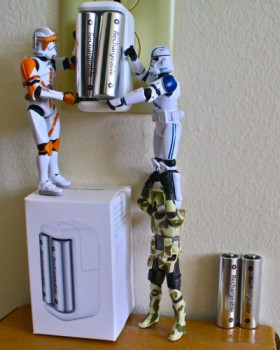
Anyway, I finally retrieved my small, brown box from the large, brown attired man and sat at my desk gleefully. Well, more pleased, I suppose. Slicing the packing tape carefully with my amber-studded Lithuanian bought switchblade pocket-knife I unpacked my brand new Apple manufactured rechargeable batteries and recharging module. This is a recent hardware release from the computer-phone-media-pureawesomeness company, designed specifically to power their line of bluetooth hardware: the Magic Mouse, the Magic Trackpad, and the keyboard (my dark brooding sense of brooding wonders why my keyboard is not magical…is it conspiracy? like the magical call-dropping iPhone 4? of course not. There is nothing magical about a device that has been around for over 30 years.)

I immediately admired the small, efficient size of the charger. It is barely bigger than (two of) the batteries themselves. The plug, like most of Apple’s wall plugs, is interchangeable, allowing for the easy adaptation to any power point size and configuration in the world (in conjunction with Apple’s World Travel Adaptor kit). This point particularly pleased me as I am a frequent world traveler, and like to keep all my lovely Apple gadgets powered on the go. At first glimpse, the batteries appear industrial. No copper-top, no lightning bolt; actually the battery is entirely silver, with only the word “rechargeable” clearly visible between a giant + and – sign at the appropriate terminals. A closer examination reveals that these are NiMH batteries, and were made in Japan (not China? that’s different). But I like that Apple chose not to waste any frivolities on the design of something you only only rarely see. The charger came with a total of six batteries, two for a mouse, two for a keyboard, and two always charged for quick swapping. (Here, Apple fails me, because I have an older bluetooth keyboard which takes three batteries, not two. I have yet to resolve this dilemma. I might sell my keyboard and buy a newer one, because one charged battery doesn’t do me a whole lot of good when I need two.)

Battery Troopers
Battery Troopers

Currently I have two batteries charging, and the other four wait impatiently for their alternating current feeding frenzy. Apple says that these batteries should knock all others out of the park, and I am genuinely curious to see how long they really last on a single charge. I sincerely hope it is longer than my old Energizer rechargeable batteries which died at the first sign of serious use. And by serious use, I mean turning on my camera. All in all, I hope to save money on battery buying and save energy with green batteries.

(They are actually silver, but you get my point.)

Time to Think

Aaaah. Room to stretch. I am writing this post from the Messiah College campus on my iMac, all of the rest having been written on my iPad, and I can tell you, it is nice to get a little room to maneuver. Don’t get me wrong, I love the iPad, and am amazed that I have lived with it as my only link to the world wide web for so long without going mad, but I own a 21″ iMac for a reason. More on that on Monday.

I have been graduated for all of twelve days, and after moving, and cleaning the old apartment, I have been sitting around the new apartment.

My Jeep has a weird issue that restricts me from driving it above 40 mph, safely that is, and Hannah takes the car into work, so I can’t really go anywhere. This being central Pennsylvania, the drivers really hate it when you drive the speed limit, much less 10 mph slower than the posted limit, and this being central Pennsylvania, everything is distressingly out of walking distance. No, really, I would walk to the grocery store out of sheer boredom, but I draw the line at anything over 8 miles. Besides, this walking would be along the roads where the maniacs drive, and that doesn’t make me feel any safer than driving my Jeep does. So, I sit around the apartment.

I could get a job, maybe, though I have tried and haven’t been successful so far (apart from not having a safe car to drive) but my wife might be hired for a job that would require us to move to Wisconsin, and it isn’t fair to an employer to get a job and quit a week and a half later. So, for the moment, I sit around the apartment.

While I do, I watch baseball, blog a bit, but mostly think. I think about my life, and all that I have accomplished: graduating from high school, Bible school, and college; dating and marrying a wonderful woman; making a few friends; and, um, I am sure other things. If I were honest, or depressed, I would say that it doesn’t feel like I have really done any of those things. Sure, I have a woman who sleeps in my (our) bed now, and I guess in a few weeks Messiah College will mail me a diploma, but if I went by feelings, as far as I can tell I feel like I did when I was 15, sitting around at home playing Need for Speed on my computer.

Maybe that is because I sit around by myself most of the day. I don’t know, because I have no basis for comparison, not having ever had a full time, or part time, job that required me to be outside of the house. I honestly don’t know what kind of job would appeal to me, though the idea of lifting heavy things or working at McDonald’s turns my stomach. If it were up to me, and money didn’t matter, I would rather just hang out with my wife and create. Create writing, create art, create music, create photography…just create. Being alone for a large part of the day saps my energy and my creative momentum. Writing this blog takes most of what I do have. That might astound me, except for the observation that my most highly creative times in the past three years have come right after my favorite English classes.

Where do I go from here? I am not really sure. For the time being, I have to wait anyway to see what happens with my wife’s job/no job thing. On the complete other side of things, the past five years of college have worn me out more than I can say, so it is really nice to have no real demands on my energy besides dishes and making the bed.

Forgive my personal ramblings, dear readers, but that is what Thursday is about on this blog, and it is mildly therapeutic for me to write this stuff. Tomorrow is baseball day, and I have a feeling it may be a bit of a rant. The Indians haven’t been playing too well as of late.

Don’t forget to email me questions, musings, or random thoughts for Tuesday’s Q&A blog, or just to say hi.

Peace.

The Hunt for Red October

The only book I am reading at the moment is Tom Clancy’s The Hunt for Red October. I first read the “thrilling” tale when I was younger, probably in my teens. I must have read it a second time a few years ago because I currently own a paperback copy that has all the earmarks of a yard sale or thrift store pickup that I don’t remember owning back in the day. Anyway, having recently come across it again, I decided to give it another read through.

This time through the story, I was continually struck by how boring, monotonous, and detail-heavy the novel manages to be. According to the back of my book, Clancy’s included level of detail and realism resulted in a rumored debrief at the White House, but I found it unnecessary. Clancy is wont to give a detailed history of every character, ship, submarine, or term that he talks about, and very often he tells a part of the story from the point of view of a sub or person who is never heard from again. In and amongst all of his detail and dramatis personae, the story stops and starts like an old pickup truck.

The reader has to plod through most of the book before the action even starts, and then it is over in about two pages. Most of the book centres around the cat-and-mouse hunt for the defecting Russian missile submarine Red October, but that ceases to be interesting after the first few chapters.

Red October is certainly a well researched, planned, and thought out novel, but it fails to hold attention or keep the reader turning pages unless they really have nothing else to do. I confess that Red October is my bathroom reading, but if I was reading it in any other setting than the 20 minutes or so I am occupied thereby, I would not have continued to read it. I am fairly certain I won’t read the book again, once I finish it, which should be in a day or two.

I have read a few of Clancy’s other Jack Ryan stories, among them Clear and Present Danger and Patriot Games, but I dont remember them well enough to know if they fall victim to the same troubles with plague October.

Honestly, for my time and effort, I would more heartily recommend that someone watch the excellent film adaptation starring Alec Baldwim and Sean Connery rather than read the book. The literary person inside of me cringes at that suggestion, but sometimes the book isn’t really better.

Starting next week I will blog through the next book I choose to read, which, for the moment, is a mystery. During my capstone writing course at Messiah College my professor assigned me the task of compiling a reading list for future reading, and I will be selecting one of the books from that list.

Please don’t forget to email me a question, pondering, or random thought for Tuesday’s Q&A blog.

’till tomorrow!

the Slave

the slave

shadows slant as the sun
arcs across the prison walls
he walks his paces
sinking to his cot and rising again
he pounds the iron walls in frustration
days come and go
without count and number
how long has it been?
will deliverance….?
falling into the corner
he sobs
running out of tears
his crime, his punishment
the love he showed
and the kindness given
for this they beat and mock
forsaken
he waits in the dungeon
locked in a foreign land across the sands
forgotten
by all but his God
but still this man
the Hebrew
trusts
footsteps come

I wrote this poem some time ago about the Biblical character of Joseph. This poem takes place in the middle his story, while wrongfully imprisoned on a charge of rape. Go read the story in Genesis 37 and the surrounding chapters. It is an interesting story.

A Brief History

For most of my life, I have been a PC guy, that is, after my Commondore 64 days. I was there for the the very beginning of Microsoft Windows 3.1. I spent hours being amazed at their killer program, Paint, and the thrilling games Minesweeper and Solitaire. And then came the fully featured Windows 95 which became 98, ME, and 2000 before finally being updated for real in XP which was the last Windows OS I actually used for any length of time.

My paternal grandfather became my patron saint of computers through the evolution of the home PC, and the rise of the Internet. He tended to upgrade his system fairly often, and when he did he would pass his old computers onto my family. My older brother Joe learned more about the inner workings of computers, but I jumped right into the mode of the everyday consumer user. I remember logging onto the very first Lego.com and StarWars.com, back in the day when the Internet was still a novelty. I loved games, playing DOS favorites Commander Keen and One Must Fall, and the very first Need For Speed game that launched their rise to fame: Hot Pursuit.

While I was such a PC user, let’s be clear, I was never a PC fanboy, I was aware of the other side of computing: the Apple computer. Some friends of my parents were Mac users from beginning, and whenever we visited for dinner, they would invariably stay late talking, and I would get bored and be allowed to play Where in the World is Carmen Sandiego on the Mac.

Eventually though, through the mid to late 90s, Apple started to make their rise to dominance, which they are continuing through today, and I started to hear a lot more about them on a regular basis. I was so taken with them, that by the time I contemplated my very first computer purchase, I was dead set on buying an Apple computer. I hadn’t used one in years, and only knew about them by reputation, but that reputation was strong enough to convince me to spend three times what I knew I could spend on a PC.

My family was about to move to Papua New Guinea for mission work, and I didn’t want to lug my old beige tower and huge CRT monitor across the world. Besides, I knew I would soon be starting college, and wanted a smaller computer to take with me. So I sold my PC, and bought a 2004 generation Apple iBook.

Since that time I have owned another older iBook (a G3), one of the first Intel iMacs, a Macbook, and now currently use an Aluminum iMac and an iPad. My only prenuptial agreement with my wife was that she ditch her Toshiba laptop, and I bought her a Macbook Air. I will never go back to PCs, and that decision runs deeper than a Mac fanboy fascination.

I really believe that Apple will be the computer of the future. Computers began as a digitization of two things: math and file storage. Way back to the UNIAC and ENIAC days, computers were glorified building sized calculators. By the time Microsoft came along, computers were glorified typewriters that also stored all your documents. That is why Windows Explorer is a file manager. Programs, or applications (games, picture editors, and other things) really were sort of an afterthought. People began to see the potential of computers, and started to write more sophisticated programs for them to run. But still, computers were primarily file cabinets.

Once the Internet went mainstream and Mac rose from the ashes, Apple turned the computer into a machine that was about the program, not the files. In other words, it wasn’t that you could also store your pictures in a digital format on your computer, but it was that your computer could show you pictures in a way never before thought possible. Music on the computer wasn’t just an alternative to a CD player, but a whole new way to play music. And movies, and so on. While the PC could do all those things, the Mac was built from the ground up to be all about those things.

Mac took the daily life things, and exploded them. My iBook was my first step into the larger world of computers that were not machines to be used, but were extensions of myself, in the same way that clothing is not just something humans wear, but part of their being.

To be continued….